KAPDEC® | Elite STEM Learning Platform | https://kapdec.com
Unit: Revisiting real numbers
Chapter: Types of Units
Reference: – Natural Numbers and Whole Numbers, Integers and Their Properties, Rational Numbers, Irrational Numbers, Real Numbers – Definition and Classification, Number Line Representation of Real Numbers, Decimal Expansion of Rational and Irrational Numbers, Surds and Their Simplification, Laws of Exponents for Real Numbers, Prime and Composite Numbers
After studying this chapter, you should be able to understand:
- Natural Numbers and Whole Numbers
- Rational Numbers & Irrational Numbers
- Number Line Representation of Real Numbers
- Laws of Exponents for Real Numbers
1. Natural Numbers and Whole Numbers
- Natural numbers are the basic counting numbers used to count discrete objects.
- Whole numbers are the set of natural numbers together with the additive identity.
2. Integers and Their Properties
- Integers are a set of numbers that include all positive counting numbers, their additive inverses, and the additive identity.
- They obey fundamental properties under arithmetic operations such as closure, associativity, commutativity, identity, and invertibility for addition.
3. Rational Numbers
- Rational numbers are numbers that can be expressed as the ratio of two integers where the denominator is not zero.
- They form a field under addition, subtraction, multiplication, and division (excluding division by zero).
4. Irrational Numbers
- Irrational numbers are numbers that cannot be expressed as a ratio of two integers.
- Their decimal representation is non-repeating and non-terminating, and they are not elements of the rational set.
5. Real Numbers – Definition and Classification
- Real numbers encompass both rational and irrational numbers.
- They form a complete, ordered field and can represent quantities along a continuous number line.
6. Number Line Representation of Real Numbers
- Every real number corresponds to a unique point on an infinitely extending, continuous, and ordered straight line.
- This representation illustrates the relative magnitude and position of numbers.
7. Decimal Expansion of Rational and Irrational Numbers
- Rational numbers have decimal expansions that either terminate after a finite number of digits or repeat in a fixed pattern.
- Irrational numbers have decimal expansions that neither terminate nor exhibit any repeating pattern.
8. Surds and Their Simplification
- Surds are irrational expressions that involve roots which cannot be simplified into rational numbers.
- Simplification of surds involves expressing them in a form with minimal irrationality, typically using properties of radicals.
9. Laws of Exponents for Real Numbers
- The laws of exponents define how expressions involving powers behave under operations such as multiplication, division, and exponentiation.
- These laws apply to all non-zero real bases and relate operations of exponents through algebraic identities.
10. Prime and Composite Numbers
- A prime number is a natural number greater than one that has no positive divisors other than one and itself.
- A composite number is a natural number greater than one that has more than two distinct positive divisors.
11. Factorization and Fundamental Theorem of Arithmetic
- Factorization refers to expressing a number as a product of its integral factors.
- The Fundamental Theorem of Arithmetic states that every positive integer greater than one has a unique prime factorization, up to the order of the factors.
12. Least Common Multiple (LCM) and Highest Common Factor (HCF)
- The Least Common Multiple (LCM) of two or more integers is the smallest positive integer that is divisible by each of the integers.
- The Highest Common Factor (HCF) is the greatest positive integer that divides each of the given integers without leaving a remainder.
13. Properties of Real Numbers
- Commutative property states that the order of addition or multiplication does not affect the result.
- Associative property states that the grouping of numbers does not affect the result of addition or multiplication.
- Distributive property connects addition and multiplication, stating that multiplication distributes over addition.
14. Identities and Inverses (Additive & Multiplicative Units)
- An additive identity is an element that, when added to any number, leaves the number unchanged.
- A multiplicative identity is an element that, when multiplied with any number, leaves the number unchanged.
- An additive inverse of a number is the element that, when added to the number, yields the additive identity.
- A multiplicative inverse of a number (excluding zero) is the element that, when multiplied with the number, yields the multiplicative identity.
15. Applications of Real Numbers in Algebraic Problems
- Real numbers are used to model, express, and solve algebraic equations, inequalities, and expressions.
- They facilitate the representation and analysis of quantitative relationships in both pure and applied mathematics.
Example: –

Source: Kapdec.com
Evaluate the expression:

Source: Kapdec.com
and prove that the result is a rational number, even though a and b are irrational.
Solution: –
Let,

Source: Kapdec.com
We’ll use these identities:
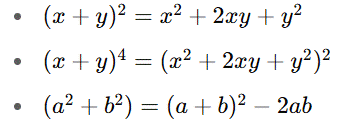
Source: Kapdec.com
Compute a2

Source: Kapdec.com
Compute b2

Source: Kapdec.com

Source: Kapdec.com

Source: Kapdec.com

Source: Kapdec.com
Plug into the original expression
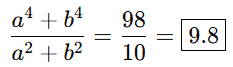
Source: Kapdec.com
✅ Five Conclusive Points
- The Real Number System is All-Inclusive
The real number system encompasses natural numbers, whole numbers, integers, rational numbers, and irrational numbers, providing a unified framework for all numeric expressions used in algebra. - Classification Enhances Conceptual Understanding
Distinguishing between types of numbers—such as rational and irrational, prime and composite, or additive and multiplicative units—enables deeper insight into their algebraic behavior and interrelationships. - Algebra Operates Within Structured Properties
The operations on real numbers follow consistent algebraic properties—commutative, associative, distributive, identity, and inverse—which form the foundation for solving equations and expressions. - Decimal and Root Forms Have Predictable Characteristics
The nature of a number’s decimal expansion or root form determines its classification; this aids in identifying whether a number is rational or irrational and how it can be simplified or approximated. - Factorization and Exponent Laws are Key Tools
Techniques like prime factorization, HCF/LCM calculations, and the use of exponent laws provide essential tools for simplifying, comparing, and solving algebraic problems efficiently.
