KAPDEC® | Elite STEM Learning Platform | https://kapdec.com
Unit: Geometry
Chapter: Angles & Triangles
Reference: – Introduction to Angles, Arms and Vertex, Naming of Angles, Interior & Exterior of an Angle, Types of Angles (Acute, Right, Obtuse, Straight, Reflex, Zero, Complete), Triangles and Their Classification (By Sides and By Angles), Angle Sum Property of a Triangle
After studying this chapter, you should be able to understand:
- Introduction to Angles & Their Formation
- Arms and Vertex of an Angle
- Naming Angles (Three-Letter and Vertex Names)
- Interior and Exterior of an Angle
- Types of Angles and Their Measures
- Classification of Triangles by Sides (Equilateral, Isosceles, Scalene)
- Classification of Triangles by Angles (Acute, Right, Obtuse)
- Angle Sum Property of a Triangle (180°)
Geometry Basic Elements: Angles
An angle is a combination of two rays (half-lines) with a common endpoint. The latter is known as the vertex of the angle and the rays as the sides, sometimes as the legs and sometimes as the arms of the angle.
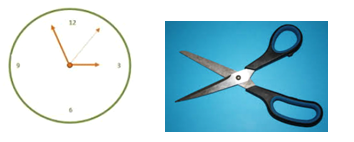
Look at the figures below-
Source: Kapdec.com
Each of the figures above show real life examples of angles which we see in daily life.
Types of Angles:
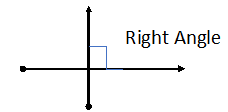
Right Angle: when two lines segments or rays intersect such that the angle formed between them is 90 degree, then it is called a “Right Angle”.
Source: Kapdec.com
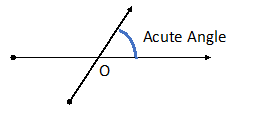
Acute Angle: Any angle which is smaller than right angle is an acute angle.
Source: Kapdec.com
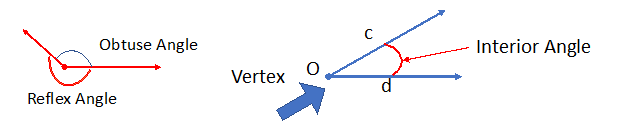
Obtuse Angle: When an angle is larger than 90 Degrees (right angle) but smaller than 180 Degree, (a straight angle), then it is called as an obtuse angle
Reflex Angle: A reflex angle is larger than a straight angle,
Source: Kapdec.com
The portion that lies in between the two rays is called the interior of the angle. In naming an angle, the vertex is always written at a point where two rays meet (intersection point).And is denoted in Capital Letters.
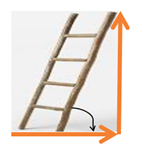
For example, the angle made by ladder with the floor or with the wall is an example of an acute angle.
Source: Kapdec.com
Measuring Angles:
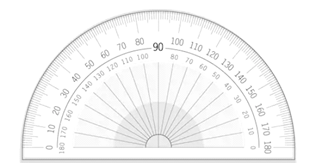
We use a protractor to measure angles. The picture of a protractor looks like below:
Source: Kapdec.com
The unit used to measure an angle is called degree. One revolution or complete angle is divided into 360 equal parts. Each part is called a degree. So three hundred sixty degree is written as 360 °
The protractor is divided into 180 equal parts. Its marking is like it starts from on left side and ends at the right side and Vice versa.
Source: Kapdec.com
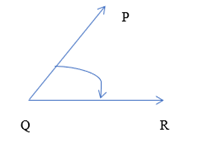
Suppose you want to measure angle PQR, from above diagram.
Following are the steps:
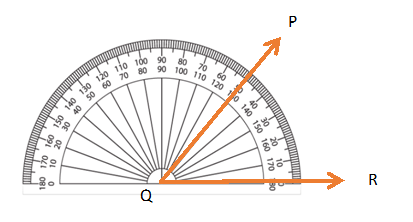
- Place the protractor such that its mid-point lies with end Q.
- The line segment QR should lie along the straight edge with the protractor.
- A protractor constitutes two scales. Always read the scale with mark coinciding with the straight line. So, in this case we will read lower scale.
- The other mark at P shows 50 °, so angle PQR=50 °
Source: Kapdec.com
