KAPDEC® | Elite STEM Learning Platform | https://kapdec.com
Unit: Heredity
Chapter: Meiosis, Meiosis, and genetic diversity
Reference: Meiosis, Meiosis-I, Meiosis II (Homotypic division)
Significance of meiosis
Learning objectives
- To learn different stages in meiosis
- To understand how meiosis helps in genetic diversity
Meiosis -it is a special type of indirect cell division which occurs only in the diploid cells to form the haploid cells. In this case the chromosome number is reduced to half in the daughter cells thus reduction division. It leads to formation of 4 daughter cells.
Meiosis-I
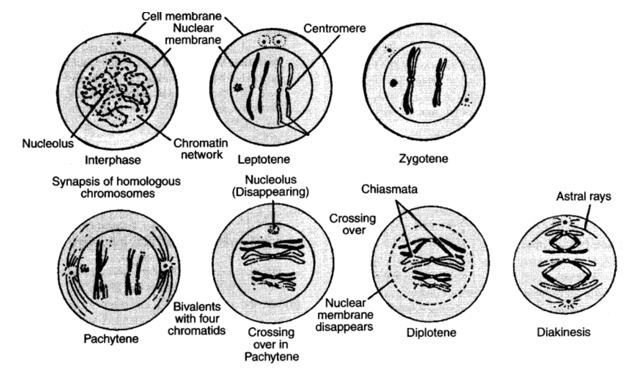
Prophase I-this is the longest phase of meiosis, it is divided into five stages
1.Leptotene-
- Chromosomes are long thread -like with chromomeres on it
- Volume of nucleus increases
- Chromatin network has half chromosomes from male and half from female parent
- Chromosomes gets condensed
2. Zygotene-
- Chromosomes condense and get shortened
- Homologous chromosomes make pairs
- This pairing is called synapsis
- The main component of synaptonemal complex is protein
3. Pachytene–
- Chromosomes become thick and short
- Each chromosome pair splits longitudinally into 4 chromatids. This is called a bivalent or tetrad
- Each tetrad has four kinetochores
- Non-sister chromatids of bivalent show exchange of segments at molecular level
- Synaptonemal complex helps in keeping the pairs stable
- Exchange of segments is called crossing over. These points appear like a cross known as chiasmata
4. Diplotene-
- Though chiasmata are formed in pachytene, they become clearly visible in diplotene due to the beginning of repulsion between synapsed homologous chromosomes. This is called desynapsis
- It involves disappearance of synaptonemal complex
5. Diakinesis-
- In this phase, the chiasmata begin to move along the length of chromosomes from the centromere towards the ends of chromosomes
- The displacement of chiasmata is termed as terminalization.
- The terminal chiasmata exist till the metaphase
- The nucleolus disappears and the nuclear membrane also begins to disappear
- Spindle fibers starts to appear in the cytoplasm
Source: Kapdec.com
Metaphase -I
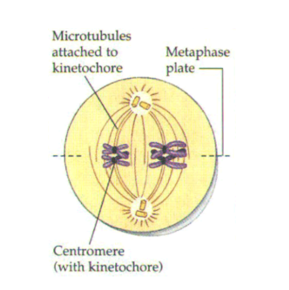
- The spindle fibers become well developed
- The tetrads move towards the equator and they orient themselves on the equator and they orient themselves on the equator in such a way that centromeres of homologous tetrads lie towards the poles and arms towards the equator
- Due to increasing repulsive forces between homologous chromosomes ,they are ready to separate from each other
Source: Kapdec.com
Anaphase-I
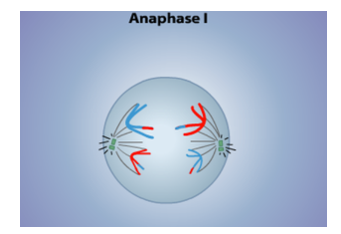
- In this phase, homologous chromosomes are pulled away from each other and carried towards opposite poles by spindle apparatus. This is called disjunction.
- The two sister chromatids of each chromosome do not separate in meiosis-I.
- This is reductional division. The sister chromatids of each chromosome are connected by a common centromere
- Both sister chromatids of each chromosome are now different in terms of genetic content as one of them has undergone the recombination.
Source: Kapdec.com
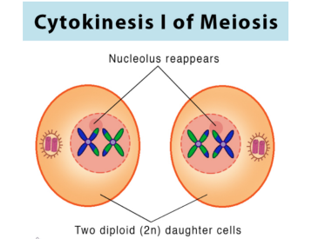
Telophase-I
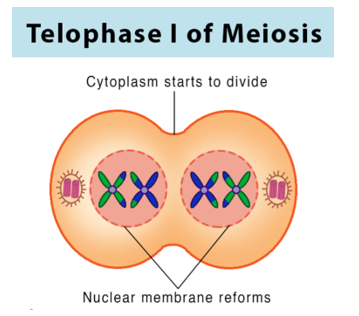
- The haploid number of chromosomes after reaching their respective poles, becomes uncoiled and elongated.
- The nuclear membrane and the nucleolus reappear and thus two daughter nuclei are formed.
Source: Kapdec.com
Cytokinesis-I
- After the karyokinesis, cytokinesis occurs and the two haploid cells are formed.
- In many cases ,these daughter cells pass through a short resting phase.
- In some cases ,the changes of the telophase may not occur
- The anaphase directly leads to the prophase of meiosis II
Source: Kapdec.com
Meiosis II (Homotypic division)
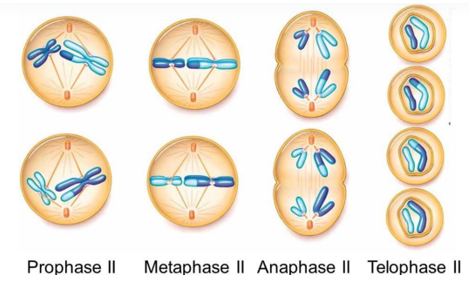
In this division ,two haploid cells formed during meiosis-1 divide further into four haploid cells. This is similar to mitosis. The daughter cells formed in second meiotic division are similar to their parent cells with respect to the chromosome number formed in meiosis-1 .This division is called homotypic division .It consists of the following phases: prophase -II, metaphase-II, anaphase-II, telophase-II and cytokinesis-II.
Prophase-II
- The chromosomes are distinct with two chromatids
- Each centriole divides into two resulting in the formation of two centrioles which migrate to opposite poles and form asters
- Spindle fibers are formed between the centrioles
- The nuclear membrane and nucleolus disappear
Metaphase-II
- Chromosomes gets arranged at the equator.
- The two chromatids of each chromosome are separated by the division of the centromere
- Spindle fibers are attached to the centromeres and some are arranged end to end between two opposite centrioles
Anaphase-II
- The separated chromatids become daughter chromosomes and move to opposite poles due to contraction of the spindle fibers attached to centromeres
Telophase-II
- During this the chromosomes uncoil
- The nuclear membrane ,nucleolus reappears.
Cytokinesis -II
- It occurs after nuclear division
- Two haploid cells are formed from each haploid cell
- Four haploid daughter cells are formed.
- These cells further change to develop into gametes.
Source: Kapdec.com
Significance of meiosis
- If meiosis is absent, the number of chromosomes would double or quadruple resulting in the formation of abnormal forms
- The constant number of chromosomes in each species across generations is maintained by meiosis
- Because of crossing over ,exchange of genetic material takes place leading to genetic variations, which are the raw materials for evolution
Solved examples
Example 1. The process of crossing over occurs in what phase of meiosis?
a) anaphase 1 b) prophase 1
c) prophase 2 d) telophase 1
Solution 1: b.The process of crossing over occurs in prophase 1 of meiosis.
Example 2. The end of meiosis results in ____ to each other.
- 2 cells that are identical
- 4 cells that are identical
- 2 cells that are not identical
- 4 cells that are not identical
Solution 2: d. The end of meiosis results in 4 cells that are not identical to each other
Summary
- In a sexually reproducing organism, it is essential that the diploid organisms create haploid cells that can fuse during fertilisation to produce diploid offspring.
- Meiosis being a type of reduction division helps in ensuring the germ cells/ gametes are haploid in number.
- Meiosis is also important as it creates new DNA combinations in the daughter cell nuclei due to the crossover in prophase I and random alignment of tetrads at metaphase I.
- The cells that are created by meiosis are genetically unique and as a whole result in some of the genetic variation found in sexual reproduction
