KAPDEC® | Elite STEM Learning Platform | https://kapdec.com
Unit: Functions Interpretation and Manipulation
Chapter: Putting Variables in Terms of Other Variables
Reference: – Understanding dependent and independent variables, solving for one variable in terms of another, manipulating linear equations to express a variable, using substitution to solve equations, Interpreting formulas in context, converting word problems into variable expressions, simplifying algebraic expressions for clarity, identifying constraints when expressing variables
After studying this chapter, you should be able to understand:
- Understanding dependent and independent variables
- Manipulating linear equations to express a variable
- Converting word problems into variable expressions
- Identifying constraints when expressing variables
Here is the theoretical elaboration of each topic from the chapter “Putting Variables in Terms of Other Variables”: –
- Understanding Dependent and Independent Variables
In algebraic relationships, some variables determine the value of others. Identifying which variable depends on the other helps in understanding functional connections and in constructing meaningful equations. - Solving for One Variable in Terms of Another
This involves manipulating an equation to isolate a specific variable. It highlights the interdependency between variables and is fundamental in solving systems and interpreting real-world relationships. - Manipulating Linear Equations to Express a Variable
Equations can be rewritten to focus on different variables. This reorganization is essential for evaluating specific outcomes and adapting formulas to suit varying contexts or inputs. - Rearranging Formulas in Geometry and Physics
Many scientific and geometric formulas involve multiple variables. Being able to rearrange these formulas is crucial for applying them in practical scenarios where only certain values are known. - Using Substitution to Solve Equations
When a variable is expressed in terms of another, it can be substituted into related equations. This technique simplifies the process of solving complex problems by reducing the number of unknowns. - Interpreting Formulas in Context
Beyond solving equations, it is important to understand what the variables represent in context. This includes identifying units, real-world meaning, and implications of changing one variable over another. - Converting Word Problems into Variable Expressions
Real-life scenarios are often described in words. Transforming these into algebraic expressions allows for analysis, modeling, and prediction using mathematical methods. - Simplifying Algebraic Expressions for Clarity
After variables are isolated, expressions can be simplified by combining like terms and reducing unnecessary complexity. This aids in better interpretation and usability of the expression. - Recognizing Real-World Applications of Variable Isolation
Isolating variables is not just a mathematical skill but a practical one. It is used in budgeting, construction, scientific analysis, and technological design to determine required inputs or constraints. - Connecting Expressions with Function Notation
Once a variable is written in terms of another, the relationship can be expressed using function notation. This helps in visual representation, evaluation, and analysis of variable changes. - Identifying Constraints When Expressing Variables
Not all variable expressions are valid in every context. Constraints such as domain, range, or real-life limitations must be considered when expressing one variable in terms of another. - Solving Literal Equations with Multiple Variables
Literal equations contain more than one variable. Solving them requires careful attention to algebraic structure and understanding how each variable influences the others.
Example: –
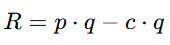
A small business models its revenue R (in dollars) using the formula:

Source: Kapdec.com
where:
- p is the price per item (in dollars),
- q is the number of items sold (units), and
- ccc is the cost per item (in dollars).
Tasks:
- Express the price p in terms of revenue R, quantity q, and cost ccc.
- Identify the dependent and independent variables in the original equation.
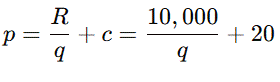
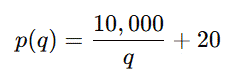
- If a company wants a fixed revenue target of $10,000 and has a cost per item of $20, express the price p in terms of q.
- Identify any real-world constraints on the variables.
- Convert the equation into function notation and interpret it.
Solution: –
1. Express p in terms of R, q, and c
Given:
Source: Kapdec.com
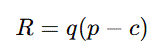
Factor q from the right-hand side:
Source: Kapdec.com
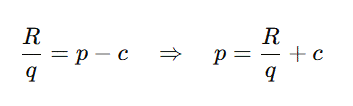
Now solve for p:
Source: Kapdec.com
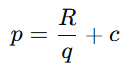
Final expression:
Source: Kapdec.com
Identify Dependent and Independent Variables
- Dependent variable: RRR (Revenue) – It changes based on p, q, and c
- Independent variables: p, q, and c – These can be controlled or set to different values
3. Express p in terms of q, with R=10,000 and c=20
- Use the rearranged formula:
Source: Kapdec.com
Final expression:
Source: Kapdec.com
4. Identify Constraints
- q>0: Quantity must be a positive real number (you can’t sell 0 or negative items)
- p>c: To make a profit, price must be greater than cost
- R≥0: Revenue should not be negative
- All variables should represent real, non-negative numbers in this business context
Interpretation:
This function describes how the price per item must change depending on the number of items sold, in order to maintain constant revenue and cover a fixed cost per item.
Here are five conclusive points for the chapter “Putting Variables in Terms of Other Variables”:
- Understanding how to isolate and express one variable in terms of others is essential for solving complex algebraic problems.
- Mastering variable manipulation enables effective substitution, simplification, and analysis of equations in real-life applications.
- Rearranging formulas empowers students to work flexibly across different fields like physics, geometry, and finance.
- Developing fluency in variable expressions builds foundational skills for interpreting and constructing functions.
- Recognizing constraints and context ensures mathematical expressions are valid and meaningful in real-world scenarios.
Scan to visit this resource online
https://kapdec.com/resources/putting-variables-in-terms-of-other-variable
