KAPDEC® | Elite STEM Learning Platform | https://kapdec.com
Unit: Transformations
Chapter: Reflexive Transformations of Polygons
Reference: – Definition of Reflexive Transformations, Reflection Symmetry of Polygons, Types of Axes of Symmetry, Properties of Reflective Symmetry, Reflections of Regular Polygons, Composition of Reflexive Transformations, Application of Reflection in Coordinate Geometry, Effect of Reflexive Transformations on Polygon Properties, Point of Reflection and Center of Symmetry, Applications of Reflexive Transformations
After studying this chapter, you should be able to understand:
- Definition of Reflexive Transformations & Reflection Symmetry of Polygon
- Reflections of Regular Polygons & Composition of Reflex
- Effect of Reflexive Transformations on Polygon Properties
- Point of Reflection and Center of Symmetry & Applications of Reflexive Transformations
Definition of Reflexive Transformations – Reflexive transformations are those where a geometric figure is mapped onto itself after a transformation, typically through reflection. The transformation involves flipping the figure across a line (called the axis of symmetry) so that it coincides exactly with its original position.
Reflection Symmetry of Polygons – Reflection symmetry refers to the property of a polygon where it can be reflected across an axis (line of symmetry) and match its original shape and size. The line of symmetry acts as a mirror, and every point on one side of the line corresponds to a point on the other side. Polygons with this symmetry are called mirror-symmetrical.
Types of Axes of Symmetry – Polygons can have one or more axes of symmetry, which are imaginary lines that divide the figure into two identical halves. Axes can be vertical, horizontal, or diagonal. Regular polygons (e.g., square, equilateral triangle) typically have multiple axes of symmetry, while irregular polygons may have one or no axis of symmetry.
Properties of Reflective Symmetry – Reflective symmetry ensures that when a polygon is reflected, the resulting figure is congruent to the original. Each corresponding pair of points on either side of the axis of reflection is equidistant from the line of symmetry, and the angles formed by these points remain unchanged. The shape and size of the polygon are preserved in this transformation.
Reflections of Regular Polygons – Regular polygons, such as squares, equilateral triangles, and regular hexagons, have multiple lines of symmetry due to their equal sides and angles. For example, a square has four axes of symmetry, and a regular hexagon has six axes. These axes divide the polygon into congruent parts, and each reflection maps the polygon onto itself.
Composition of Reflexive Transformations – When multiple reflections are applied in sequence, the resulting transformation can sometimes lead to a different type of transformation, such as a translation or rotation. The direction and position of the axes of reflection determine the outcome of the composition. For example, two reflections across intersecting lines can result in a rotation.
Application of Reflection in Coordinate Geometry – In coordinate geometry, reflections can be represented by algebraic formulas. For example, reflecting a point across the x-axis changes the sign of the y-coordinate, while reflecting across the y-axis changes the sign of the x-coordinate. Reflection over lines such as y=x or other linear equations can also be described by specific coordinate transformations.
Effect of Reflexive Transformations on Polygon Properties – Reflexive transformations preserve several properties of the polygon, such as side lengths, angles, and area, which ensures that the reflected polygon is congruent to the original. These transformations do not alter the inherent geometric characteristics of the polygon but simply relocate it or alter its orientation.
Point of Reflection and Center of Symmetry – The point of reflection refers to the location or axis across which the polygon is reflected. In some cases, especially for regular polygons, the center of symmetry is a point that remains fixed under reflection and is equidistant from all parts of the polygon. This center plays a crucial role in determining the reflection’s impact on the figure’s alignment.
Real-World Applications of Reflexive Transformations – Reflexive transformations are widely applied in various real-world fields, such as architecture, art, engineering, and design. In architecture, reflection symmetry is often used in building designs, ensuring aesthetic balance and functional layout. In art, reflection is used to create patterns, such as tessellations, and in design, it is employed to establish visual harmony and balance.
Reflexive Transformations
If you remember from past grades, the reflexive property is the idea that any number is equal to itself. Algebraically, the property looks like a = a. Similarly, in the geometric context, a reflexive transformation, then, is one that transforms a figure into itself again.
In this lesson, we will go through all the transformations we have learned and discuss which transformations are reflexive for rectangles, parallelograms, trapezoids, and regular polygons.
Regular Polygons
A regular polygon is a polygon that is equiangular and equilateral. Equiangular means it has all equal angles, like a rectangle. Equilateral means it has all equal sides, like a rhombus. A square has both and is thus a regular polygon. In fact, the square is the only type of regular quadrilateral.
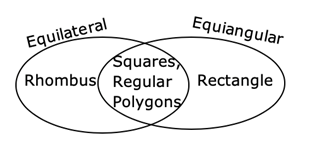
Source: Kapdec.com
Equilateral triangles are also regular polygons. While we have not dealt too much with polygons of more than four sides, we will be using regular pentagons and hexagons for some of our examples in this lesson.
Dilations and Stretches
We will start with dilations and stretches because they are the easiest reflexive transformations to deal with.
The only reflexive dilations and stretches for any geometric figure is by a factor of 1. These transformations deliberately and specifically change elements of the geometric figure, so it is impossible to make any reflexive dilations or stretches unless it is by a factor of 1.
A system of dilations and stretches can be reflexive if the net product of the factors is 1. For example, a dilation of 4 followed by a dilation of ¼ is a reflexive dilation.
Translations
Similarly, the only reflexive translation is one that is 0 units in all directions. A system of translations can be reflexive if the net sum of the translations is 0. For example, a translation of 4 units left followed by a translation of 4 units right is reflexive.
A geometric figure’s position in space is just as important as its side length, angle measures, and position of its elements relative to each other. This will be important as we move forward to reflections and rotations.
Rotations
What makes a rotation reflexive depends on the type of polygon. In this lesson, we will deal with parallelograms, isosceles trapezoids (non-parallel sides are congruent), rectangles, and regular polygons. Before we go into specifics, let’s look at rules that apply to all four of these types of polygons:
- A 360o rotation is always reflexive, about any point of rotation. (This applies to any geometric figure.)
- Any non-360o rotation must have a point of rotation at the intersection of the angle bisectors of the figure to be reflexive.
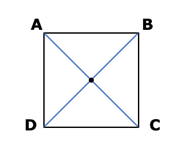
Let’s start with regular polygons. A square is a good place to start:
Source: Kapdec.com
A square has all congruent sides. Right now, side CD is at the base. If we were to make BC the base, the square would look the exact same, and same goes for AB and AD. We can achieve four rotations to make different sides the base to get back to CD as the base, which is our 360o rotation that we already know is reflexive. 360o ÷ 4 = 90o. Thus, every multiple of 90o rotations about the intersection of diagonals is a reflexive rotation.
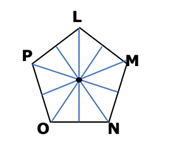
Let’s continue our investigation by looking at a pentagon:
Source: Kapdec.com
Since all sides are congruent, once again, all you need to do to make a reflexive transformation is rotate it so that a new side is the base. With five sides, you can make five rotations until you come back to the side “ON” as the base. This means that every 360o ÷ 5 = 72o rotation is a reflexive transformation for a pentagon.
Do you notice a pattern? A general expression for the number of degrees for a reflexive rotation of a polygon of n sides is 360o ÷ n.
The number of sides is also the maximum number of reflexive rotations a polygon can have, and 360o ÷ n is the minimum reflexive rotation. From here on out, we will not have to test any more rotations than the number of sides that a polygon has.
Reflections
Without knowing the name or the larger geometric sense of them, we have known about reflexive reflections for quite a while now. A reflexive reflection occurs about a line of symmetry, a topic we have dealt with for quite a few grades now. To take a deeper look, we will look at regular polygons first once again.
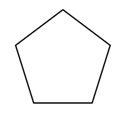
This time let’s look at a pentagon first:
Source: Kapdec.com
There’s quite clearly a left-right symmetry to a pentagon. One line of symmetry must be a straight line bisecting the top angle and bisecting the base side.
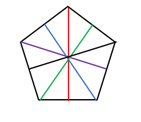
Since a pentagon has rotational symmetry about each side, there must be a line of symmetry bisecting every angle and every side of the pentagon. This leads us to the following schematic of the pentagon’s lines of symmetry:
Source: Kapdec.com
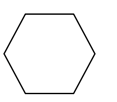
Each colored line is a line of symmetry. A pentagon has 5 lines of symmetry, as many as it has sides. Let’s see if this rule extends to hexagons:
Source: Kapdec.com
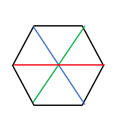
With the pentagon, we ended up taking all the angle bisectors as lines of symmetry, which also happened to be all the perpendicular bisectors. Let’s see what happens when we take the angle bisectors of the hexagon:
Source: Kapdec.com
Each angle bisector is indeed a line of symmetry, but they all bisect the opposite angle! This leaves us with only three lines of symmetry, which is less than the pentagon had. However, we haven’t looked at the perpendicular bisectors of the sides yet:
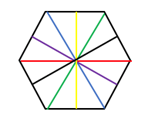
The perpendicular bisectors all bisect the opposite side as well, but more importantly, they are all lines of symmetry! Therefore, a regular
Source: Kapdec.com
Hexagon also has as many lines of symmetry as it has sides just like the regular pentagon. This trend extends to all regular polygons.
The number of sides a polygon has is also the maximum number of lines of symmetry a given polygon can have. The candidates for lines of symmetry are the angle bisectors and the perpendicular bisectors.
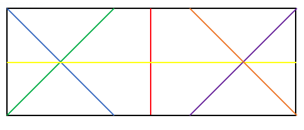
Let’s look at a rectangle:
Source: Kapdec.com
The angle bisectors are not the lines of symmetry, but the perpendicular bisectors are. Thus, a rectangle has two lines of symmetry.
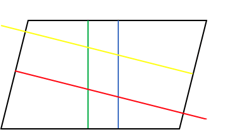
Since a rectangle is a type of parallelogram, and a rectangle only has lines of symmetry with its perpendicular bisectors, we only need to check the perpendicular bisectors on a parallelogram:
Source: Kapdec.com
None of these are lines of symmetry for a parallelogram. A parallelogram generally does not have any lines of symmetry. Lastly, let’s look at the isosceles trapezoid:
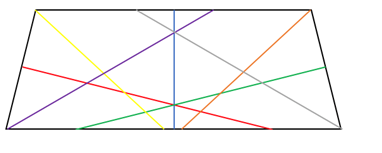
Source: Kapdec.com
There is one line of symmetry on the trapezoid, on the vertical perpendicular bisector colored blue on the diagram. This is only a line of symmetry if the trapezoid is isosceles; otherwise, a trapezoid generally has zero lines of symmetry.
Five-point conclusion summarizing the Reflexive Transformations of Polygons chapter in HS Geometry:
- Reflexive Transformations Preserve Congruency – Reflexive transformations, such as reflections, preserve the size and shape of polygons, ensuring that the reflected figure is congruent to the original. This property is central to geometric proofs and symmetry studies.
- Symmetry Is Key to Understanding Reflections – Polygons with reflection symmetry can be mapped onto themselves through a mirror-like operation. The number of axes of symmetry directly correlates with the regularity and structure of the polygon, such as in regular polygons like squares and hexagons.
- Multiple Reflections Can Lead to New Transformations – The composition of two or more reflections can yield a translation or rotation, depending on the alignment of the reflection axes. This composition expands the scope of geometric transformations and their effects.
- Reflection Is a Powerful Tool in Coordinate Geometry – In coordinate geometry, reflections are systematically defined by specific algebraic rules, making them practical for geometric problem-solving and transformation analysis on the coordinate plane.
- Reflexive Transformations Have Practical Applications – Real-world applications of reflexive transformations are abundant in fields like architecture, design, and art. Reflection symmetry is frequently used to create balanced, aesthetically pleasing structures and patterns.
Scan to visit this resource online
https://kapdec.com/resources/reflexive-transformations-of-polygons
