KAPDEC® | Elite STEM Learning Platform | https://kapdec.com
Unit: Similarity
Chapter: Properties of Similar Triangles
Reference: – Corresponding Angles of Similar Triangles, Proportionality of Sides in Similar Triangles, Ration of Areas of Similar Triangles, AA Similarity Criterion for Triangles, SSS Similarity Criterion for Triangles, SAS Similarity Criterion for Triangles, Basic Proportionality Theorem (Thales’ Theorem), Converse of the Basic Proportionality Theorem
After studying this chapter, you should be able to understand:
- Corresponding Angles of Similar Triangles
- Proportionality of Sides in Similar Triangles & Ration of Areas of Similar Triangles
- AA, SAS & SSS Similarity Criterion for Triangles
- Converse of the Basic Proportionality Theorem
Corresponding Angles of Similar Triangles – In similar triangles, the corresponding angles are congruent. This means that each angle in one triangle has a matching angle in the other triangle, and their measures are identical. This is a key property that helps to establish triangle similarity, as the shape of the triangles remains the same despite potential differences in size.
Proportionality of Sides in Similar Triangles – In similar triangles, the corresponding sides are proportional. This means that the ratio of the lengths of one pair of corresponding sides is the same as the ratio of the lengths of the other corresponding sides. Mathematically, if two triangles are similar, the side lengths
Ratio of Areas of Similar Triangles – The ratio of the areas of two similar triangles is the square of the ratio of their corresponding sides. If the ratio of the sides of two similar triangles is
AA Similarity Criterion for Triangles – The Angle-Angle (AA) criterion for similarity states that if two angles of one triangle are congruent to two angles of another triangle, then the triangles are similar. Since the sum of the interior angles of a triangle is always 180°, the congruence of two angles automatically ensures that the third angle is also congruent, guaranteeing similarity.
SSS Similarity Criterion for Triangles – The Side-Side-Side (SSS) similarity criterion states that if the corresponding sides of two triangles are proportional, then the triangles are similar. This criterion does not require the angles to be compared directly; it focuses purely on the proportionality of the sides to establish similarity.
SAS Similarity Criterion for Triangles – The Side-Angle-Side (SAS) similarity criterion states that if one angle of a triangle is congruent to an angle of another triangle, and the sides including these angles are proportional, then the two triangles are similar. This criterion combines angle congruency with side proportionality to establish similarity between triangles.
Basic Proportionality Theorem (Thales’ Theorem) – The Basic Proportionality Theorem, also known as Thales’ Theorem, states that if a line is drawn parallel to one side of a triangle, it divides the other two sides into segments that are proportional. This means that the line creates smaller triangles that are similar to the original triangle.
Converse of the Basic Proportionality Theorem – The converse of the Basic Proportionality Theorem states that if a line divides two sides of a triangle proportionally, then the line must be parallel to the third side. This converse helps in proving parallelism by using proportional relationships within the triangle.
Application of Properties in Right Triangles – In right triangles, similar triangle properties can be used to solve unknown sides and angles. For example, if the two right triangles are similar, the ratios of the corresponding legs and hypotenuses will be proportional, making it easier to solve for missing lengths or angles. This property is often used in trigonometric applications.
Applications of Similarity in Geometric Problems – The principles of similarity are widely applied in real-world problems involving indirect measurement, scale models, and maps. For instance, similar triangles can be used to measure the height of a building by comparing it to a smaller triangle formed by a shadow or distance, or in finding unknown distances in navigation and map-making.
Geometry: Triangles
Similarity of Triangles
A triangle is a closed curve formed by three-line segments.
“Tri” refers to three, i.e., it has three sides and three vertices. And we have learned that the sum of three interior angles of a triangle is always equal to 180 degrees.
In this chapter, we are going to take our discussion on a journey towards the concept of similarity of triangles and related theorems, or you can call it related properties.
Similarity of Triangles
As the name “similarity “itself suggests similar and NOT exact.
Similarity means having the same shape but not necessarily the same size. Similar Figures refers to the two or more figures of same shape but not of same size.
Similarity is observed everywhere in real life. For example, books. Books differ in their size. The sizes of your mathematics book differ from your literature book.
This sign ~ (read as “similar to”) is used to indicate the figure as similar.
Similarly, the triangles do have certain properties in similarity. The triangles are said to be similar when their corresponding angles are equal, and their corresponding sides are in the same proportion.
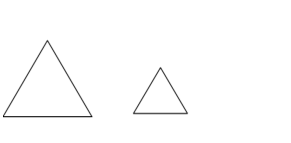
For example: We have two triangles below. Are the two triangles similar?
Source: Kapdec.com
Both the figures are isosceles triangles, but their size differs. Hence, they are not congruent but similar.
BASIC PROPORTIONALITY THEOREM (BPT)
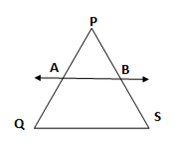
THEOREM 1: The parallel drawn to one of the sides of a triangle intersecting the other two sides at distinct points, then the other two sides are divided in the same ratio.
Source: Kapdec.com
GIVEN: Triangles PQS and line AB parallel to QS intersect PQ at A and PS at B.
TO PROVE:PAAQ= PBBS

Source: Kapdec.com
.
PROOF: In ∆

Source: Kapdec.com
PQS and ∆

Source: Kapdec.com
PAB
∠PQS= ∠PAQ (Corresponding angles)
∠QSP= ∠ABP (Corresponding angles)
∆PQS ~ ∆PAB (A.A.A. rule of similarity)
Then we can write, PQPA= PSPB (Corresponding sides of similar triangles are proportional)
Then, PA+AQPA= PB+BSPB
AQPA+1=BSPB+1
AQPA= BSPB
PAAQ= BSPB
Hence, Proved.
The converse of this theorem is also true, therefore,
THEOREM 2: When a line divides any two sides of a triangle in the same proportion, then the line is parallel to the opposite side.
Applications
- Used in geometry and construction for designing parallel structures.
- Helps in map scaling and trigonometry calculations.
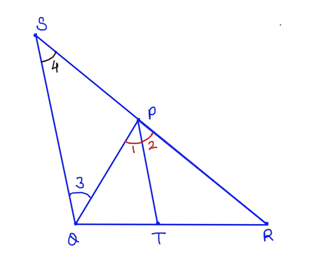
THEOREM 3: The internal bisector of an angle of a triangle divides the opposite side internally in the ratio of the sides containing the angle.
Source: Kapdec.com
GIVEN: ∆PQR and PT is internal bisector of ∠P.
TO PROVE: TRTQ= PRPQ
CONSTRUCTION: Draw SQ ∥ PT so that it meets RP when extend to S.
PROOF: In the figure,
∠1= ∠3 (Alternate angles)
∠2= ∠4 (Corresponding angles)
∠1= ∠2 (PT is internal bisector of ∠

Source: Kapdec.com
P)
∠3= ∠4 (On comparing the above conditions)
PQ = PS (Sides opposite equal angles of a triangle are equal being Isosceles ∆

Source: Kapdec.com
)
So, in ∆ SQR, PT ∥QS by Basic Proportionality Theorem
∴ RTTQ= PRPS
RTTQ= PRPQ (As PS = PQ)
Hence Proved.
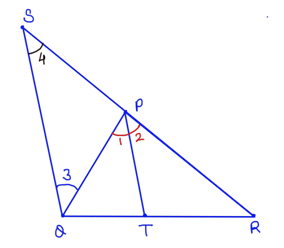
THEOREM 4: If a line is dropped from one vertex of a triangle divides the third side in the ratio of the other two sides, the line is an angle bisector of the vertex.
Source: Kapdec.com
GIVEN: ∆PQR and T is a point on RQ such thatRTTQ= PRPQ.
TO PROVE: PT is bisector of ∠P.
CONSTRUCTION: Draw SQ || PT so that it meets RP when extend to S.
PROOF: In ∆QRS,
RTTQ= PRSP∵PT ∥SQ
RTTQ= PRPQ (Given)
PRPS= PRPQ (On comparing the above conditions)
∠3= ∠4 (Isosceles Triangle property)
∠1= ∠4 (Corresponding angle)
∠2= ∠3 (Alternate angles)
∠1= ∠2 (On comparing the above conditions)
∴

Source: Kapdec.com
PT is bisector of∠P.
Five-point conclusion summarizing the Properties of Similar Triangles chapter in HS Geometry:
- Key Similarity Criteria – The similarity of triangles can be established using specific criteria like AA, SSS, and SAS, which focus on the congruency of angles and proportionality of sides, offering a comprehensive approach to identifying similar triangles.
- Proportionality and Ratios – One of the most important properties of similar triangles is the proportionality of corresponding sides, which leads to the concept of scaling and allows for the determination of unknown side lengths and areas in geometric problems.
- Real-World Applications – Similarity in triangles is extensively used in real-world applications, such as determining distances (e.g., using shadows), creating scale models, and in map-making, where similar triangles provide a practical approach to measurement.
- Theorems for Proportionality – The Basic Proportionality Theorem (Thales’ Theorem) and its converse provide foundational geometric tools for understanding proportional relationships within triangles, which is key for proving similarity and parallelism in various contexts.
- Area Relationships – The ratio of areas of similar triangles is directly related to the square of the ratio of their corresponding sides, making it an essential concept when dealing with the areas of geometric figures, especially in scaling scenarios.
