KAPDEC® | Elite STEM Learning Platform | https://kapdec.com
Unit: Electric Force, Field, and Potential
Chapter: Gravitational and electromagnetic forces
Reference: AP Physics Algebra, Electric Force, Field, and Potential, Gravitational and electromagnetic forces, Fields Gravitational Field Gravitational field strength (g), Gravitational Force between Point Masses, Gravitational Potential and Potential energy, The Gravitational Potential (V), Electrostatic Potential, Electric Potential Difference, Unit for Electric Potential, Potential due to a Point Charge, Conservation of electric energy
After studying this chapter, you should be able to,
- Understand the concept of Gravitational Field
- Explain the concept of Electrostatic Potential
- Conservation of electric energy
- the concept of electromagnetic forces
Fields:
When an object is dropped on Earth, it starts moving towards the surface. If you hold a fridge magnet close enough, it will snap to the front of the fridge.
In both of these examples, a thing feels a force even when it is not in contact with another object. This non-contact force is thought to be caused by fields, which objects cause depending on their qualities.
A gravitational field is produced by objects with mass, whereas an electric field is produced by items with charge. When other things with mass or charge are placed in these fields, they feel a force.
Gravitational Field
A force field is an area in which an object experiences a non-contact force.
Force fields are formed during the interaction of masses, static charges or moving charges. Different types of fields are formed depending on which interaction takes place:
Gravitational fields – formed during the interaction of masses
Electric fields – formed during the interaction of charges.
Therefore, a gravitational field is an area where objects with mass experience a non-contact force.
There are two types of gravitational fields:
Uniform field – Exerts the same gravitational force on a mass everywhere in the field
Radial field – The force exerted depends on the position of the object in the field
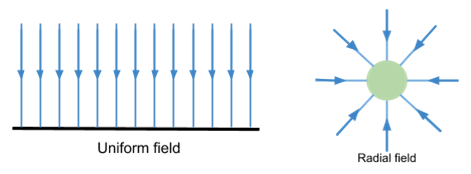
Source: Kapdec.com
The arrows on the field lines show the direction in which a force acts on a mass, and the distance between field lines represents the strength of the force exerted by the field in that region. The closer the lines, the stronger the gravitational field strength.
The Earth’s gravitational field is radial, however very close to the surface it is almost completely uniform.
Gravitational field strength (g):
Gravitational field strength is the force per unit mass exerted by a gravitational field on an object. This value is constant in a uniform field but varies in a radial field. You can use the following formula to calculate the gravitational field strength:
G=F/m
Where F is the force exerted and m is the mass of the object in the field.
Gravitational Force between Point Masses
Gravity acts on any objects which have mass and is always attractive.
Newton’s law of gravitation states that the magnitude of the gravitational force between two masses is directly proportional to the product of the masses, and is inversely proportional to the square of the distance between them, (where the distance is measured between the two centres of the masses).
F= m1m2/r2
Where G is the gravitational constant, m1/m2 are masses and r is the distance between the centre of the masses.
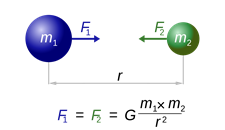
Source: Kapdec.com
It is important to note that the mass of a uniform sphere is considered to act as a point mass at its centre when calculating the gravitational force experienced by an object outside the sphere.
The gravitational field strength (g) in a radial field follows the equation
g= GM/r2
Where G is the gravitational constant, M is the mass of the object causing the field and r is the distance between the centre of the masses.
As you can see the field strength follows an inverse square relationship, meaning that if its distance increases by a factor of 2, the field strength will decrease by a factor of (22 =) 4 as seen in the equation.
Objects, like satellites, orbit around masses due to their gravitational fields as the gravitational force exerted on the object acts as a centripetal force, which causes a centripetal acceleration causing them to move in a circle.
Gravitational Potential and Potential energy:
The Potential energy of an object under the influence of a conservative force may be defined as the energy stored in the body and is measured by the work done by an external agency in bringing the body from some standard position to the given position. If a force F displaces a body by a small distance dr against the conservative force, without changing its speed, the small change in the potential energy dU is given by,
dU = –F.dr
In the case of the gravitational force between two masses M and m separated by a distance r,
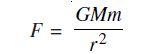
Source: Kapdec.com
∴

Source: Kapdec.com
gravitational potential energy
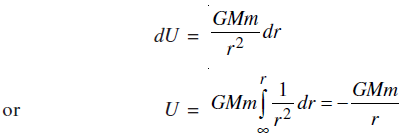
Source: Kapdec.com
It shows that the gravitational potential energy between two particles of masses M and m separated by a distance r is given by
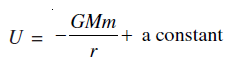
Source: Kapdec.com
The gravitational potential energy is zero when r approaches infinity. So, the constant is zero and
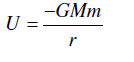
Source: Kapdec.com
The Gravitational Potential (V) of mass M is defined as the gravitational potential energy of the unit mass. Hence, Gravitational potential,
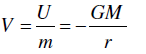
Source: Kapdec.com
It is a scalar quantity and its SI unit is J/kg.
Electric energy can be stored in a common device called a capacitor, which is found in nearly all electronic circuits. A capacitor is used as a storehouse for energy. Capacitors store the energy in common photo flash units.
Electrostatic Potential
The electrostatic potential (V) at any point in a region with the electrostatic field is the work done in bringing a unit positive charge (without acceleration) from infinity to that point. If ‘W’ is the work done in moving a charge ‘q’ from infinity to a point, then the potential at that point is V = W / q.
Electric Potential Difference
Similar to electric potential, the electric potential difference is the work done by external force in bringing a unit positive charge from point R to point P. i.e.,
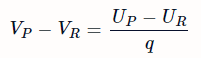
Source: Kapdec.com
Here VP and VR are the electrostatic potentials at P and R, respectively, and UP and UR are the potential energies of a charge q when it is at P and at R respectively.
Unit for Electric Potential
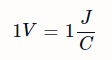
The unit of measurement for electric potential is the volt, so the electric potential is often called voltage. A potential of 1 volt (V) equals 1 joule (J) of energy per 1 coulomb (C) of charge.
Source: Kapdec.com
Potential due to a Point Charge
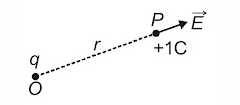
Consider a point charge q placed at point O. Consider any point P in the field of the above charge. Let us calculate the potential at point P due to the charge q kept at a point O. Since the work done is independent of the path, we choose a convenient path, along the radial direction.
Source: Kapdec.com
Let the distance OP = r.
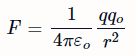
The electric force at P, due to q will be directed along OP, given by
Source: Kapdec.com
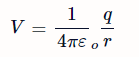
And electric potential is,
Source: Kapdec.com
Example: (a) Calculate the potential at a point P due to a charge of 4 × 10⁻⁷C located 9 cm away. (b) Hence obtain the work done in bringing a charge of 2 × 10⁻⁹ C from infinity to the point P. Does the answer depend on the path along which the charge is brought?
Solution: (a) V=14πϵ0qr =9×109×4×10-79×10-2=4×10⁴ v.
(b) W=VQ
= 4X104 X 2 X 10-9 = 6 X10 -5
No, the work done will be path independent.
Conservation of electric energy
- The conservation of electric energy, also known as the conservation of electrical energy or the law of conservation of energy applied to electricity, states that electric energy cannot be created or destroyed; it can only be converted from one form to another or transferred between different components in an electrical system. This principle is a fundamental concept in physics and is based on the broader principle of conservation of energy, which applies to all forms of energy.
- In an isolated electrical system, where no energy is added or removed from the system, the total electric energy remains constant over time. However, it is important to note that energy losses can occur due to factors such as resistance, heat dissipation, or inefficiencies in electrical devices. These losses result in a conversion of electric energy into other forms, such as heat or sound.
- In practical applications, it is crucial to minimize energy losses in electrical systems to increase efficiency and reduce waste. This can be achieved through various means, including using conductors with low resistance, optimizing circuit designs, and employing energy-efficient devices.
- The conservation of electric energy is a fundamental principle in the analysis and design of electrical systems, and it plays a crucial role in fields such as electrical engineering, power generation and distribution, and renewable energy systems. By understanding and applying this principle, engineers and scientists can develop more efficient and sustainable electrical systems.
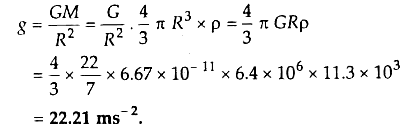
Example: If the earth were made of lead of relative density 11.3, what
then would be the value of acceleration due to gravity on the surface of the earth? Radius of the earth = 6.4 × 10⁶ m
Solution:
Density of the earth,
p = Relative density × density of water
Acceleration due to gravity on the earth’s surface,
Source: Kapdec.com
Key points:
- The potential due to a dipole depends not just on r but also on the angle between the position vector r and the dipole moment vector p.
- The electric dipole potential falls of, at a large distance as 1/r2.
- The gravitational field is the region of space around a massive object where the force of gravity is exerted on other objects.
- The strength of the gravitational field is determined by the mass of the object creating the field. The larger the mass, the stronger the field.
- Gravitational fields are described mathematically by the gravitational field equation, which states that the force per unit mass at a point in a gravitational field is equal to the gravitational field strength at that point.
- The gravitational field strength is a vector quantity, meaning it has both magnitude and direction. Its direction is always towards the centre of the massive object creating the field.
- The gravitational field strength decreases with distance from the centre of the massive object creating the field. This is described by the inverse-square law, which states that the strength of the field is inversely proportional to the square of the distance from the centre of the object.
- Gravitational fields are not just created by massive objects like planets and stars, but also by any object with mass, no matter how small. This means that every object in the universe is surrounded by a gravitational field.
- Gravitational fields can cause the motion of objects to change, either by pulling them towards the massive object or by causing them to orbit around it. This is why the gravitational field of the Sun is so important for the orbits of the planets in our solar system.
- Gravitational fields can also cause the phenomenon of gravitational lensing, where light is bent as it passes through the field. This can result in distorted images of distant objects and is an important tool for astronomers studying the universe.
- The study of gravitational fields is an important part of both classical mechanics and general relativity and has profound implications for our understanding of the structure and evolution of the universe.
Scan to visit this resource online
https://kapdec.com/resources/gravitational-and-electromagnetic-forces
