KAPDEC® | Elite STEM Learning Platform | https://kapdec.com
Unit : Natural selection
Chapter: Phylogeny
Reference: Phylogeny, Evidence for specific phylogenies
Phylogenetic tree, Importance of a phylogenetic tree
Types of phylogenetic tree, Animal Phylogeny, Phylogenetic analysis in bioinformatics
Learning objectives
- To describe the types of evidence that can be used to infer an evolutionary relationship.
- To explain how a phylogenetic tree and/or cladogram can be used to infer evolutionary relatedness
Phylogeny
Phylogeny refers to the evolutionary history of a group of organisms. A phylogenetic tree is used to depict the relationship between different organisms. Phylogeny is important because it enriches our knowledge about how the organisms evolved. It also strengthens our understanding about genes, genomes, and species.
Evidence for specific phylogenies
The fossil record is often used to determine the phylogeny of groups containing hard body parts; it is also used to date divergence times of species in phylogenies that have been constructed based on molecular evidence.
Phylogenetic tree
A phylogenetic tree is a diagram that represents evolutionary relationships among organisms. Phylogenetic trees are hypotheses, not definitive facts. The pattern of branching in a phylogenetic tree reflects how species or other groups evolved from a series of common ancestors.
Understanding a phylogeny is a lot like reading a family tree. The root of the tree represents the ancestral lineage, and the tips of the branches represent the descendants of that ancestor. As you move from the root to the tips, you are moving forward in time
Importance of a phylogenetic tree
- Phylogenetic trees can serve as the foundation for an “evolutionary synthetic biology,” which helps us to better understand the evolution of cellular pathways, macromolecular machines, and other emergent properties of early life.
- To study how the species were spread geographically.
- To study the common ancestors of extant and extinct species.
- It is used to identify the most recent common ancestors and to recognize how closely related species are.
- To relate the milestones of the evolution of major life forms to the tree of life.
- To represent evolutionary relationships between organisms that are believed to have some common ancestry.
Types of phylogenetic tree
The two main types of phylogenetic trees are cladograms and phylograms. Cladograms do not have scaled branches, so they do not represent the amount of time between generations, while phylograms do have scaled branches. Both cladograms and phylograms can be rooted or unrooted.
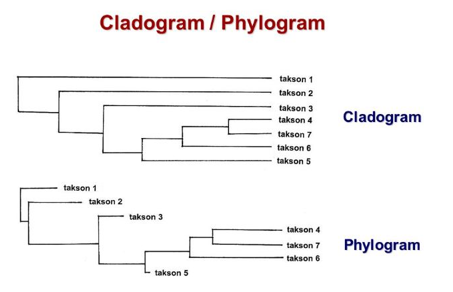
Source: Kapdec.com
Animal Phylogeny
- A unique phylogeny example is the evolutionary tree of animals demonstrating the history of animal organs.
- It demonstrates animal phylogeny in terms of animal organ evolution.
- The evolutionary connection of major animal lineages may be determined by the organ level of structure in this figure.
- For example, the digestive system appeared some 600 million years ago, while the liver evolved about a hundred million years later in vertebrates like humans.
Phylogenetic analysis in bioinformatics
Phylogenetics is important because it enriches our understanding of how genes, genomes, species (and molecular sequences more generally) evolve.
Building a phylogenetic tree requires four distinct steps:
- Identify and acquire a set of homologous DNA or protein sequences
- Align those sequences
- Estimate a tree from the aligned sequences
- Present that tree in such a way as to clearly convey the relevant information to others
Solved examples
Example 1. Which evidence would be the most accurate when developing a cladogram?
a) Morphological b) Molecular c) Ecological d) Fossil
Solution 1: b. Molecular evidence would be the most accurate when developing a cladogram.
Example 2. Phylogenetic trees show…
a) Evolutionary relationships between different species
b) How one species has evolved through time
c) Which species has evolved the most
d) Which species have evolved from other species
Solution 2: a. Phylogenetic trees show evolutionary relationships between different species.
Summary
- Phylogeny refers to the evolutionary history of a group of organisms.
- A phylogenetic tree is used to depict the relationship between different organisms.
- Molecular phylogenetics is an important part of bioinformatics.
- The two main types of phylogenetic trees are cladograms and phylograms.
