KAPDEC® | Elite STEM Learning Platform | https://kapdec.com
Unit: Conductors, Capacitors, Dielectrics
Chapter: Capacitors, Dielectrics
Reference: AP Physics Electricity and Magnetism, Conductors, Capacitors, Dielectrics, Capacitor and Capacitance, Effect of Dielectric on Capacitance, Dielectrics and Polarization, Types of capacitors, Combination of Capacitors, Van De Graaff Generator
After studying this chapter, you should be able to,
- State the definition of Capacitor and Capacitance
- Understand the concept of the Effect of Dielectric on Capacitance:
- know the concept of a Combination of Capacitors
Capacitor and Capacitance
• Capacitor: The system of two conductors separated by an insulator is called a capacitor.
The device which is used to store charge is known as a capacitor. The applied voltage and size of the capacitor decide the amount of charge that can be stored i.e., Q = CV
Two similar connecting plates are placed in the capacitor in front of each other where one plate is connected to the positive terminal and the other plate is connected to the negative terminal.
• Capacitance: The ratio of the magnitude of the charge stored on the plate to the potential difference between the plates is called capacitance. It is written as:

Source: Kapdec.com
Size, shape, medium and other conductors in surrounding influence, the capacitance of a conductor.
Its S.I. unit is Farad.
1F = 1CV–1 For a parallel plate capacitor (with a vacuum between the plates),

Source: Kapdec.com
where A is the area of each plate and d is the separation between the parallel plates.
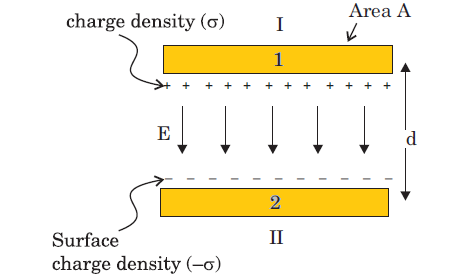
Source: Kapdec.com
Effect of Dielectric on Capacitance:
• If the medium between the plates of a capacitor is filled with an insulating substance (dielectric), the electric field due to the charged plates induces a net dipole moment in the dielectric. This effect, called polarization, gives rise to a field in the opposite direction.
• The dielectric is polarised by the field and also the effect is equivalent to two charged sheets with surface charge densities σp and -σp .
• The net electric field inside the dielectric and hence the potential difference between the plates is thus reduced. Consequently, the capacitance C increases from its value Co when there is no medium (vacuum), C = KCo where K= εε0 is the dielectric constant of the insulating substance.
Dielectrics and Polarization:
• Dielectrics: A non-conducting substance which has a negligible number of charge carriers unlike conductors is called dielectrics.
• Electric polarization: The difference between induced electric field and imposed electric field in dielectric due to bound and free charges is known as electric polarization. It is written as:

Source: Kapdec.com
Types of capacitors:
• Parallel plate capacitor:
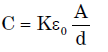
Source: Kapdec.com
• Cylindrical capacitor:
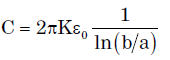
Source: Kapdec.com
• Spherical capacitor:
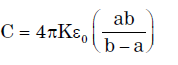
Source: Kapdec.com
Combination of Capacitors
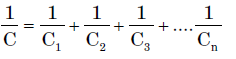
• For capacitors in the series combination, the total capacitance C is given by
Source: Kapdec.com
• In the parallel combination, the total capacitance C is C = C1 + C2 + C3 …… Cn, where C1, C2, C3 …… are individual capacitances.
• Capacitors connected in series have the same charges and when connected in parallel have the same voltage.
• Potential across the capacitor remains the same if the battery is connected but if it is disconnected then the charge remains the same which is stored in capacitor.
Electrical Energy Stored in a Capacitor:
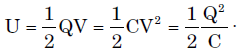
• The energy U stored in a capacitor of capacitance C, with charge Q and voltage V is
Source: Kapdec.com
The electric energy density (energy per unit volume) in a region with an electric field is

Source: Kapdec.com
• Electric density is alternatively known as electrostatic pressure.
Van De Graaff Generator:
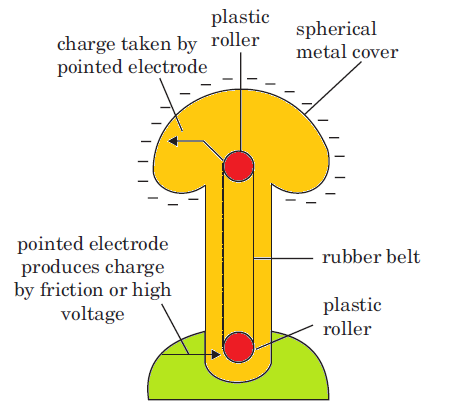
• A Van de Graaff generator consists of a large spherical conducting shell (a few meters in diameter).
• There are two pulleys, one at ground level and one at the centre of the shell. Both of them are wounded around by a long and narrow endless
belt of insulating material.
• The motor drives the lower pulley which keeps moving this belt continuously.
• At ground level to the top, it continuously carries the positive charge and is sprayed on to it by a brush.
Then the positive charge is transferred by it to another conducting brush connected to the large shell.
• After the transferring of the positive charge is done, it spreads out uniformly on the outer surface.
It can build a voltage difference of as much as 6 to 8 million volts.
Source: Kapdec.com
Example: A capacitor of capacity 10μF is charged to a potential of 400V. When it’s both plates are connected by a conducting wire, the heat generated will be ________
Solution: Given, the capacity of the capacitor, 𝐶 = 10 × 10−6μF
Potential 𝑉 = 400volt
Stored energy = Heat generated

Source: Kapdec.com
Key Points:
Capacitors:
- A capacitor is a passive electronic component that stores and releases electrical energy.
- It consists of two conductive plates separated by a dielectric material.
- The plates can be made of various materials, such as metal or conductive polymers.
- Capacitors are used in electronic circuits for various purposes, including energy storage, filtering, timing, and coupling.
- The capacitance of a capacitor is a measure of its ability to store charge. It is determined by the physical characteristics of the capacitor, such as the area of the plates, the distance between them, and the dielectric material used.
- The unit of capacitance is the farad (F), but capacitors are commonly found in smaller units like microfarads (µF) and picofarads (pF).
- Capacitors can be connected in series or parallel to increase or decrease their overall capacitance, respectively.
- Capacitors can be polarized or non-polarized. Polarized capacitors, like electrolytic capacitors, have a positive and a negative terminal and must be connected in the correct polarity in a circuit.
- Capacitors have various applications, including energy storage in power supplies, smoothing voltage in rectifiers, decoupling in integrated circuits, and timing in oscillators.
Dielectrics:
- A dielectric is an insulating material used between the conductive plates of a capacitor.
- It prevents direct electrical contact between the plates while allowing an electric field to form across it.
- Dielectrics are typically non-conductive materials like ceramics, plastics, or glass.
- The dielectric constant (also known as relative permittivity) is a property of the dielectric material that determines how much electric flux can be stored per unit voltage across the dielectric.
- The dielectric constant is a dimensionless value, and it represents the ratio of the capacitance of a capacitor with the dielectric material to the capacitance of the same capacitor with a vacuum (or air) as the dielectric.
- Dielectric materials with higher dielectric constants allow for higher capacitance values in capacitors.
- Dielectrics also affect the voltage rating and insulation resistance of capacitors.
- Dielectrics can be classified as polar or non-polar. Polar dielectrics have permanent electric dipole moments, while non-polar dielectrics do not.
- Some common dielectric materials include ceramic (like ceramic capacitors), tantalum oxide (used in tantalum capacitors), aluminium oxide (used in aluminium electrolytic capacitors), polyester, polypropylene, and polyethene.
