KAPDEC® | Elite STEM Learning Platform | https://kapdec.com
Unit: Functions
Chapter: Notation of Functions
Reference: – Definition of a Function, Function Notation, Evaluating a Function, Domain of a Function, Range of a Function, Independent and Dependent Variables, Multiple Function Notations, Piecewise Function Notation, Arithmetic with Functions, Composite Function Notation, Implicit vs. Explicit Function Notation, Function as a Mapping Rule, Inverse Function Notation
After studying this chapter, you should be able to understand:
- Definition of a Function & Function Notation
- Domain of a Function & Range of a Function
- Multiple Function Notations & Piecewise Function Notation
- Function as a Mapping Rule & Inverse Function Notation
- Definition of a Function
A function is a special type of relation in which each input from a given set (called the domain) is associated with exactly one output in another set (called the range). It ensures a unique output for every input.
- Function Notation
Function notation is a symbolic way of representing functions using symbols such as f(x), where f is the name of the function and x is the input variable. It emphasizes the idea of input-output relationships.
- Evaluating a Function
Evaluating a function means determining the output value that corresponds to a specific input, by applying the rule defined by the function notation.
- Domain of a Function
The domain of a function is the complete set of all input values for which the function rule is defined and produces a valid output.
- Range of a Function
The range of a function is the complete set of all output values that result from using all the valid inputs in the domain.
- Independent and Dependent Variables
The independent variable is the input value chosen freely, while the dependent variable is the output value that depends on the input, typically represented as f(x).
- Multiple Function Notations
Functions may be represented with different letters or input variables, such as g(x), h(t), or P(n), depending on the context or nature of the relationship being modelled.
- Piecewise Function Notation
Piecewise functions are defined by different rules or expressions over different intervals of the domain, and function notation allows for specifying each condition clearly.
- Arithmetic with Functions
Function arithmetic involves performing operations like addition, subtraction, multiplication, and division between two or more functions, and expressing the results using function notation.
- Composite Function Notation
Composite functions involve applying one function to the result of another function. This is represented as f(g(x)), which means that the output of g(x) becomes the input to f.
- Implicit vs. Explicit Function Notation
An explicitly defined function gives the output directly in terms of the input. An implicitly defined function expresses a relationship between variables without directly solving for one variable in terms of the other.
- Function as a Mapping Rule
A function can be viewed as a rule that assigns to each element in the domain exactly one element in the range, often represented using notation and sometimes visualized using mapping diagrams.
- Inverse Function Notation
The inverse of a function reverses the roles of input and output and is denoted, assuming the original function is one-to-one and has an inverse.
- Function Table Representation
A function table organizes pairs of input and output values, showing how each input is related to its corresponding output, using function notation to define the rule.
- Graphical Interpretation of Function Notation
On a graph, f(x) represents the y-value corresponding to a specific x-value. The notation emphasizes that the vertical coordinate depends on the horizontal coordinate according to the function’s rule.
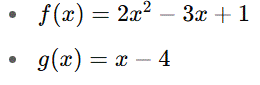
Example: –
Let,
Source: Kapdec.com
Find and simplify the expression:

Source: Kapdec.com
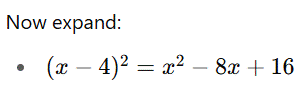
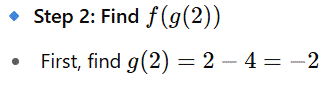
Solution: –

Source: Kapdec.com
Source: Kapdec.com
So,

Source: Kapdec.com
Now distribute:

Source: Kapdec.com
Source: Kapdec.com

Source: Kapdec.com

Source: Kapdec.com

Source: Kapdec.com
Simplify: –

Source: Kapdec.com
✅ Five Conclusive Points
- Function Notation Clearly Represents Input-Output Relationships
Using symbols like f(x), function notation defines how each input is uniquely associated with an output, reinforcing the concept of a function as a rule or mapping.
- Functions Must Have One Output for Every Input
A fundamental property of functions is that each input in the domain corresponds to exactly one output, which distinguishes functions from general relations.
- Notation Helps Distinguish Between Different Functions
Using various symbols (like f(x), g(t), h(n) allows multiple functions to be described and analysed simultaneously in a precise and organized manner.
- Function Notation Supports Complex Operations and Transformations
Notation allows for evaluating, combining (e.g., f+ g), composing (e.g., f(g(x)), and inverting functions, providing a foundation for more advanced algebraic and graphical work.
- Function Notation Connects Algebraic, Numerical, and Graphical Representations
Whether working with equations, tables of values, or graphs, function notation provides a consistent language to describe and interpret mathematical relationships across different forms.
Scan to visit this resource online
https://kapdec.com/resources/notation-of-functions-domain-and-range
