KAPDEC® | Elite STEM Learning Platform | https://kapdec.com
Unit: Ecology
Chapter: Energy flow in ecosystem
Reference : Energy flow in ecosystem ,productivity ,food chain, trophic levels and ecological pyramids
Learning objectives
- To understand productivity, types of food chain
- To learn about ecological pyramids
Energy flow in ecosystem
- Energy is the ability to do work. The main source of energy for an ecosystem is the radiant energy or light energy derived from the sun.
- 50% of the total solar radiation that falls on earth is photosynthetically active radiation (PAR).
- The amount of solar radiation reaching the surface of the earth is 2 cals/sq.cm/min.
- It is constant and is called solar constant or solar flux. About 95 to 99% of the energy is lost by reflection. The light energy is converted into chemical energy in the form of sugar by photosynthesis.
6H2O + 6CO2+ Light → 6C6H12O6 + 6O2
- The rate of energy transfer between elements of an ecological system is called energy flow. The flow of energy is unidirectional in the ecosystem.
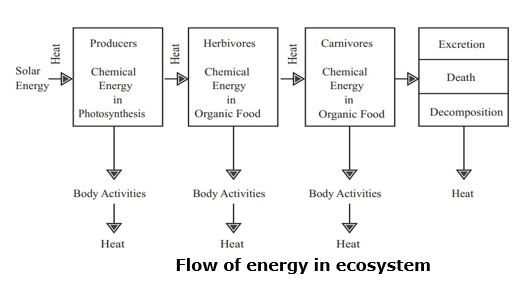
Source: Kapdec.com
Flow of energy in ecosystem
Productivity-
- Productivity refers to the rate of biomass production
- It is of two types – primary productivity and secondary productivity.
- Primary productivity is the amount of biomass produced per unit area over a time period by plants during photosynthesis.
- It is expressed in terms of weight (g–2) or energy (kcal m–2). It is of two types: GPP and NPP.
- Gross primary productivity (GPP) – It is the rate of production of biomass or accumulation of energy by green plants per unit area per unit time. GPP depends on the chlorophyll content.
- Net primary productivity (NPP) – It is the amount of biomass which has been stored by green plants.
- The net primary productivity results in the accumulation of plant biomass, which serves as the food of herbivores & decomposers.
- NPP is equal to the rate of organic matter created by photosynthesis minus the rate of respiration and other losses.
- Net primary productivity = Gross primary productivity – Respiration losses. (or GPP–R = NPP)
- Secondary Productivity is the amount of biomass synthesized by consumers per unit area per unit time.
- Consumers tend to utilize already produced food materials in their respiration and convert the food matter to different tissues by an overall process. So secondary productivity is not divided into ‘gross’ and ‘net’ amounts.
- The annual net primary productivity of the whole biosphere is approximately 170 billion tons (dry weight) of organic matter.
- Producers include green plants which can manufacture their own food. These can fix the energy obtained from the sun. Producers are autotrophic, generally chlorophyll bearing organisms.
- Consumers cannot make their own food but are directly or indirectly dependent on producers for obtaining food. Consumers may be : Primary consumers obtain their food by directly feeding on producers (plants), secondary consumers from primary consumers (herbivores) and tertiary consumers from secondary consumers.
- The conversion of radiant energy of sun into chemical energy and its subsequent transfer to other organisms occurs in accordance with the laws of thermodynamics.
- First law of thermodynamics states that energy is neither created nor destroyed but can be transferred from one component to another. Ex. sunlight energy can be transformed into energy of food & heat.
- Second law of thermodynamics: At each step of energy transformation, there occurs dissipation of energy and increase in disorderliness.
- Trophic structures of ecosystem are a type of producer-consumer arrangements in which each food level is called trophic levels.
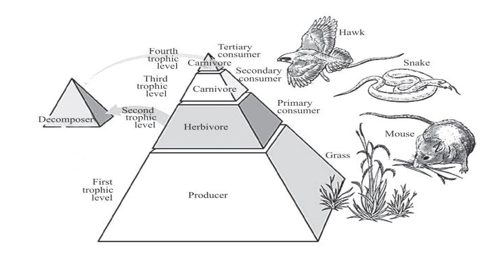
Source: Kapdec.com
-
- Food chain- order or sequence of different organisms which are arranged in a way that the food is passed from one type of organism to other organisms such that the organisms of one order or trophic level are the food of the organisms of next order.
- Types of food chain-
- Grazing food chain- food chain starts from plants, goes through herbivores, and ends in carnivores. This type of food chain depends on the autotrophs which capture the energy from solar radiation.
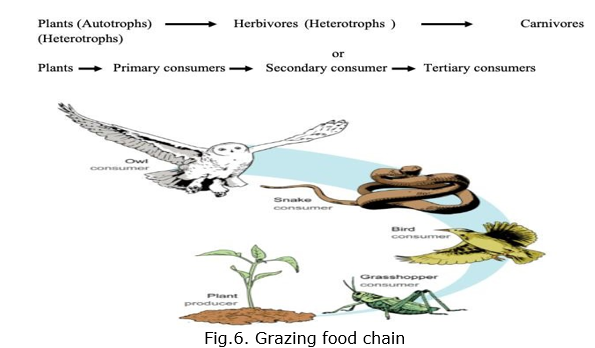
Source: Kapdec.com
- Detritus food chain- starts from dead organic matter and ends in inorganic compounds. There are certain groups of organisms which feed exclusively on the dead bodies of animals and plants. These organisms are called detritivores.
- Food web- group of inter-related food chains in a particular community. They are important in maintaining the stability of an ecosystem.
- Trophic levels- a step or division of food chain which is characterized by method of obtaining its food. The number of trophic levels is equal to number of steps in food chain.
Ecological pyramids
- First describe by Charles Elton, the number of individuals present or amount of biomass synthesized or amount of energy stored at successive trophic levels in an ecosystem can be graphically represented in the form of pyramids.
- Three ecological pyramids which are studied are – pyramid of number, pyramid of biomass and pyramid of energy.

Source: Kapdec.com
Types of pyramids
- Pyramid of number- always upright. It is a graphical representation of numerical strength of various populations in different trophic levels per unit area of an ecosystem with producer forming base, intermediate levels forming intermediate tiers & apex formed by top carnivore.
- Pyramid of biomass- Biomass refers to the total weight of living matter per unit area. In an ecosystem the biomass decreases from the producer level to the consumer level. Pyramid of biomass of terrestrial ecosystem is upright, pyramid of biomass of aquatic ecosystem is inverted.
- Pyramid of energy- Pyramid of energy is always upright because during the flow of energy from one trophic level to the next one, there always occurs a loss of energy. According to 10 per cent law only 10% of the total energy stored in a trophic level is transferred to the next trophic level of a food chain. This law was given by Lindemann (1942).
Solved examples
Example 1. Each step in a food chain is known as :
a) Trophs b) Trophic Level c) Feeding Position d) Placement
Solution 1: b. Each step in a food chain is known as trophic level.
Example 2. Which organisms always make up the first trophic level in every food chain, food web, and ecosystem?
a) Primary Producers b) Primary Consumers
c) Secondary Consumers d) Tertiary Consumers
Solution 2: a. Primary producers always make up the first trophic level in every food chain, food web, and ecosystem.
Summary
- Each ecosystem has characteristic physical structure resulting from interaction amongst abiotic and biotic components
- Productivity, decomposition, energy flow, and nutrient cycling are four important components of ecosystem.
- Primary productivity is rate of capture of solar energy or biomass production of producers. It is divided into two types- gross primary productivity (GPP) and net primary productivity.
- Energy flow is unidirectional. First plants capture solar energy and then, food is transferred from producers to decomposers. Organism of different trophic levels in nature are connected to each other for food or energy relationship forming food chain.
