KAPDEC® | Elite STEM Learning Platform | https://kapdec.com
Unit: Data Handling and Analysis
Chapter: Grouping Data
Reference: – Introduction to Grouping Data, Methods of Grouping Data, Frequency Distribution and Its Importance, Class Intervals and Their Role in Grouping, Cumulative Frequency and Its Applications, Graphical Representation of Grouped Data, Advantages and Limitations of Grouping Data, Applications of Grouped Data in Real-World Scenarios
After studying this chapter, you should be able to understand:
- Introduction to Grouping Data & Methods of Grouping Data
- Class Intervals and Their Role in Grouping
- Cumulative Frequency and Its Applications
- Applications of Grouped Data in Real-World Scenarios
1. Introduction to Grouping Data
- Grouping data involves organizing large datasets into meaningful categories to simplify analysis.
- It helps in identifying patterns, making comparisons, and drawing conclusions efficiently.
- When data is unorganized, it can be difficult to interpret; grouping structures it for better understanding.
2. Methods of Grouping Data
- Data can be grouped based on specific characteristics, such as numerical ranges or categorical properties.
- Common methods include forming categories, using interval-based classification, or sorting data into lists.
- The method chosen depends on the nature of the data and the purpose of the analysis.
3. Frequency Distribution and Its Importance
- Frequency distribution organizes data by counting how often each value or range of values appears.
- It is an essential statistical tool used to summarize large amounts of data efficiently.
- It helps in comparing datasets, identifying trends, and facilitating further mathematical analysis.
4. Class Intervals and Their Role in Grouping
- A class interval is a defined range of values that helps in categorizing continuous data systematically.
- Choosing appropriate class intervals ensures that the data remains meaningful and easy to interpret.
- Class intervals can be equal or varying in size, depending on the dataset and the required analysis.
5. Cumulative Frequency and Its Applications
- Cumulative frequency represents the running total of occurrences in a dataset up to a certain point.
- It is useful in understanding data distribution, particularly when dealing with large amounts of information.
- This method is often used to create cumulative frequency graphs for better visualization of trends.
6. Graphical Representation of Grouped Data
- Visualizing grouped data through graphs like histograms, bar graphs, and frequency polygons enhances understanding.
- These visual tools help in identifying trends, distributions, and comparisons more effectively than tables.
- Properly designed graphs ensure accurate representation and avoid misinterpretation of grouped data.
7. Advantages and Limitations of Grouping Data
- Grouping data simplifies analysis by reducing complexity, making it easier to interpret and compare.
- However, grouping may lead to loss of individual details and potential distortion if intervals are not chosen carefully.
- Balancing accuracy and simplicity is key to ensuring that grouped data provides meaningful insights.
8. Applications of Grouped Data in Real-World Scenarios
- Grouped data is widely used in business, economics, scientific research, and educational assessments.
- It supports decision-making, forecasting trends, and analysing large-scale survey results.
- Effective data grouping helps in managing vast amounts of information in a structured and useful manner.
Example: –
A school conducted a mathematics test for 50 students, and the marks (out of 100) obtained by students are recorded as follows:
Raw Data (Student Marks):
23, 45, 67, 78, 34, 89, 92, 56, 43, 77, 88, 69, 72, 55, 60, 81, 95, 37, 48, 53, 80, 61, 70, 85, 50, 66, 74, 90, 42, 30, 97, 58, 63, 87, 54, 82, 71, 79, 99, 40, 52, 75, 68, 35, 64, 83, 91, 76, 86, 59
Solution: –
Step 1: Forming Class Intervals
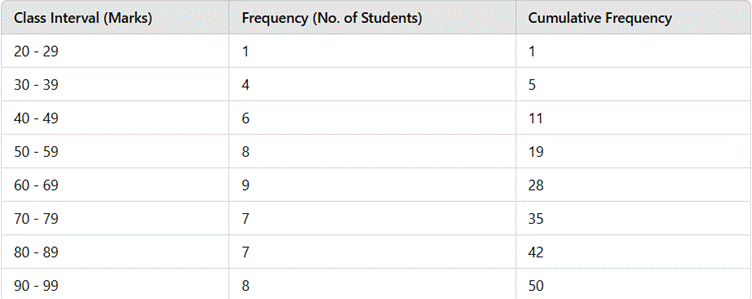
Since the data consists of marks ranging from 23 to 99, we create class intervals of size 10 (e.g., 20-29, 30-39, etc.).
Source: Kapdec.com
Step 2: Graphical Representation
A histogram can be plotted using the class intervals on the x-axis and frequency on the y-axis to visualize the distribution of student scores.
A cumulative frequency polygon can also be used to show the cumulative distribution of marks.
Step 3: Identifying Trends and Outliers
- The most common score range is 60-69, with the highest frequency of 9 students.
- The lowest number of students (only 1) scored in the 20-29 range.
- The cumulative frequency column helps in determining the median (the middle value), which falls in the 60-69 range.
- No extreme outliers are present, as all values fall within a reasonable range.
Here are five conclusive points summarizing the chapter “Grouping Data”
1. Grouping Data Simplifies Complex Information
- Large datasets can be difficult to interpret in raw form.
- Organizing data into meaningful groups enhances clarity and reduces complexity.
- Properly grouped data makes it easier to recognize patterns and relationships.
2. Frequency Distribution Helps in Statistical Analysis
- Categorizing data using frequency distribution allows for systematic study.
- It enables comparisons between different datasets and helps identify trends.
- Frequency tables provide a structured representation of how often values occur.
3. Graphical Representations Enhance Understanding
- Histograms, bar graphs, and frequency polygons offer visual summaries of grouped data.
- These tools highlight trends, variations, and distributions effectively.
- Well-structured graphs aid in making informed conclusions from data.
4. Proper Class Intervals Ensure Meaningful Interpretation
- Selecting appropriate class intervals prevents misrepresentation of data.
- Intervals should be chosen to maintain both precision and readability.
- A well-structured classification allows for accurate statistical evaluation.
5. Grouped Data Has Broad Real-World Applications
- Businesses, scientists, and researchers use grouped data for analysis and decision-making.
- It is applied in market research, population studies, academic assessments, and more.
- Organized data supports predictions, trends, and insights across various industries.
