KAPDEC® | Elite STEM Learning Platform | https://kapdec.com
Unit: Right Triangles
Chapter: Application
Reference: – Right Triangles in Real-World Problem Solving, Using the Pythagorean Theorem in Practical Situations, Applications of Trigonometric Ratios in Right Triangles, Angles of Elevation and Depression, Right Triangles in Navigation and Surveying, Application of Right Triangles in Architecture and Engineering, Shadow and Height Measurement Using Right Triangles, Distance Calculation in Two-Dimensional and Three-Dimensional Space
After studying this chapter, you should be able to understand:
- Right Triangles in Real-World Problem Solving & Using the Pythagorean Theorem in Practical Situations
- Applications of Trigonometric Ratios in Right Triangles
- Right Triangles in Navigation and Surveying
- Distance Calculation in Two-Dimensional and Three-Dimensional Space
Right Triangles in Real-World Problem Solving – Right triangles are widely used to model real-world situations that involve measurements of height, distance, and angles. Their structured properties allow for accurate determination of unknown values, making them essential tools in various fields such as construction, navigation, and physics.
Using the Pythagorean Theorem in Practical Situations – The relationship between the sides of a right triangle plays a crucial role in solving practical measurement problems. By understanding how the three sides interact, one can determine unknown distances in various contexts, such as mapping, architecture, and structural design.
Applications of Trigonometric Ratios in Right Triangles – The consistent relationships between the angles and sides of right triangles allow for the use of trigonometric ratios to find missing values. These ratios provide a method for indirect measurement, where angles and known sides help determine unknown lengths in practical applications.
Angles of Elevation and Depression – When an observer looks upward or downward at an object, the angle formed between their line of sight and a horizontal reference is known as the angle of elevation or depression. These angles are widely used in fields like aviation, astronomy, and civil engineering to estimate distances and heights when direct measurement is impractical.
Right Triangles in Navigation and Surveying – Navigation and land surveying often involve determining distances and positions based on right triangle properties. By measuring angles and distances from specific reference points, surveyors and navigators can locate objects, map terrain, and establish boundaries efficiently.
Application of Right Triangles in Architecture and Engineering – The structural integrity and design of buildings and infrastructure rely on the predictable properties of right triangles. Engineers and architects use these principles to ensure accurate positioning of walls, support beams, and inclined surfaces, allowing for stability and efficiency in construction.
Ladders, Ramps, and Inclined Planes – Many structures involve sloped surfaces that can be analysed using right triangles. Understanding how angles and lengths relate allows for the proper design of ramps, staircases, and ladders to ensure accessibility, comfort, and safety in everyday applications.
Shadow and Height Measurement Using Right Triangles – When light sources cast shadows, the resulting triangles can be analysed to determine the height of objects. By comparing proportions, one can estimate the height of tall buildings, trees, or flagpoles without directly measuring them, making this technique useful in fields like forestry and urban planning.
Distance Calculation in Two-Dimensional and Three-Dimensional Space – Right triangles provide a foundational method for calculating distances in both flat and three-dimensional space. These calculations are used in design, physics, and engineering to determine the shortest path between points, analyse diagonal distances, and understand spatial relationships.
Right Triangles in Physics and Motion – Many physical phenomena, including motion, forces, and wave behavior, can be analysed using right triangles. The breakdown of forces into perpendicular components, the trajectory of objects in motion, and the interaction of waves all depend on understanding the geometric relationships of right-angled triangles.
Trigonometry: Introduction to Trigonometry
Application (Heights and Distance)
Measuring Height and Distance
Trigonometry has its biggest use in determining the distances that are very difficult or nearly impossible to measure otherwise. The applications of trigonometry are widespread.
If we were to prepare a list of applications of trigonometry then it would be endless, however some of the most common examples are:
- Trigonometry in Construction: –
- Measuring heights of building
- Determining the roof angles and support distances required.
- Determining elevations, and gradient etc.
- Trigonometry in Aviation:
- Imagine your own travel via plane, and consider the weather outside – there are many factors that would impact the air speed and angle. Those are mass, gravity, speed, wind forces, direction. Consider a very simple scenario – that an airplane traveling at certain speed in the North direction and wind blowing in east direction at a speed of 25 miles per hour would impact the direction of travel and hence air plan angle of travel has to be adjusted for wind speed. And such calculation is made possible by Trigonometry.
- Trigonometry in –
- Oceanography – to measure the wave heights etc.
- Sub Marine – to calculate the presence of objects
- Space – calculating the distances of planets and stars.
And so on, the list could go on and on.
In nutshell, we could say that the trigonometry has many applications and its uses are widespread.
Let us consider some examples to understand the applications: –
Some basic terms:
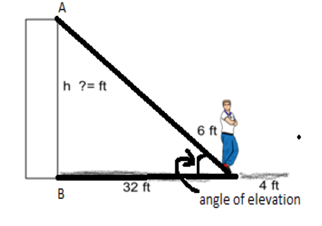
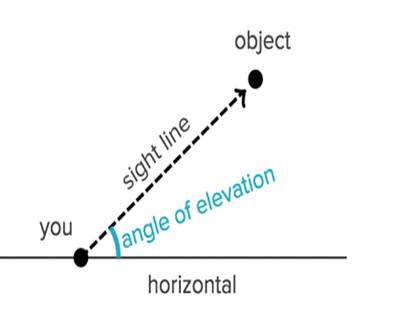
- Angle of elevation– The angle between base and hypotenuse.
Source: Kapdec.com
Source: Kapdec.com
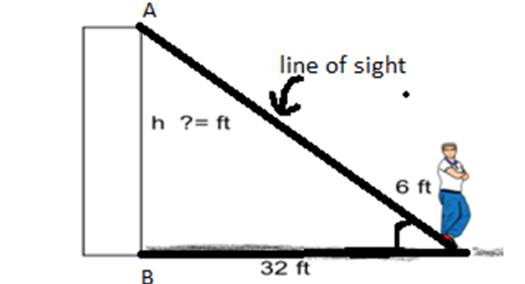
In this figure, the line AC drawn from the eye of the student to the top of the object is called the line of sight. The student is looking at the top of the object. The angle BCA, so formed by the line of sight with the horizontal, is called the angle of elevation of the top of the object from the eye of the student.
Line of sight: The sight of the viewer.
The line of sight is the line drawn from the eye of an observer to the point in the object viewed by the observer. The angle of elevation of the point viewed is the angle formed by the line of sight with the horizontal when the point being viewed is above the horizontal level, i.e., the case when we raise our head to look at the object.
Source: Kapdec.com
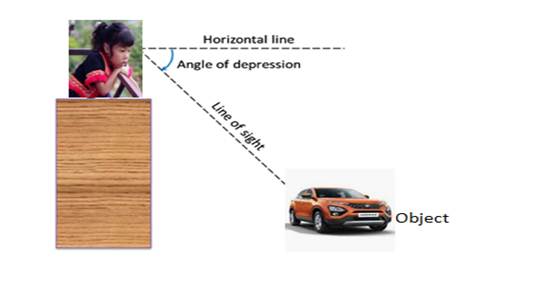
- Angle of depression- The angle between horizontal line (line parallel to base) and hypotenuse.
Now, consider the situation given in Fig. below. The girl sitting on the balcony is looking down at a car. In this case, the line of sight is below the horizontal level. The angle so formed by the line of sight with the horizontal is called the angle of depression.
Thus, the angle of depression of a point on the object being viewed is the angle formed by the line of sight with the horizontal when the point is below the horizontal level, i.e., the case when we lower our head to look at the point being viewed.
Source: Kapdec.com
Fundamental Role in Geometry – Right triangles serve as a cornerstone of geometric analysis, providing a structured approach to solving problems involving distance, height, and angle relationships in both two-dimensional and three-dimensional spaces.
Wide Range of Practical Applications – The principles of right triangles extend beyond theoretical mathematics into real-world applications such as construction, navigation, physics, engineering, and architectural design, making them essential in various professions.
Reliability in Indirect Measurement – Right triangles allow for accurate measurements without direct observation, enabling the estimation of heights, distances, and angles through methods like trigonometric ratios and proportional reasoning.
Interdisciplinary Importance – Concepts related to right triangles integrate seamlessly with other fields, including physics for force analysis, astronomy for celestial calculations, and technology for computer graphics and digital modeling.
Foundation for Advanced Mathematical Concepts – A strong understanding of right triangles paves the way for more complex mathematical topics such as trigonometry, calculus, and vector analysis, reinforcing their importance in higher education and scientific research.
