KAPDEC® | Elite STEM Learning Platform | https://kapdec.com
Unit: Simple Equations & Inequalities
Chapter: Single-Variable Linear Equations & Inequalities, and Their Properties
Reference: – Definition of Linear Equations in One Variable, Solution of Linear Equations, Properties of Equality, Transposition Method, Application of Distributive Property, Equations with Variables on Both Sides, Linear Equations Involving Fractions and Decimals, Introduction to Linear Inequalities in One Variable, Solving Linear Inequalities, Graphical Representation of Linear Inequalities on Number Line, Compound Inequalities, Interpreting Inequality Solutions
After studying this chapter, you should be able to understand:
- Definition of Linear Equations in One Variable & Solution of Linear Equations
- Properties of Equality, Transposition Method & Application of Distributive Property
- Solving Linear Inequalities & Graphical Representation of Linear Inequalities on Number Line
- Interpreting Inequality Solution
Definition of Linear Equations in One Variable:
A linear equation in one variable is an algebraic equation that involves a single variable raised only to the first power. Its general form is where the variable is multiplied by a constant and added to another constant.
Solution of Linear Equations:
The solution of a linear equation is the value of the unknown variable that, when substituted back into the equation, makes both sides of the equation equal.
Properties of Equality:
These are fundamental rules of algebra that allow us to manipulate equations without changing their solution. They include the addition, subtraction, multiplication, and division properties, which state that the same operation can be performed on both sides of an equation to maintain equality.
Transposition Method:
Transposition involves moving a term from one side of the equation to the other by changing its sign. It’s a shortcut for using addition or subtraction on both sides of an equation.
Application of Distributive Property:
The distributive property allows multiplication to be distributed over addition or subtraction inside parentheses. It helps in expanding or simplifying expressions within an equation.
Equations with Variables on Both Sides:
These are linear equations where the unknown variable appears on both sides of the equality sign. Solving involves gathering all variable terms on one side and constants on the other.
Linear Equations Involving Fractions and Decimals:
These equations include coefficients or constants that are fractions or decimals. Solving them requires eliminating denominators or converting decimals appropriately before isolating the variable.
Introduction to Linear Inequalities in One Variable:
A linear inequality in one variable is similar to a linear equation but uses inequality signs like greater than, less than, greater than or equal to, or less than or equal to instead of an equality sign.
Solving Linear Inequalities:
This involves finding all values of the variable that satisfy the inequality. Techniques are similar to solving equations but require reversing the inequality symbol when multiplying or dividing both sides by a negative number.
Graphical Representation of Linear Inequalities on Number Line:
After solving an inequality, its solution set can be shown on a number line using open or closed circles and arrows to indicate the range of values that satisfy the inequality.
Compound Inequalities:
A compound inequality involves two inequalities joined by “and” or “or.” It represents a variable that simultaneously satisfies both inequalities (for “and”) or either one (for “or”).
Inequalities with Variables on Both Sides:
These inequalities have the variable present on both sides of the inequality symbol. Solving them requires isolating the variable on one side while respecting the properties of inequalities.
Interpreting Inequality Solutions:
Solutions to inequalities can be expressed in multiple formats, such as set notation, interval notation, or visually on a number line, to describe all possible values of the variable.
Word Problems Leading to Linear Equations and Inequalities:
These are real-life scenarios or practical problems that can be modelled using single-variable linear equations or inequalities. They require translating text into a mathematical statement.
Checking and Verifying Solutions:
After solving, substituting the solution back into the original equation or inequality ensures that the result satisfies the original condition, confirming its correctness.
Example: –
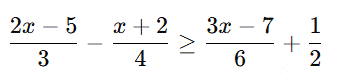
Solve for x:
Source: Kapdec.com
Also, express the solution:
- In interval notation
- Graph it on the number line
Solution: –
Step 1: Eliminate denominators by multiplying through by the Least Common Denominator (LCD)
The denominators are 3, 4, 6, and 2.
LCD of 3, 4, 6, 2 = 12
Now multiply both sides of the inequality by 12:

Source: Kapdec.com
Simplifying each term:

Source: Kapdec.com
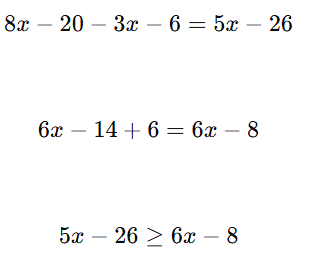
Step 2: Distribute and simplify both sides
Left side:
Source: Kapdec.com
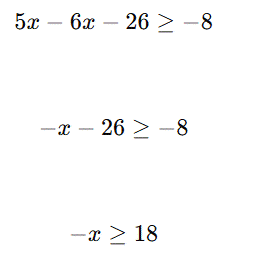
Step 3: Bring variables on one side and constants on the other
Move 6x to the left:
Source: Kapdec.com
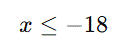
Step 4: Solve for x
Divide both sides by −1:
(Remember: When dividing by a negative number, flip the inequality sign!)
Source: Kapdec.com
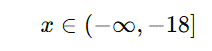
Step 5: Final Answer in Interval Notation
Source: Kapdec.com
Step 6: Graph on Number Line:
- Draw a number line.
- Mark the point −18.
Final Conclusion:
The solution is all real numbers less than or equal to -18. It shows that careful handling of fractions, distribution, and inequality rules (especially flipping the sign) is critical at advanced levels of single-variable linear inequality solving.
Here are five conclusive points: –
Understanding the Structure is Essential:
Mastering single-variable linear equations and inequalities requires recognizing their structure and the relationship between variables and constants.
Solving Requires Stepwise Logical Operations:
Using properties of equality and inequality systematically (addition, subtraction, multiplication, division) is key to solving and simplifying expressions correctly.
Different Representation Formats Exist:
Solutions to equations and inequalities can be represented algebraically, graphically (number lines), and through interval or set notation, depending on the context.
Real-World Relevance:
Single-variable linear equations and inequalities model real-world problems such as budgeting, distance-speed-time problems, and comparing quantities under constraints.
Checking the Solution is Crucial:
Verification by substituting the solution back into the original equation or inequality is essential to avoid errors and ensure the solution satisfies the given condition.
Scan to visit this resource online
https://kapdec.com/resources/single-variable-linear-equations-inequalities-and-their-properties
