KAPDEC® | Elite STEM Learning Platform | https://kapdec.com
UNIT: Gene expression and regulation
Chapter: DNA and RNA structure
Reference: DNA, RNA, DNA structure, RNA structure, difference between DNA and RNA
Learning objectives
- To learn the structure of DNA and RNA
- To differentiate between DNA and RNA
DNA
DNA was first founded by Friedrich Miescher in 1869. In February 1953, Watson and Crick completed their model, which is now accepted as the first correct model of the double-helix of DNA. DNA is a long polymer chain made from repeating units called nucleotides. Each of these nucleotides is symbolized by a single letter. It is a nucleic acid.
Deoxyribonucleic acid (DNA) contains the genetic instructions for the development and function of living things. DNA in the cell stores information for a long-term period. The information is held in the sequence of pieces of DNA called genes.
RNA
In 1868, Friedrich Miescher discovered Nucleic acids. He named the material ‘nuclein’ since it was found in the nucleus. Leslie Orgel is the father of the RNA. He was a chemist and established a world theory of the origin of life.
RNA is present in all biological cells. It is an important biological macromolecule principally involved in the synthesis of proteins, carrying the messenger instructions from DNA, which itself contains the genetic instructions required for the development and maintenance of life.
DNA structure
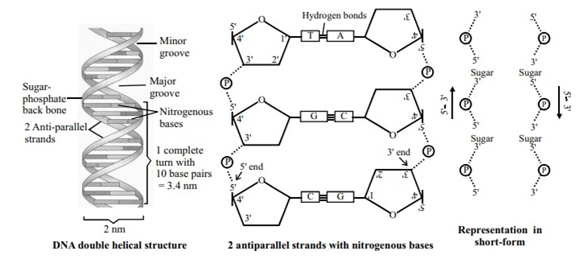
- The structure of DNA can be understood as a twisted ladder. It is a nucleic acid composed of nucleotides.
- The DNA molecule is made up of units called nucleotides, which comprise three different components, such as phosphate groups, nitrogen bases, and sugars.
- The phosphate and sugar groups bind to the nucleotides to form each strand of DNA.
- The four basic types of nitrogen are Guanine (G), Adenine (A), Cytosine (C), and Thymine (T). They pair together as follows: Cytosine (C) and Guanine (G) and Adenine (A) and Thymine (T), and are essential for the formation of double helix DNA in a twisted ladder.
- The order of the nitrogen bases determines the instructions for DNA or genetic code.
- Both strands of DNA run in opposite directions. These fibres are held together by a hydrogen bond between two parallel bases.
- The strings are twisted, where each strand forms a coil in the right hand and ten nucleotides form a single turn. The entire helix contains a 3.4 nm pitch. Therefore, the interval between two consecutive base pairs is 0.34 nm.
- DNA combines and forms chromosomes where each chromosome contains one molecule of DNA in it. In all, humans have 23 pairs of chromosomes in the nucleus of cells.
Source: Kapdec.com
RNA structure
- Ribonucleic acid (RNA) is a molecule that is present in most living organisms and viruses.
- It is made up of nucleotides, which are ribose sugars attached to nitrogenous bases and phosphate groups.
- The nitrogenous bases include adenine, guanine, uracil, and cytosine. RNA mostly exists in the single-stranded form, but there are special RNA viruses that are double-stranded.
- The RNA molecule can have a variety of lengths and structures.
- An RNA virus uses RNA instead of DNA as its genetic material and can cause many human diseases.
- Transcription is the process of RNA formation from DNA, and translation is the process of protein synthesis from RNA.
- The means of RNA synthesis and the way that it functions differs between eukaryotes and prokaryotes.
- Specific RNA molecules also regulate gene expression and have the potential to serve as therapeutic agents in human diseases.
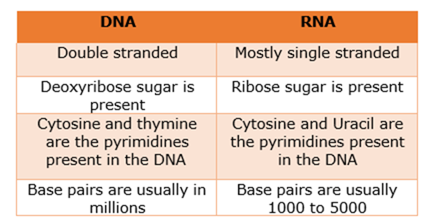
Difference between DNA and RNA
Source: Kapdec.com
Solved examples
Example 1. Which of the following chemical bonds is found between 3′ and 5′ carbons of adjacent nucleotides?
a) Phosphodiester bond b) Hydrogen bond
c)Disulphide bond d) James bond
Solution 1: a. The chemical bond which is found between 3′ and 5′ carbons of adjacent nucleotides is phosphodiester bonds.
Example 2. Which of the following units are repeatedly joined together to form a strand of DNA?
a) amino acids b) nucleotides c) fatty acids d) polysaccharides
Solution 2: b. Nucleotides repeatedly joined together to form a strand of DNA.
Summary
- Nucleic acid is polymer of nucleotide and are of two types DNA and RNA
- DNA and RNA both act as genetic material but DNA is more stable and resists evolutionary changes and it is believed that DNA is formed from RNA after some modifications.
- RNA is mostly functions as catalyst and transfer expression of information.
- Complementary base paring is present in DNA double helix between purine of one strand and pyrimidine of second.
- These bonds connect 2 nucleotides. Between A and T, there are 2 hydrogen bonds and in between G and C there are hydrogen bonds.
