KAPDEC® | Elite STEM Learning Platform | https://kapdec.com
Unit: Comparing Quantities
Chapter: Introduction to Comparing Quantities
Reference: – Concept of Ratio and Proportion, Understanding Percentages, Relationship Between Ratios, Fractions and Percentages, Comparing Ratios and Percentages, Applications of Ratio and Percentage in Daily Life, Unitary Method for Comparing Quantities, Successive Percentage Changes, Real-World Problem-Solving with Ratios and Percentages
After studying this chapter, you should be able to understand:
- Concept of Ratio and Proportion & Understanding Percentages
- Fractions and Percentages & Comparing Ratios and Percentages
- Unitary Method for Comparing Quantities
- Real-World Problem-Solving with Ratios and Percentages
- Concept of Ratio and Proportion
- A ratio is a way of comparing two or more quantities by expressing how much of one quantity exists in relation to another.
- Proportion extends this concept by stating that two ratios are equal, establishing a relationship between four quantities.
- Understanding ratios and proportions helps in scaling figures, creating models, and solving problems in various fields such as business, architecture, and science.
- Understanding Percentages
- A percentage represents a part of a whole in terms of one hundred equal parts.
- It is widely used in practical scenarios such as determining discounts, interest rates, tax calculations, and statistical data representation.
- Converting between percentages, fractions, and decimals is essential for ease of comparison in different contexts.
- Relationship Between Ratios, Fractions, and Percentages
- Ratios, fractions, and percentages are different ways of expressing the relationship between quantities.
- A ratio can be transformed into a fraction by treating the first quantity as the numerator and the second as the denominator.
- Percentages offer a standardized way of expressing fractions and ratios, making it easier to compare values across different scenarios.
- Comparing Ratios and Percentages
- Comparing ratios involves expressing them in equivalent forms to determine their relative sizes or relationships.
- Percentages allow direct comparisons between different quantities by converting values to a common scale.
- Understanding percentage increase and decrease helps analyse trends in various fields such as finance, economics, and population studies.
- Applications of Ratio and Percentage in Daily Life
- Ratios and percentages are fundamental in business, science, and everyday decision-making.
- They are used to calculate profits, losses, discounts, interest rates, and population growth.
- These concepts also play a key role in understanding statistical data, medical dosage calculations, and engineering scale models.
- Unitary Method for Comparing Quantities
- The unitary method involves finding the value of a single unit first and then using it to determine other related values.
- This method is useful in solving problems related to speed, cost, wages, and conversions.
- It helps simplify complex proportional relationships and makes calculations more intuitive.
- Successive Percentage Changes
- When a quantity undergoes multiple percentage changes, each change affects the result of the previous one.
- This concept is used in financial calculations, such as price markups, tax applications, and investment growth.
- Understanding how successive percentage changes work is essential for making informed financial and economic decisions.
- Real-World Problem-Solving with Ratios and Percentages
- Businesses use ratios and percentages to analyse profit margins, revenue growth, and financial performance.
- Governments and researchers use these concepts in statistical data interpretation, such as population studies and economic trends.
- Understanding how to apply ratios and percentages in word problems enhances logical reasoning and analytical skills.
Example: –
A smartphone manufacturing company produces a model that initially costs $20,000. Over time, the price undergoes multiple changes:
- The company increases the price by 25% due to high demand.
- After a few months, it offers a 15% discount as a promotional offer.
- Additionally, a sales tax of 18% is applied to the final price after the discount.
Using the concepts of percentages, successive percentage changes, and unitary method, determine:
- The price after the 25% increase.
- The price after the 15% discount.
- The final price after applying the 18% tax.
- The overall percentage change from the original price
Solution: –
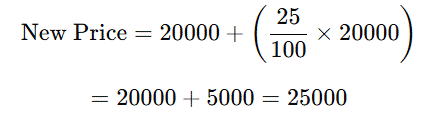
(1) Price After 25% Increase
A 25% increase means the new price is:
Source: Kapdec.com
So, after the price increase, the new price is $25,000.
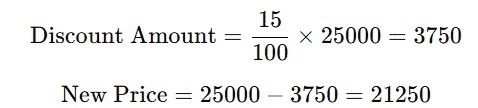
(2) Price After 15% Discount
A 15% discount means reducing the price by 15% of $25,000:
Source: Kapdec.com
So, after the discount, the new price is $21,250.
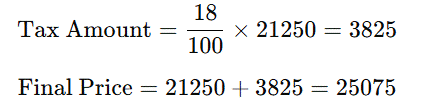
(3) Final Price After 18% Tax
A 18% tax is applied on $21,250:
Source: Kapdec.com
So, after applying tax, the final price is $25,075.
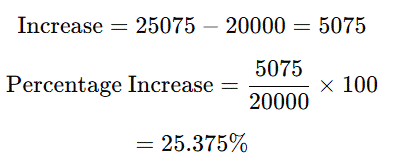
(4) Overall Percentage Change from Original Price
The original price was $20,000, and the final price is $25,075.
The overall increase is:
Source: Kapdec.com
Thus, the overall percentage increase in price from the original cost is 25.38%.
Conclusive Points for “Introduction to Comparing Quantities (Ratio & Percentage)”
- Ratios and percentages are essential tools for comparison – They provide a structured way to compare different quantities, making them useful in diverse applications such as finance, business, and science.
- Percentages standardize comparisons – Converting values into percentages allows easy evaluation of quantities on a common scale, which is especially helpful in analysing trends and statistical data.
- The unitary method simplifies problem-solving – By determining the value of a single unit first, this method enables efficient calculations in proportional reasoning and real-life applications like pricing, speed, and wages.
- Successive percentage changes influence final outcomes – When multiple percentage changes occur, each impacts the previous result, making this concept crucial in financial growth, discounts, and taxation.
- Practical applications make these concepts indispensable – Ratios and percentages are fundamental in daily life, influencing decisions in areas such as budgeting, population studies, investments, and economic analysis.
Scan to visit this resource online
https://kapdec.com/resources/introduction-to-comparing-quantities
