KAPDEC® | Elite STEM Learning Platform | https://kapdec.com
Unit: Quadratic Equations
Chapter: Solving Quadratic Equations, Use of Quadratic Formulae
Reference: – Recognizing Factorable Quadratic Expressions, Structure of a Quadratic Equation, Greatest Common Factor (GCF) Method, Factoring Trinomials with Leading Coefficient One, Factoring Trinomials with Leading Coefficient Not One, Difference of Squares, Perfect Square Trinomials, Solving by Factoring and Using Zero Product Property, Checking Solutions of Factored Equations, Factoring with Variables on Both Sides
After studying this chapter, you should be able to understand:
- Recognizing Factorable Quadratic Expressions
- Greatest Common Factor (GCF) Method
- Difference of Squares & Perfect Square Trinomials
- Factoring with Variables on Both Sides
Here is a theoretical elaboration of each point under the chapter “Solving Using Factoring Methods” from the Quadratic Equations module:
- Recognizing Factorable Quadratic Expressions
A quadratic equation is considered factorable if it can be expressed as a product of two binomial expressions, making it easier to find the roots through algebraic manipulation. - Structure of a Quadratic Equation
A quadratic equation follows a specific form that includes a squared term, a linear term, and a constant. Understanding this structure helps in identifying suitable factoring methods. - Greatest Common Factor (GCF) Method
Factoring begins by identifying the greatest common factor among the terms of the equation, which simplifies the expression and prepares it for further decomposition. - Factoring Trinomials with Leading Coefficient One
When the leading coefficient is one, factoring involves identifying two numbers that multiply to the constant term and add up to the middle coefficient. - Factoring Trinomials with Leading Coefficient Not One
For trinomials with a leading coefficient other than one, factoring becomes a more strategic process requiring multiplication and grouping to reorganize terms effectively. - Difference of Squares
This technique is used when an expression is the subtraction of two perfect squares, which can always be factored into conjugate binomials. - Perfect Square Trinomials
These trinomials are specific quadratic forms where the first and last terms are squares and the middle term is twice the product of their square roots, allowing clean factorization. - Solving by Factoring and Using Zero Product Property
After factoring, equations are solved by applying the zero-product property, which states that if a product of factors is zero, at least one of the factors must be zero. - Checking Solutions of Factored Equations
Solutions derived from factoring must be verified by substituting them back into the original equation to ensure they satisfy the condition. - Factoring with Variables on Both Sides
When variables appear on both sides of the equation, they must first be rearranged into a standard quadratic form before factoring is applied. - Quadratic Word Problems Using Factoring
Real-life problems can be translated into quadratic equations, and factoring methods help interpret practical solutions such as dimensions, time, or cost. - Connections Between Roots and Factors
The roots of a quadratic equation correspond directly to the values that make each factor equal to zero, highlighting the inverse relationship between solutions and the factored form.
Example: –
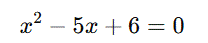
Solve the quadratic equation:
Source: Kapdec.com
Solution: –
Solution (Factoring Trinomial with Leading Coefficient One):
Find two numbers that multiply to 6 and add up to -5:
- The numbers are -2 and -3.
Factor the expression:

Source: Kapdec.com
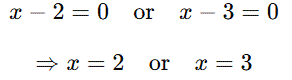
Apply the Zero Product Property:
Source: Kapdec.com
Final Answer:
x=2 or x=3
Here are five conclusive points for the chapter “Solving Using Factoring Methods” under Quadratic Equations:
- Factoring provides a reliable algebraic approach for solving quadratic equations without requiring advanced operations like completing the square or using the quadratic formula.
- Identifying the correct factoring method—such as GCF, trinomials, or difference of squares—is crucial for simplifying and solving equations effectively.
- The zero-product property allows factored expressions to yield solutions quickly and logically by setting each factor equal to zero.
- Factoring enhances students’ structural understanding of polynomial expressions and strengthens foundational algebraic skills.
- Mastery of factoring equips students to apply quadratic models in real-world problem-solving scenarios with clarity and precision.
Scan to visit this resource online
https://kapdec.com/resources/solving-quadratic-equations-use-of-quadratic-formulae
