KAPDEC® | Elite STEM Learning Platform | https://kapdec.com
Unit: Cartesian Coordinate System
Chapter: Cartesian Plane and Plotting of a Point
Reference: – Cartesian Plane and Coordinates, Distance and Section Formula, Collinearity of Points, Area of Geometric Figures, Straight Line Concepts, Reflection and Symmetry, Locus of a Point, Transformation of Coordinates
After studying this chapter, you should be able to understand:
- Cartesian Plane and Coordinates
- Distance & Section Formula & Geometric figures
- Straight line concepts & Reflection of Symmetry
- Locus of a Point & transformation of Coordinates
Cartesian Plane and Coordinates
The Cartesian Coordinate System, also known as the Rectangular Coordinate System, is a two-dimensional system for defining the position of points in a plane using ordered pairs of numbers. This system was developed by René Descartes, a French mathematician, and is widely used in geometry, algebra, physics, and computer graphics.
1. Definition and Concept of the Cartesian Plane
The Cartesian Plane is a flat, two-dimensional surface defined by two perpendicular lines called coordinate axes. These axes divide the plane into four regions, called quadrants.
Each point in this plane is represented by an ordered pair (x, y) where:
- x is the abscissa, representing the horizontal position.
- y is the ordinate, representing the vertical position.
The Cartesian Plane is used to plot points, lines, and geometric shapes, making it essential for analytical geometry.
2. Coordinate Axes (X-axis & Y-axis) and Quadrants
Coordinate Axes
- The X-axis is the horizontal axis.
- The Y-axis is the vertical axis.
- These axes intersect at the origin (0,0).
Quadrants
The Cartesian plane is divided into four quadrants, each having distinct signs for coordinates:
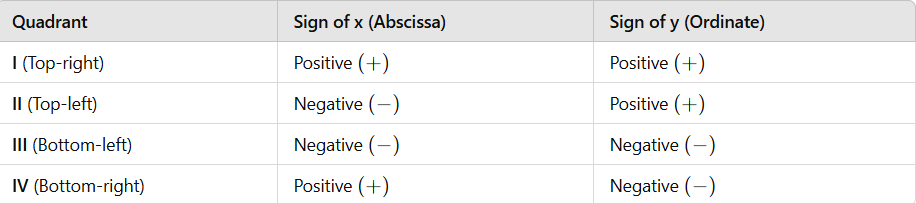
Source: Kapdec.com
For example:
- Point (3, 4) is in the first quadrant.
- Point (-5, 2) is in the second quadrant.
- Point (-2, -7) is in the third quadrant.
- Point (6, -1) is in the fourth quadrant.
Points that lie on the axes do not belong to any quadrant:
- If y = 0, the point is on the X-axis (e.g., (4,0).
- If x = 0, the point is on the Y-axis (e.g., (0, -5).
- The origin (0,0) is the intersection of both axes.
3. Distance of a Point from Axes
To find the distance of a point from the coordinate axes, we use the absolute values of its coordinates:
- Distance from the X-axis = ∣y∣
- This is the vertical distance of the point from the X-axis.
- Example: For P (3,4) the distance from the X-axis is ∣4∣
- Distance from the Y-axis = ∣x∣
- This is the horizontal distance of the point from the Y-axis.
- Example: For P (3,4) the distance from the Y-axis is 3
4. Identifying Signs of Coordinates in Different Quadrants
To determine the signs of coordinates in different quadrants:
- If a point is in Quadrant I, both x and y are positive.
- If a point is in Quadrant II, x is negative, and y is positive.
- If a point is in Quadrant III, both x and y are negative.
- If a point is in Quadrant IV, x is positive, and y is negative.
Collinearity of Points
Definition
Three or more points are said to be collinear if they lie on the same straight line. If no single straight line can pass through all given points, they are non-collinear.
To check whether three points (x1,y1) (x2,y2) and (x3,y3) are collinear, we can use two methods:
- Distance Formula Method
- Slope Method
1. Locus of a Point
Definition
The locus of a point is the set of all points that satisfy a given condition or a mathematical rule in a coordinate plane. It describes the path traced by a moving point under certain geometric constraints.
Examples:
- Locus of a point at a fixed distance from another point (Circle)
- The set of all points at a constant distance r from a fixed point
- Locus of a point equidistant from two fixed points (Perpendicular Bisector)
- The set of points equidistant from two given points forms the perpendicular bisector of the segment joining them.
- Locus of a point equidistant from two parallel lines
- The locus is a new parallel line exactly halfway between the two given lines.
General Method to Find the Locus of a Point:
- Assume the coordinates of the moving point as (x, y).
- Express the given condition as an equation in terms of xxx and y.
- Simplify the equation to get the required locus.
Reflection
Reflection in coordinate geometry means flipping a point, line, or shape over a given axis while maintaining its distance from that axis.
Reflection of a Point Across Axes:
If a point (x, y) is reflected:
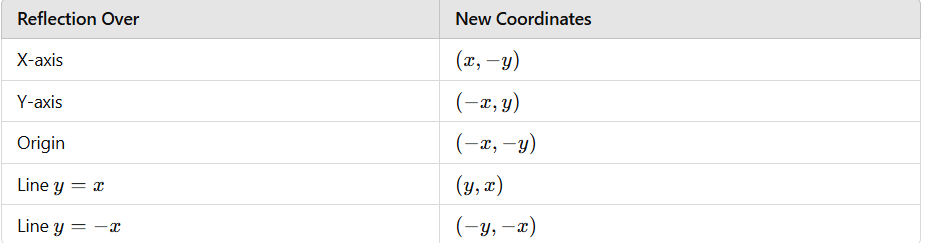
Source: Kapdec.com
Symmetry
Symmetry in coordinate geometry refers to the invariance of a figure when reflected or rotated.
Types of Symmetry:
- Reflectional Symmetry: If a figure is divided by a line into two mirror-image halves, it has reflectional symmetry. Example: A parabola is symmetric about the Y-axis.
- Rotational Symmetry: A shape has rotational symmetry if it looks the same after rotation by a certain angle around a point. Example: A square has 90° rotational symmetry.
- Point Symmetry: A shape is unchanged after a 180° rotation around a centre point.
3. Transformation of Coordinates
Definition
A transformation of coordinates refers to changing the position, size, or orientation of a figure in the Cartesian plane using algebraic rules.
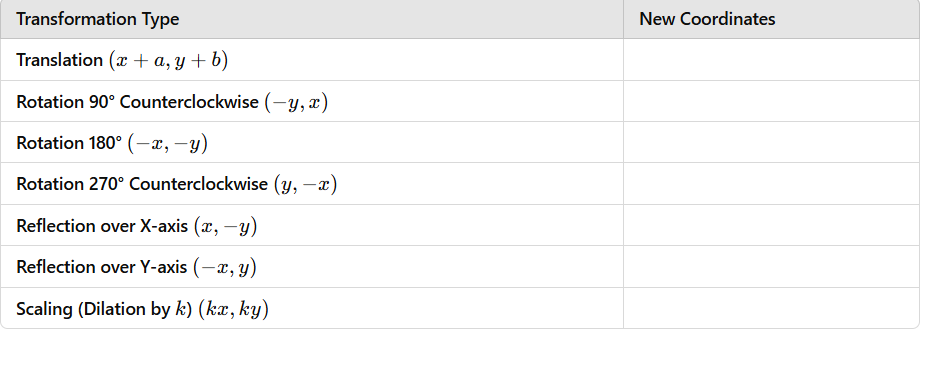
Source: Kapdec.com
New coordinates are as below: –
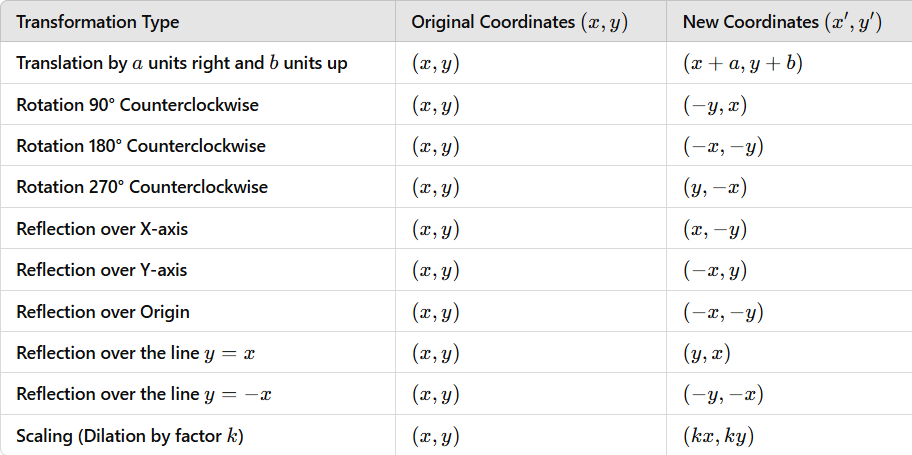
Source: Kapdec.com
STRAIGHT LINE CONCEPTS: –
Definition
A straight line in the Cartesian plane is the shortest distance between two points. It is represented by a linear equation of the form:
Ax+By+C=0
where A, B and C are constants, and x, y are coordinates of any point on the line.
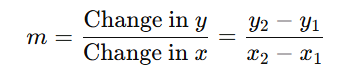
Slope of a Line
The slope m of a line measures its steepness and is given by:
Source: Kapdec.com
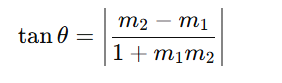
Angle Between Two Lines
- If two lines have slopes m1 and m2, the angle θ between them is:
Source: Kapdec.com
CONCLUSION: –
The Cartesian coordinate system provides a structured way to represent points, lines, and shapes mathematically, enabling precise calculations for distance, slope, collinearity, and transformations.
- Understanding geometric properties like symmetry, reflection, and area through coordinate geometry allows for accurate problem-solving in advanced mathematics and real-world applications.
Scan to visit this resource online
https://kapdec.com/resources/cartesian-plane-and-plotting-of-a-point
