KAPDEC® | Elite STEM Learning Platform | https://kapdec.com
Unit: Direct & Inverse Proportion
Chapter: Inverse Proportion
Reference: – Concept of Inverse Proportion, Mathematical Representation of Inverse Proportion, Difference Between Direct and Inverse Proportion, Graphical Representation of Inverse Proportions, Real-life Applications of Inverse Proportion, Solving Equations Involving Inverse Proportion, Impact of Scaling on Inverse Proportions, Limitations and Special Cases, Inverse Proportions in Advanced Mathematical Models
After studying this chapter, you should be able to understand:
- Concept of Inverse Proportion & Mathematical Representation
- Graphical Representation of Inverse Proportions
- Solving Equations Involving Inverse Proportion
- Inverse Proportions in Advanced Mathematical Models
- Concept of Inverse Proportion
- In an inverse proportion, two quantities are related in such a way that when one increases, the other decreases proportionally.
- This relationship maintains a constant product between the two quantities, meaning their multiplication always results in the same value.
- It is commonly observed in real-world scenarios where resources are distributed among multiple agents, affecting their individual share inversely.
- Mathematical Representation of Inverse Proportion
- The relationship between the two variables is represented by an equation where their product remains constant.
- Unlike direct proportion, where an increase in one variable leads to an increase in the other, inverse proportion ensures that an increase in one result in a proportional decrease in the other.
- This equation is useful for solving problems involving speed and time, work distribution, or pressure and volume in physics.
- Difference Between Direct and Inverse Proportion
- Direct proportion describes a relationship where both quantities change in the same direction, whereas inverse proportion describes a scenario where one quantity increases while the other decreases.
- The graph of a direct proportion is a straight line passing through the origin, while an inverse proportion graph forms a curve (hyperbola).
- Recognizing these differences helps in choosing appropriate methods to solve real-world problems.
- Graphical Representation of Inverse Proportions
- When plotted on a graph, an inverse proportional relationship does not form a straight line but rather a downward-sloping curve (hyperbola).
- The curve shows that as one variable increases along the x-axis, the corresponding value on the y-axis decreases.
- Understanding the shape of this graph helps in analysing relationships in physics, economics, and business settings.
- Real-life Applications of Inverse Proportion
- Many practical situations exhibit inverse proportionality, such as the relationship between speed and travel time, number of workers and time taken to complete a task, or gas pressure and volume.
- These concepts help in optimizing resources, workforce planning, and scientific calculations.
- Applying inverse proportion principles allows for better decision-making in areas such as engineering, logistics, and environmental science.
- Solving Equations Involving Inverse Proportion
- Problems involving inverse proportion require setting up equations that relate two variables through their constant product.
- Rearranging and solving these equations provides insight into how one variable changes in response to another.
- This skill is essential in mathematical problem-solving and real-world applications like scaling recipes, physics equations, and cost analysis.
- Impact of Scaling on Inverse Proportions
- If one variable in an inverse proportion is scaled up or down, the other variable must be adjusted accordingly to maintain the constant relationship.
- This is particularly useful in areas like architecture, mechanical engineering, and finance, where proportional adjustments are required.
- Understanding scaling helps in predicting outcomes based on changes in initial conditions.
- Limitations and Special Cases
- While inverse proportion applies to many scenarios, it does not hold in cases where zero or undefined values exist.
- Situations where variables have fixed minimum or maximum values might not follow a strict inverse proportionality rule.
- Identifying these exceptions ensures accurate application in scientific and economic models.
- Inverse Proportions in Advanced Mathematical Models
- Beyond basic applications, inverse proportion is used in higher-level mathematics, such as calculus, probability distributions, and optimization problems.
- Many scientific laws, such as Boyle’s Law in physics, rely on inverse proportionality to explain relationships between physical quantities.
- Understanding these advanced applications allows for deeper exploration of mathematical relationships in various disciplines.
Example: –
A group of workers is assigned to complete a road construction project. If 15 workers can complete the task in 24 days, how many days will it take for 40 workers to complete the same task, assuming they work at the same rate?
Solution: –
In this problem, the number of workers and the time required to complete the work are inversely proportional. This means that as the number of workers increases, the time required to complete the task decreases proportionally.
Let d be the number of days required for 40 workers.
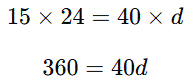
Since the product of the two variables (workers and days) remains constant, we set up the inverse proportion equation:

Source: Kapdec.com
Substituting the given values:
Source: Kapdec.com
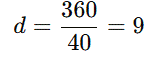
Solving for d:
Source: Kapdec.com
Final Answer:
If 40 workers are assigned, the project will be completed in 9 days.
Here are five conclusive points for the topic Inverse Proportion:
- Inverse Proportion Establishes an Opposite Relationship
- When one quantity increases, the other decreases proportionally, maintaining a constant product.
- This concept is useful in solving problems related to work distribution, travel time, and physical laws.
- Mathematical and Graphical Representation Provides Clarity
- The inverse proportional relationship is expressed through an equation where the product of two variables remains unchanged.
- When plotted on a graph, this relationship forms a downward-sloping curve (hyperbola), distinguishing it from direct proportionality.
- Practical Applications Span Multiple Fields
- Inverse proportion is widely used in physics (Boyle’s Law), economics (supply-demand relationships), and engineering (gear ratios).
- Understanding this concept helps in optimizing processes, reducing costs, and improving efficiency in various industries.
- Solving Inverse Proportion Equations Enhances Problem-Solving Skills
- Setting up and solving equations involving inverse proportionality allows for accurate predictions in real-world scenarios.
- These problem-solving techniques are essential for academic success and practical applications in business, science, and technology.
- Recognizing Limitations and Exceptions is Crucial
- Not all relationships follow inverse proportionality, especially when variables have fixed minimum or maximum values.
- Identifying cases where inverse proportion does not apply ensures accurate mathematical modeling and decision-making.
