KAPDEC® | Elite STEM Learning Platform | https://kapdec.com
Unit: Exponents and Roots
Chapter: Problems with Exponents and Roots
Reference: – Simplifying expressions involving both exponents and roots, converting between radical and exponential forms, solving equations involving roots and exponents, applying exponent rules in multi-step expressions, Rational exponents and their interpretations, Operations with square roots and cube roots, Identifying extraneous solutions in radical equations, Domain constraints in radical expressions
After studying this chapter, you should be able to understand:
- Simplifying expressions involving both exponents and roots
- Converting between radical and exponential forms
- Applying exponent rules in multi-step expressions
- Domain constraints in radical expressions
Here is a theoretical elaboration of the key concepts under the chapter Problems with Exponents and Roots: –
- Expressions involving exponents and roots often require simplification using foundational rules of algebra, ensuring the expression is presented in its most reduced and interpretable form.
- Converting between radical notation and exponential notation allows for flexible manipulation and clearer recognition of equivalent forms, which is especially useful in algebraic transformations and comparisons.
- Solving equations that contain roots or exponents demands isolating the variable by reversing the operation using inverse properties, with careful attention to maintaining equality across the equation.
- Exponent rules, such as the laws governing multiplication, division, and powers of powers, must be applied systematically to multi-step problems to ensure accuracy in expression manipulation.
- Rational exponents represent roots in exponential form, allowing a unified treatment of roots and powers within the same algebraic framework, enhancing clarity and simplifying complex expressions.
- Operations involving square and cube roots follow specific properties that allow for addition, subtraction, and multiplication under the radical, provided like terms or factorable patterns are identified.
- Some radical equations may lead to extraneous solutions—values that do not satisfy the original equation—requiring validation of each proposed solution by substitution back into the original context.
- Domain restrictions in radical expressions arise when the value under the root must be non-negative or defined for real numbers, ensuring that the solution set remains valid in real-world and mathematical contexts.
- Graphical interpretation of exponential and root functions enables a visual understanding of their growth patterns, transformations, and asymptotic behavior, supporting deeper conceptual learning.
- Real-life applications such as population growth, radioactive decay, and geometric scaling often involve exponent and root models, bridging the gap between abstract mathematics and practical problem-solving.
Example: –
Simplify the expression:
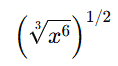
Source: Kapdec.com
Solution: –
Convert radicals to fractional exponents:
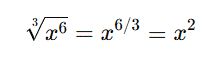
Source: Kapdec.com
Now raise to the power 1/2:

Source: Kapdec.com
Here are five conclusive theoretical points for the topic Problems with Exponents and Roots:
- Understanding and applying the rules of exponents and roots builds a strong foundation for simplifying complex algebraic expressions.
- Mastery of rational exponents allows smoother transitions between exponential and radical forms in both problem-solving and function analysis.
- Recognizing extraneous solutions is essential when solving equations involving roots or exponents to ensure mathematical accuracy.
- Real-world modeling with exponential and root functions helps bridge abstract concepts with practical applications.
- Visual and algebraic interpretations together support deeper insight into the behavior and properties of exponential and radical relationships.
