KAPDEC® | Elite STEM Learning Platform | https://kapdec.com
Unit: Linear Equation in two variables
Chapter: Combining Quadratic and Linear Equations
Reference: – Definition of Linear Equations, Definition of Quadratic Equations, Graphical Representation of Linear Equations, Graphical Representation of Quadratic Equations, Intersection Points Between Line and Parabola, Solving Systems of Linear and Quadratic Equations Algebraically, Substitution Method for Solving Systems, Discriminant in Quadratic Equations, Number of Solutions for Linear-Quadratic Systems, Graphical Interpretation of No Intersection, Graphical Interpretation of Tangency
After studying this chapter, you should be able to understand:
- Definition of Linear Equations & Definition of Quadratic Equations
- Graphical Representation of Linear Equations & Graphical Representation of Quadratic Equations
- Solving Systems of Linear and Quadratic Equations Algebraically & Substitution Method for Solving Systems
- Graphical Interpretation of Tangency
Definition of Linear Equations:
A linear equation is an algebraic equation in which each term is either a constant or the product of a constant and a single variable. Its graph forms a straight line on a Cartesian plane.
Definition of Quadratic Equations:
A quadratic equation is a second-degree polynomial equation in a single variable. It contains a term where the variable is squared, and its graph forms a parabola.
Graphical Representation of Linear Equations:
A linear equation is represented graphically as a straight line. Its position and orientation are determined by its slope and y-intercept.
Graphical Representation of Quadratic Equations:
A quadratic equation is represented graphically as a parabola. The parabola opens either upwards or downwards depending on the sign of the quadratic coefficient.
Intersection Points Between Line and Parabola:
These are points on a graph where the line and the parabola meet. The coordinates of these points satisfy both the linear and the quadratic equations simultaneously.
Solving Systems of Linear and Quadratic Equations Algebraically:
This process involves substituting the expression from the linear equation into the quadratic equation, resulting in a single-variable quadratic equation that can be solved algebraically.
Substitution Method for Solving Systems:
This method involves expressing one variable from the linear equation in terms of the other and substituting this expression into the quadratic equation to find the solution.
Discriminant in Quadratic Equations:
The discriminant is the part of the quadratic formula that determines the nature of the roots (solutions) of a quadratic equation. It helps identify if the system has two, one, or no real solutions.
Number of Solutions for Linear-Quadratic Systems:
The number of solutions to a linear-quadratic system depends on how many times the line intersects the parabola: two, one, or zero real solutions.
Graphical Interpretation of No Intersection:
When the line does not intersect the parabola on the graph, it indicates that there are no real solutions to the system of equations.
Graphical Interpretation of Tangency:
When the line just touches the parabola at one point, it means the system has exactly one real solution. This corresponds to the discriminant being zero.
Graphical Interpretation of Two Intersections:
When the line cuts through the parabola at two distinct points, it signifies that there are two real solutions to the system.
Effect of Changing Slope/Intercept on Intersection:
Adjusting the slope or y-intercept of the linear equation affects where and how it intersects the parabola, changing the number and nature of solutions.
Real-World Problems Involving Linear and Quadratic Systems:
These are applied mathematics scenarios where both linear and quadratic relationships coexist, requiring solving both equations simultaneously to find meaningful answers.
Checking Solutions Graphically and Algebraically:
Verifying the solutions involves plotting both equations on a graph to observe intersections and solving the system algebraically to confirm the intersection points.
Example: –
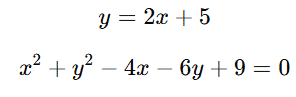
Solve the following system of equations (Linear and Quadratic) and find all real solutions (if any):
Source: Kapdec.com
Solution: –
Step 1: Understand the Problem
We are solving a system where:

Source: Kapdec.com

Source: Kapdec.com
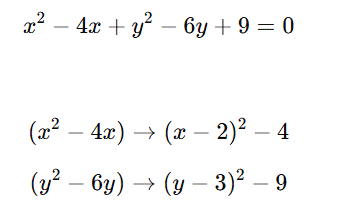
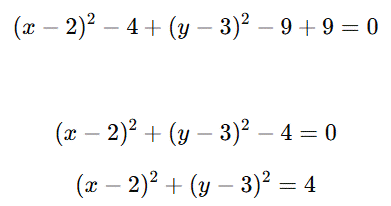
Step 2: Simplify the Quadratic Equation
Let’s complete the square for both xxx and yyy terms:
Source: Kapdec.com
Source: Kapdec.com
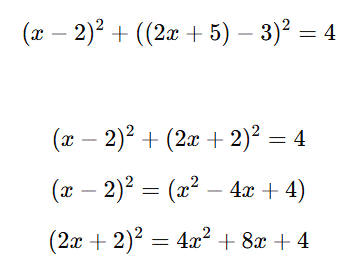
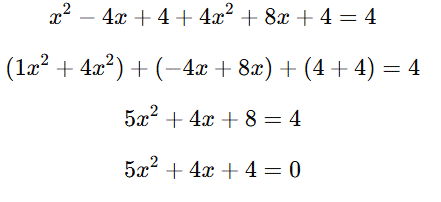
Step 3: Substitute Linear Equation into Quadratic
Source: Kapdec.com
Source: Kapdec.com
Final Answer:
There is no real solution to this system.
Here are five conclusive points: –
- Systems of Linear and Quadratic Equations represent simultaneous relationships
In many algebraic and real-world scenarios, we need to find solutions that satisfy both a linear and a quadratic condition at the same time. This combination results in a system of equations that requires careful solving. - Number of solutions depends on the graphical intersection
The solution to a linear-quadratic system depends on how the line and parabola intersect on a graph:
- Two solutions (line cuts parabola at two points)
- One solution (line is tangent to the parabola)
- No real solution (line does not touch the parabola at all)
- Algebraic methods (Substitution/Elimination) remain the primary tools for solving
The substitution method is commonly used where we substitute the linear equation into the quadratic equation and solve for the variable, reducing it to a quadratic equation in one variable. - Discriminant determines the nature of solutions before solving completely
By calculating the discriminant of the resulting quadratic equation, we can quickly predict the number and nature (real or imaginary) of the solutions before solving the equation. - Graphical understanding is critical for visualization and verification
Graphing both the linear and quadratic equations on the coordinate plane provides a visual way to understand the nature of the solutions, especially in word problems or modeling real-life situations.
Scan to visit this resource online
https://kapdec.com/resources/combining-quadratic-and-linear-equations
