KAPDEC® | Elite STEM Learning Platform | https://kapdec.com
Unit: Three-Dimensional Solids
Chapter: Cross-Sections
Reference: – Definition of Cross-Sections, Cross-Sections of Prisms, Cross-Sections of Pyramids, Cross-Sections of Cylinders, Cross-Sections of Cones, Cross-Sections of Spheres, Cross-Sections in Real-World Applications, Effect of Plane Orientation on Cross-Sections, Conic Sections from Three-Dimensional Figures, Cross-Sections in Volume and Surface Area Calculations
After studying this chapter, you should be able to understand:
- Definition of Cross-Sections & Cross-Sections of Prisms
- Cross-Sections of Pyramids, Cylinders, cones, Spheres
- Cross-Sections in Real-World Applications & Effect of Plane Orientation on Cross-Sections
- Cross-Sections in Volume and Surface Area Calculations
Definition of Cross-Sections
A cross-section is the shape obtained when a solid object is cut by a plane. The resulting shape depends on the plane’s orientation and position relative to the solid. Cross-sections help in understanding the internal structure of three-dimensional figures without physically altering them.
Cross-Sections of Prisms
A prism consists of two congruent bases connected by parallelogram faces. When a prism is cut parallel to its base, the cross-section is identical in shape to the base. A diagonal or vertical cut may produce different polygons, such as rectangles, parallelograms, or trapezoids, depending on the angle of the intersection.
Cross-Sections of Pyramids
A pyramid has a single base and triangular faces converging at a common vertex. A cross-section parallel to the base results in a smaller version of the base. If the plane cuts diagonally or perpendicularly through the pyramid, the resulting cross-section can take the form of a triangle, trapezoid, or other irregular shapes.
Cross-Sections of Cylinders
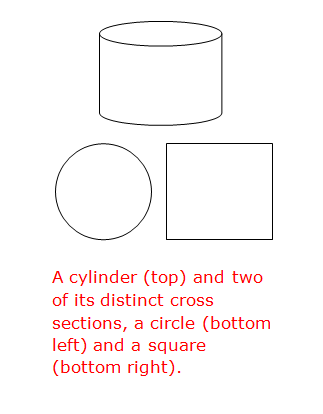
A cylinder consists of two circular bases and a curved surface. When a cylinder is cut parallel to its bases, the resulting cross-section is a circle. A vertical cut results in a rectangular cross-section, while an oblique cut can produce an elliptical cross-section, revealing the relationship between three-dimensional and two-dimensional geometry.
Cross-Sections of Cones
A cone has a circular base and a curved surface tapering to a single vertex. When sliced horizontally, the cross-section forms a circle. If the plane intersects the cone at an angle, the cross-section can form an ellipse. A vertical cut through the vertex produces a triangular cross-section, while other angles can create more complex conic sections.
Cross-Sections of Spheres
A sphere is a perfectly symmetrical three-dimensional object with no edges or vertices. Any plane cutting through a sphere result in a circular cross-section. The closer the plane is to the center, the larger the circle. When the plane passes through the sphere’s center, the cross-section represents the largest possible circle, also known as a great circle.
Cross-Sections in Real-World Applications
Cross-sections have extensive real-life applications in various fields. In medicine, cross-sections are used in MRI and CT scans to view internal structures of the human body. In engineering and architecture, cross-sectional analysis helps in designing stable structures, understanding material distribution, and ensuring precise measurements in construction and manufacturing.
Effect of Plane Orientation on Cross-Sections
The shape of a cross-section depends on the orientation of the plane used to cut the solid. A parallel plane produces uniform cross-sections, while an angled plane can result in more complex and irregular shapes. The direction of the plane’s intersection also influences how the cross-section relates to the original solid in terms of size and proportions.
Conic Sections from Three-Dimensional Figures
Conic sections are special types of cross-sections that result from slicing a cone at different angles. A horizontal cut results in a circular cross-section, an angled cut produces an elliptical cross-section, a tilted cut passing through one side creates a parabolic cross-section, and a cut passing through both sides forms a hyperbolic cross-section. These shapes have important mathematical properties and applications in physics, astronomy, and engineering.
Cross-Sections in Volume and Surface Area Calculations
Cross-sections provide insight into how volume and surface area are distributed within a three-dimensional shape. Understanding cross-sections is crucial in determining how much space an object occupies, how materials are distributed within a structure, and how slicing affects measurements. This concept is widely used in geometry, calculus, and real-world design applications.
Cross Sections
Source: Kapdec.com
Previously, we delved extensively into the world of zero- and one-dimensional geometric figures like points, lines, and rays. In this chapter, we’re going to jump straight to three-dimensional figures.
We are still going to extensively cover two-dimensional figures in later chapters. Three-dimensional figures depend in too complex a way or simply don’t depend on most of the properties we cover in later chapters, so it’s most appropriate to discuss them now.
In this lesson, we will use cross-sections to help get a deeper understanding of three-dimensional solids. We will extend this knowledge to surface area and volume in the other two lessons of this chapter.
Defining a Cross-Section
Imagine you had a block of cheese and you sliced it completely straight, trying to make as thin a slice as possible. The slice you would get would completely depend on the shape of the block of cheese. You could slice to get a standard piece of cheese, or you could slice it the long way to get an unusually large piece of cheese. However you go about it, you are obtaining a cross section.
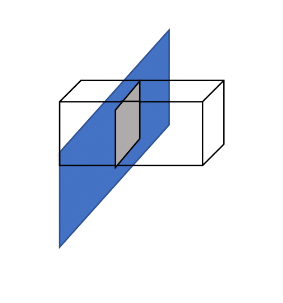
A cross-section is a two-dimensional figure created by the intersection of a plane and a three-dimensional solid.
Source: Kapdec.com
At the right is schematic of the cross section of a
rectangular prism and a plane. The blue plane
intersects the rectangular prism and creates the
Rectangular cross section in gray, which appears
as a parallelogram in the diagram simply because
of the angle at which we are viewing the
Rectangular prism.
Cross-Sections of Various Solids
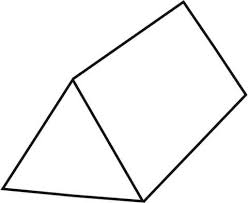
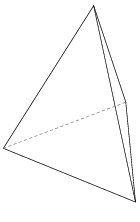
Below is a table that simply lists the vertical and horizontal cross sections of various solids we have dealt with before. There are three dimensions in which a plane can slice any three-dimensional solid, but in all the solids we will deal with, at least two of the dimensions have the same cross sections. Thus, for now, we will only deal with vertical and horizontal cross sections.
|
Solid Name |
Solid shape |
Vertical Cross Section |
Horizontal Cross Section |
|
Rectangular Prism |
|
Rectangle |
Rectangle |
|
Triangular Prism |
|
Triangle |
Rectangle |
|
Cylinder |
|
Circle |
Rectangle |
|
Sphere |
|
Circle |
Circle |
|
Triangular pyramid |
|
Triangle |
Triangle |
|
Rectangular Pyramid |
|
Triangle |
Rectangle |
|
Cone |
|
Triangle |
Circle |
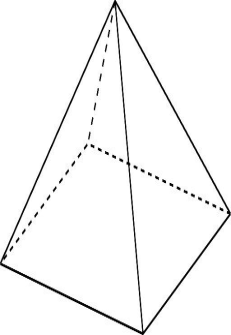
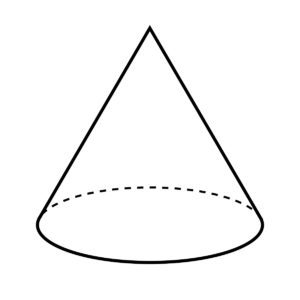
Source: Kapdec.com
Properties of Cross Sections
As you can see above, every single solid we have dealt with can be broken down into vertical and horizontal cross sections of triangles, circles, and rectangles. What significance does this carry?
Prisms and Rectangles
If your solid has a cross-section of a rectangle, it is a prism. Picture a two-dimensional shape translated through three-dimensional space, leaving a straight trail as it goes. This straight trail is considered a prism. Rectangular prisms, triangular prisms, and cylinders (which could be considered “circular prisms”) are all examples of prisms.
Circles
If your solid has a circular cross-section, it is created by the rotation about a line of symmetry of the cross section perpendicular to the circle. A sphere is created by the rotation of a circle, a cylinder is created by the rotation of a rectangle, and a cone is created by the rotation of a triangle. To visualize this, cut out any one of these three shapes, tie it to a string, and spin it very quickly. It should appear to take the form of one of those three three-dimensional solids.
Understanding Shapes Within Solids
Cross-sections provide a way to analyze the internal structure of three-dimensional objects by slicing them with a plane, helping to visualize and study different geometric properties.
Dependence on Plane Orientation
The shape of a cross-section is directly influenced by the angle and position of the slicing plane. A single solid can produce multiple different cross-sections depending on how it is cut.
Connection Between 2D and 3D Geometry
Cross-sections bridge the gap between two-dimensional and three-dimensional geometry, helping to understand how planar shapes exist within solid figures and their relationships in space.
Real-World Applications
Cross-sectional analysis is widely used in fields like engineering, architecture, medical imaging (CT scans, MRIs), and manufacturing, demonstrating its importance beyond theoretical geometry.
Foundation for Advanced Mathematics
The study of cross-sections prepares students for advanced mathematical concepts such as conic sections, volume integration in calculus, and applications in physics, reinforcing its significance in higher studies.
