KAPDEC® | Elite STEM Learning Platform | https://kapdec.com
Unit: Geometry
Chapter: Triangles: Concepts, Theorems, Similarity & Pythagorean Theorem
Reference: – Introduction to Triangles, Basic Properties and Types, Congruence of Triangles, Criteria for Congruence, Similarity of Triangles, Criteria for Similarity, Pythagoras Theorem and its Converse, Applications and Problem Solving
After studying this chapter, you should be able to understand:
- The fundamental properties and classifications of triangles.
- The concepts and criteria for triangle congruence.
- The principles and tests for triangle similarity.
- The Pythagorean Theorem and its applications.
Introduction to Triangles
Definition
A triangle is a closed two-dimensional geometric figure with three sides, three angles, and three vertices. It is one of the basic shapes in geometry, formed by connecting three non-collinear points.
The sum of the interior angles of a triangle is always 180 degrees.
[Importance of Triangles]
- Triangles are rigid structures, making them essential in construction and engineering.
- Form the building blocks for more complex polygons.
- Fundamental in trigonometry and coordinate geometry.
- Used in various real-world applications like bridges, roofs, and trusses.
Example
Triangle ABC: Has vertices A, B, C; sides AB, BC, CA; and angles ∠A, ∠B, ∠C.
[Subtopics]
1. Basic Elements
- Sides: The three line segments that form the triangle.
- Angles: The three angles formed at the vertices.
- Vertices: The points where two sides meet.
Key Points:
- The sum of the lengths of any two sides of a triangle is greater than the length of the third side (Triangle Inequality Theorem).
- The difference between the lengths of any two sides is less than the length of the third side.
2. Notation
Triangles are usually denoted by the symbol Δ followed by the vertices (e.g., ΔABC).
Basic Properties and Types
[Definition]
Triangles can be classified based on their sides and angles. Understanding these classifications helps in analysing their properties and solving problems.
[Importance of Classification]
- Different types have specific properties that can be used in proofs and calculations.
- Helps in identifying the appropriate theorems to apply.
- Essential for understanding congruence and similarity.
Examples
- Based on Sides:
- Scalene: All sides are of different lengths.
- Isosceles: Two sides are equal.
- Equilateral: All three sides are equal.
- Based on Angles:
- Acute: All angles are less than 90°.
- Right: One angle is exactly 90°.
- Obtuse: One angle is greater than 90°.
[Subtopics]
1. Angle-Side Relationships
- In any triangle, the side opposite the largest angle is the longest, and vice versa.
- In a right triangle, the side opposite the right angle is the hypotenuse (the longest side).
2. Special Lines in a Triangle
- Median: A line from a vertex to the midpoint of the opposite side.
- Altitude: A perpendicular from a vertex to the opposite side.
- Angle Bisector: A line that divides an angle into two equal parts.
Congruence of Triangles
[Definition]
Two triangles are said to be congruent if they have exactly the same shape and size. This means all corresponding sides and angles are equal. The symbol for congruence is ≅.
[Importance of Congruence]
- Used to prove equality of sides and angles in geometric figures.
- Essential for constructing triangles with given measures.
- Forms the basis for many geometric proofs.
Examples
- If ΔABC ≅ ΔDEF, then AB = DE, BC = EF, CA = FD, and ∠A = ∠D, ∠B = ∠E, ∠C = ∠F.
[Subtopics]
1. Conditions for Congruence
Two triangles are congruent if they satisfy any of the following criteria:
- SSS (Side-Side-Side): All three sides are equal.
- SAS (Side-Angle-Side): Two sides and the included angle are equal.
- ASA (Angle-Side-Angle): Two angles and the included side are equal.
- AAS (Angle-Angle-Side): Two angles and a non-included side are equal.
- RHS (Right-Hypotenuse-Side): In right triangles, the hypotenuse and one side are equal.
Criteria for Congruence
[Definition]
These are the minimum sets of conditions required to prove that two triangles are congruent. They ensure that the triangles are identical in all respects.
[Importance of Criteria]
- Provide logical shortcuts for proving congruence.
- Reduce the amount of information needed to establish equality.
- Fundamental for geometric constructions and proofs.
Examples
- Prove that two triangles are congruent using the SAS criterion.
[Subtopics]
1. Explanation of Criteria
- SSS: If the three sides of one triangle are equal to the three sides of another triangle, the triangles are congruent.
- SAS: If two sides and the included angle of one triangle are equal to two sides and the included angle of another triangle, the triangles are congruent.
- ASA: If two angles and the included side of one triangle are equal to two angles and the included side of another triangle, the triangles are congruent.
- AAS: If two angles and a non-included side of one triangle are equal to the corresponding parts of another triangle, the triangles are congruent.
- RHS: If the hypotenuse and one side of a right triangle are equal to the hypotenuse and one side of another right triangle, the triangles are congruent.
Similarity of Triangles
[Definition]
Two triangles are said to be similar if they have the same shape but not necessarily the same size. This means their corresponding angles are equal and their corresponding sides are proportional. The symbol for similarity is ~.
[Importance of Similarity]
- Used to solve problems involving proportional relationships.
- Essential in trigonometry for defining trigonometric ratios.
- Applied in map reading, model making, and shadow problems.
Examples
- If ΔABC ~ ΔDEF, then ∠A = ∠D, ∠B = ∠E, ∠C = ∠F, and AB/DE = BC/EF = CA/FD.
[Subtopics]
1. Conditions for Similarity
Two triangles are similar if they satisfy any of the following criteria:
- AAA (Angle-Angle-Angle): All corresponding angles are equal.
- SSS (Side-Side-Side): All corresponding sides are proportional.
- SAS (Side-Angle-Side): One angle is equal and the sides including the angle are proportional.
Criteria for Similarity
[Definition]
These are the minimum conditions required to prove that two triangles are similar. They ensure that the triangles have the same shape.
[Importance of Similarity Criteria]
- Simplify proofs involving proportional sides and equal angles.
- Used in theorems like Basic Proportionality Theorem (Thales’ Theorem).
- Essential for solving problems involving heights and distances.
Examples
- Prove that two triangles are similar using the AA criterion.
[Subtopics]
1. Explanation of Criteria
- AA (Angle-Angle): If two angles of one triangle are equal to two angles of another triangle, the triangles are similar. (The third angle is automatically equal.)
- SSS Similarity: If the corresponding sides of two triangles are proportional, the triangles are similar.
- SAS Similarity: If one angle of a triangle is equal to one angle of another triangle and the sides including these angles are proportional, the triangles are similar.
Pythagoras Theorem and its Converse
[Definition]
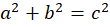
In a right-angled triangle, the square of the length of the hypotenuse (the side opposite the right angle) is equal to the sum of the squares of the lengths of the other two sides.
If a triangle has sides a, b, c with c as the hypotenuse, then:
Source: Kapdec.com
The converse is also true: If in a triangle, the square of one side is equal to the sum of the squares of the other two sides, then the triangle is right-angled.
[Importance of Pythagoras Theorem]
- Used to find the length of one side of a right triangle if the other two are known.
- Applied in distance problems, construction, and navigation.
- Forms the basis for the distance formula in coordinate geometry.
Examples
- Find the length of the hypotenuse in a right triangle with legs 3 cm and 4 cm.
[Subtopics]
1. Proof of Pythagoras Theorem
There are many proofs, including algebraic proofs and geometric proofs using area.
2. Applications
- Checking if a triangle is right-angled.
- Solving problems involving ladders, poles, and shadows.
Example Solution:
For legs 3 cm and 4 cm:
Hypotenuse² = 3² + 4² = 9 + 16 = 25
Hypotenuse = √25 = 5 cm.
Applications and Problem Solving
[Definition]
The concepts of congruence, similarity, and the Pythagorean theorem are combined to solve complex geometric problems. These can include proving statements, finding unknown lengths, or solving real-world problems.
Importance of Problem Solving
- Integrates multiple concepts for a comprehensive understanding.
- Develops logical reasoning and analytical skills.
- Prepares for advanced mathematics and practical applications.
Examples
- A ladder leans against a wall. If the foot of the ladder is 6 m from the wall and the ladder is 10 m long, how high does it reach on the wall?
[Subtopics]
1. Strategy for Problem Solving
- Draw a diagram.
- Identify known and unknown quantities.
- Determine which theorems or criteria apply.
- Set up equations or proportions.
- Solve and interpret the result.
[Example: -]
Problem Statement:
In a right triangle ABC, right-angled at B, BC = 6 cm and AB = 8 cm. A perpendicular BD is drawn from B to the hypotenuse AC.
a) Find the length of AC.
b) Prove that ΔADB ~ ΔABC.
c) Using similarity, find the length of BD.
Question: Solve parts (a) to (c). Prove your answers by providing step-by-step solutions and giving three independent reasons supporting your conclusion for part (b) from these domains: (A) Angle-Angle (AA) Criterion, (B) Proportionality of Sides, (C) Geometric Reasoning.
[Solution: -]
Given: Right triangle ABC, right-angled at B.
AB = 8 cm, BC = 6 cm. BD ⟂ AC.
a) Find the length of AC (the hypotenuse)
Using Pythagoras Theorem:

Source: Kapdec.com
,

Source: Kapdec.com
cm.
b) Prove that ΔADB ~ ΔABC
(A) Angle-Angle (AA) Criterion
- In ΔADB and ΔABC:
- ∠ADB = ∠ABC (Both are right angles, 90°)
- ∠BAD = ∠BAC (Common angle, ∠A)
- Since two angles of ΔADB are equal to two angles of ΔABC, the triangles are similar by the AA criterion.
Therefore, ΔADB ~ ΔABC.
(B) Proportionality of Sides
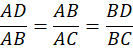
From the similarity stated in (A), the corresponding sides are proportional.
Source: Kapdec.com
We can use this proportionality to find unknown lengths, which is a direct consequence of the similarity.
(C) Geometric Reasoning
BD is the altitude to the hypotenuse of the right triangle ABC. A known geometric property is that the altitude to the hypotenuse divides the right triangle into two smaller triangles that are similar to the original triangle and to each other. This is a standard result derived using angle chasing, as done in (A).
c) Using similarity, find the length of BD
Since ΔADB ~ ΔABC, the ratio of corresponding sides is equal.
We use the ratio:

Source: Kapdec.com
Substitute the known values:

Source: Kapdec.com

Source: Kapdec.com
,

Source: Kapdec.com
cm.
Alternative method using area:
Area of ΔABC =

Source: Kapdec.com
cm².
Also, Area of ΔABC =

Source: Kapdec.com
.
So,

Source: Kapdec.com
=>

Source: Kapdec.com
cm. This verifies our answer.
Final Answers:
a) AC = 10 cm
b) ΔADB ~ ΔABC (proven by AA criterion)
c) BD = 4.8 cm
Because the similarity in part (b) was established using the independent logical steps of the AA criterion, the resulting side proportionality, and a known geometric property, the proof is rigorous. The calculation for BD is consistent using both similarity and the area method.
Scan to visit this resource online
https://kapdec.com/resources/triangles-concepts-theorems-similarity-pythagorean-theorem
