KAPDEC® | Elite STEM Learning Platform | https://kapdec.com
Unit: Quadratic Equations
Chapter: Square Root Methods, Nature of Roots
Reference: – Solving Quadratic Equations Using Square Roots, Understanding Perfect Square Trinomials, Applying the Principle of Square Roots, Working with Non-Perfect Square Roots, Interpreting the Discriminant, Classifying the Nature of Roots (Real, Imaginary, Rational, Irrational), Graphical Meaning of Roots, Real-life Applications of Square Root Method, Solving Equations with Complex Roots, Comparing Factoring and Square Root Methods, Simplifying Radicals in Solutions
After studying this chapter, you should be able to understand:
- Solving Quadratic Equations Using Square Roots
- Understanding Perfect Square Trinomials & Applying the Principle of Square Roots
- Classifying the Nature of Roots (Real, Imaginary, Rational, Irrational)
- Simplifying Radicals in Solutions
Here is the theoretical elaboration of each concept under “Square Root Methods, Nature of Roots”:
- Solving Quadratic Equations Using Square Roots
This approach involves isolating the squared variable on one side of the equation and then applying the square root to both sides. It is especially effective when the equation is in the form of a perfect square or can be rewritten into one. - Understanding Perfect Square Trinomials
These are specific quadratic expressions that can be factored into identical binomial expressions. Recognizing these helps in simplifying equations and directly applying square root methods. - Applying the Principle of Square Roots
This principle states that if a squared expression equals a number, then the original expression is equal to the positive or negative square root of that number. This forms the basis for solving certain quadratics. - Working with Non-Perfect Square Roots
In cases where the number under the square root is not a perfect square, the solution will involve irrational numbers. These expressions are simplified by factoring out perfect squares when possible. - Interpreting the Discriminant
The discriminant is the part of the quadratic formula under the square root. Its value determines the type of solutions a quadratic equation will have — whether real, repeated, irrational, or complex. - Classifying the Nature of Roots
The nature of a quadratic’s roots—real and distinct, real and equal, or complex—is determined by evaluating the discriminant. This helps understand the solution’s behavior without fully solving the equation. - Graphical Meaning of Roots
The roots of a quadratic function correspond to the x-intercepts of its graph. The number and type of roots affect whether the graph touches, crosses, or does not intersect the x-axis. - Real-life Applications of Square Root Method
This technique is useful in modeling real-world problems such as calculating distance, area, and physics-based scenarios, where the equation involves squaring of a variable. - Solving Equations with Complex Roots
When the discriminant is negative, the roots involve imaginary numbers. The square root method extends to complex numbers, requiring knowledge of imaginary units. - Comparing Factoring and Square Root Methods
Both methods solve quadratic equations but apply to different forms. Square root methods are more efficient when the equation is already a square, whereas factoring is useful when the expression can be broken into binomials. - Simplifying Radicals in Solutions
Solutions that include square roots may be simplified further by factoring and reducing the radical. This is essential for expressing the solution in its most reduced and meaningful form. - Determining Number of Solutions from Discriminant
By analysing the discriminant before solving, one can predict whether there will be two solutions, one repeated solution, or no real solution at all, streamlining the problem-solving process.
Example: –
Solve the equation using the square root method:
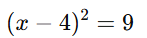
Source: Kapdec.com
Solution: –
Apply the square root to both sides:
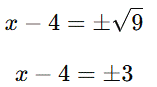
Source: Kapdec.com
Solve both cases:
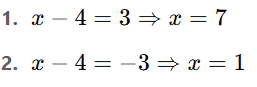
Source: Kapdec.com
Final Answer:
x=1 or x=7
Here are five conclusive insights for the chapter “Square Root Methods, Nature of Roots”:
- Square root methods are most effective when solving quadratics structured as perfect squares or easily transformable into such forms.
- The discriminant plays a central role in determining the type of roots, guiding whether solutions are real, repeated, irrational, or complex.
- Understanding the nature of roots helps in predicting the graph’s intersection with the x-axis and interpreting the function’s real-world implications.
- Mastery of simplifying radicals is key to expressing solutions in their most concise form.
- These techniques bridge algebraic solving with graphical understanding and applications across physics, geometry, and modeling.
