KAPDEC® | Elite STEM Learning Platform | https://kapdec.com
Unit: Energy
Chapter: Open and closed systems: Work and Energy
Reference: AP Physics Algebra, Energy, Open and closed systems, Closed system, Open system, Open and closed systems More examples, Isolated System, System’s Energy, Work and Energy, Work, Work Done by a Constant Force, Nature of Work Done, Notions of Work and Kinetic Energy, The Work-Energy Theorem, Energy, Kinetic Energy
After studying this chapter, you should be able to:
- know the whole concept of open and closed systems related to energy
- define work done by a force and give the unit of work;
- calculate the work done by an applied force;
- state work-energy theorem;
Open systems and closed systems are concepts commonly used in physics and engineering to describe how energy flows in and out of a system.
Closed system
A closed system is a physical system that doesn’t exchange any matter or energy with its surroundings. This means that the total energy of a closed system remains constant over time, according to the law of conservation of energy. Closed systems are often used in theoretical models to simplify calculations and make predictions about the behaviour of physical systems.
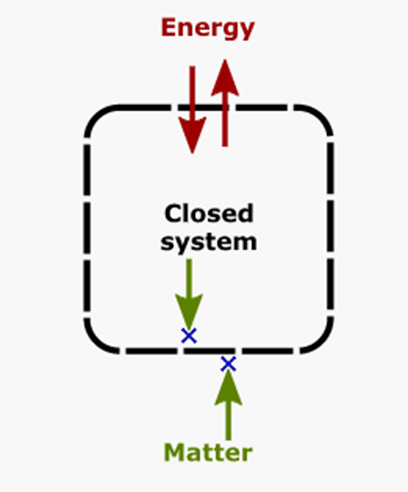
Source: Kapdec.com
An example of a closed system might be a sealed container of gas, where the gas molecules bounce off the walls of the container but don’t interact with anything outside of it. Another example might be a pendulum swinging back and forth, where the energy of the system remains constant as it swings between potential and kinetic energy.
Open system
An open system is a physical system that exchanges both matter and energy with its surroundings. Open systems are more common in the real world and can be found in many natural and technological processes. In an open system, energy can be transferred in or out of the system, and the total energy of the system can change over time.
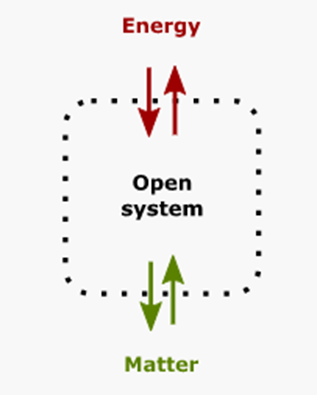
Source: Kapdec.com
An example of an open system might be a pot of boiling water on a stove, where heat is transferred from the stove to the water to increase its temperature and cause it to evaporate. The water and steam can also escape from the pot, representing a transfer of matter from the system to the surroundings.
In summary, closed systems do not exchange matter or energy with the surroundings and the total energy remains constant. Open systems, on the other hand, exchange both matter and energy with the surroundings, leading to changes in the system’s total energy over time.
Open and closed systems More examples
An example of an open system is a fertilized hen’s egg. The system is the chick embryo and shell, and the surroundings are the nest and the hen. Carbon dioxide passes out of the system, through the shell, and oxygen is taken up through the shell, to sustain the embryo’s metabolism. So, there is the exchange of mass between the system and the surroundings. Heat flows from the hen’s body, through the shell to the embryo, so there is also an exchange of energy, making this an open system.
An example of a closed system would be a stoppered beaker on a hot plate. Because the beaker (system) is stoppered, there is no exchange of mass between the system and the surroundings. Heat does flow from the hot plate, through the flask, to the system, so there is an exchange of energy. This is a closed system.
Isolated System
There is only one example of an isolated system, one in which there is no exchange of either energy or mass, and that is our Universe. Experimentally, it is impossible to set up an isolated system, but it is a theoretically interesting concept.
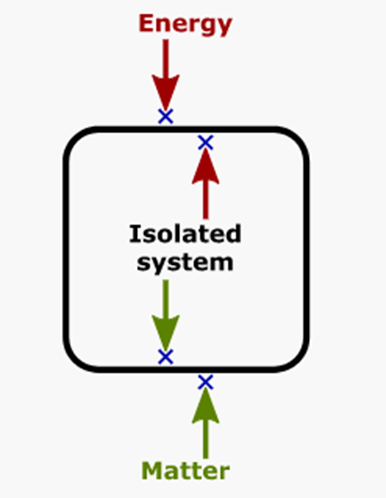
Source: Kapdec.com
We can set up a system in the lecture room, a sealed plastic bag containing a chunk of dry ice. The surroundings are the lab bench on which it is sitting, and a book placed on top of the bag. We will leave this system to evolve during the rest of the lecture.
System’s Energy:
When we talk about the energy in a system, we are referring to the Internal Energy of that system, which is given the symbol, E. The Internal Energy of a system is the sum of all of the kinetic and potential energies of the particles in that system:
E = K.E. + P.E.
Kinetic energy is the energy a body possesses due to its motion. Kinetic energy is described in the equation:
K.E. = 1/2 mv2
where m is the mass of the object and v is its velocity. Remember that Temperature is a measure of the average kinetic energy of the molecules in a system. This motion is called translational motion and involves random movement through space.
Potential energy is the energy that a body possesses due to its position relative to other bodies.
Work:
Work is said to be done when a force applied on the body displaces the body through a certain distance in the direction of the force.
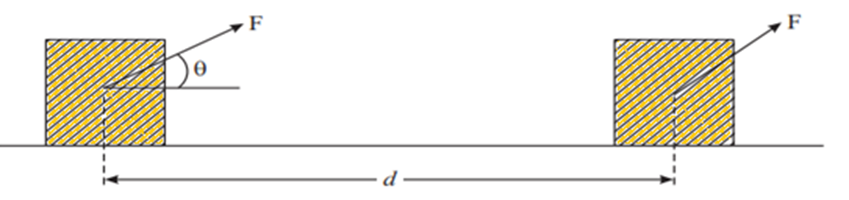
Let us suppose that a constant force F acting on an object results in displacement d i.e., moves it by a distance d along a straight line on a horizontal surface, as shown in Fig. given below. The work done by a force is the product of the magnitude of the force component in the direction of displacement and the displacement of this object.
Source: Kapdec.com
Fig: A force F on a block moves it by a horizontal distance d. The direction of force makes an angle θ with the horizontal direction
If force F is acting at angle θ with respect to the displacement d of the object, its component along d will be F cos θ. Then work done by force F is given by
W = F cosθ.d
In vector form, the work done is given by:
W = F. d
Note that if d = 0, W = 0. That is, no work is done by a force, whatever its magnitude, if there is no displacement of the object. Also note that though both force and displacement are vectors, work is a scalar.
Work Done by a Constant Force
Let a constant force F be applied on the body such that it makes an angle θ

Source: Kapdec.com
with the horizontal and body is displaced through a distance s. Then work done by the force in displacing the body through a distance s is given by
W = (F cos q) s = Fs cos q Þ W = (F cos q) s = Fs cos q
W =F

Source: Kapdec.com
. S

Source: Kapdec.com
Nature of Work Done
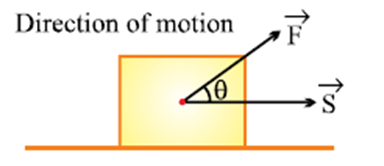
Positive work
Positive work means that force (or its component) is parallel to the displacement component)
0º £ q < 90º
Source: Kapdec.com
The positive work segments that the external force favours the motion of the body.
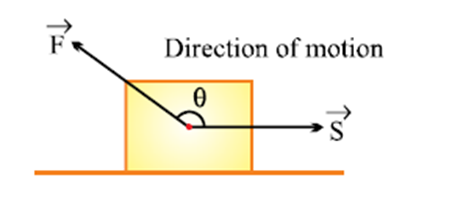
Negative work
Negative work means that force (or its component) is opposite to the displacement
i.e., 90º < q £ 180º
Source: Kapdec.com
The negative work segments that the external force opposes the motion of the body.
Notions Of Work and Kinetic Energy: The Work-Energy Theorem
The following relation for rectilinear motion under constant acceleration a has been encountered in Motion in straight line chapter,
v2 − u2 = 2 as
where u and v are the initial and final speeds and s the distance traversed. Multiplying both sides by m/2, we have
12

Source: Kapdec.com
mv2 − 12
Source: Kapdec.com
mu2 = mas = Fs
where the last step follows from Newton’s Second Law. We can generalise Eq. 12
Source: Kapdec.com
mv2 − 12
Source: Kapdec.com
mu2 = mas = Fs to three dimensions by employing vectors
v2 − u2 = 2 a.d
Here a and d are the acceleration and displacement vectors of the object respectively.
Once again multiplying both sides by m/2, we obtain
12
Source: Kapdec.com
mv2 − 12
Source: Kapdec.com
mu2 = m a.d = F.d
The above equation provides a motivation for the definitions of work and kinetic energy. The left side of the equation is the difference in the quantity ‘half the mass times the square of the speed’ from its initial value to its final value. We call each of these quantities the ‘kinetic energy’, denoted by K. The right side is a product of the displacement and the component of the force along the displacement. This quantity is called ‘work’ and is denoted by W. Eq. 12
Source: Kapdec.com
mv2 − 12
Source: Kapdec.com
mu2 = mas = Fs is then
K¦ − Ki = W
where Ki and K¦ are respectively the initial and final kinetic energies of the object. Work refers to the force and the displacement over which it acts. Work is done by a force on the body over a certain displacement.
Equation 12
Source: Kapdec.com
mv2 − 12
Source: Kapdec.com
mu2 = mas = Fs is also a special case of the work-energy (WE) theorem: The change in kinetic energy of a particle is equal to the work done on it by the net force. We shall generalise the above derivation to a varying force in a later section.
Energy:
The energy of a body is defined as its capacity for doing work.
(1) It is a scalar quantity.
(2) Dimension: [ML2T2] it is the same as that of work or torque.
(3) Units: Joule [S.I.], erg [C.G.S.]
Practical units: electron volt (eV), Kilowatt hour (KWh), Calories (Cal)
Relation between different units:
1 Joule = 107 erg
1 eV = 1.6 × 10⁻¹⁹ Joule
1 KWh = 3.6 × 10⁶ Joule
1 Calorie = 4.18 Joule
(4) Mass energy equivalence: The relation between the mass of a particle
m and its equivalent energy is given as E = mc2
Where c = velocity of light in vacuum.
Kinetic Energy:
The energy possessed by a body by virtue of its motion is called kinetic
energy.
Let m = mass of the body, v = velocity of the body then
K.E. = 12

Source: Kapdec.com
mv2
(1) Kinetic energy depends on frame of reference:
The kinetic energy of a person of mass m, sitting in a train moving with speed v, is zero in the frame of train but 12
Source: Kapdec.com
mv2 in the frame of the earth.
(2) Work-energy theorem: It states that work done by a force acting on a body is equal to the change produced in the kinetic energy of the body.
This theorem is valid for a system in presence of all types of forces
(external or internal, conservative or non-conservative).
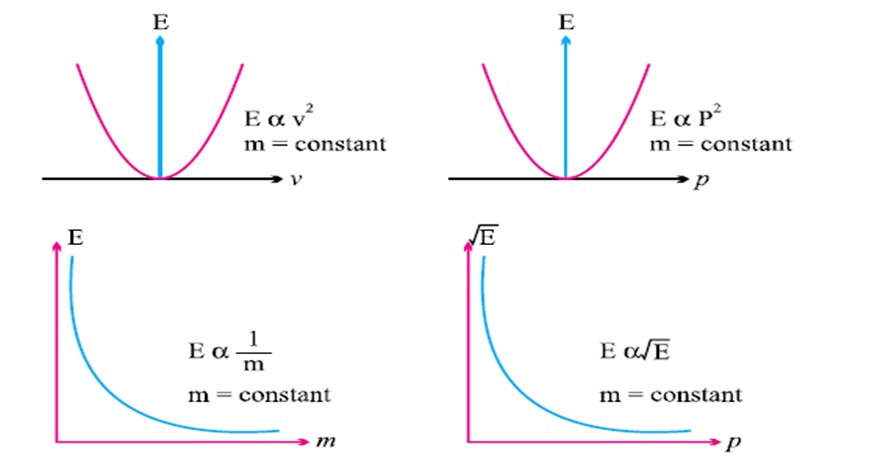
(3) Relation of kinetic energy with linear momentum: As we know
Momentum P =2EV

Source: Kapdec.com
2m/E
(4) Various graphs of kinetic energy
Source: Kapdec.com
Example 1: A body of mass 10 kg is initially moving with a speed of 4.0 m s–1. A force of 30 N is now applied to the body for 2 seconds.
(i) What is the final speed of the body after 2 seconds?
(ii) How much work has been done during this period?
(iii) What is the initial kinetic energy?
(iv) What is the final kinetic energy?
(v) What is the distance covered during this period?
(vi) Show that the work done is equal to the change in kinetic energy?
Solution:
(i) Force (F) = ma or a = F/m = 30/10 = 3 m s– ²
The final speed v2 = v1 + at = 4 + (3 × 2) = 10 m s–1
(ii) The distance covered in 2 seconds:
s = ut + 12
Source: Kapdec.com
at²
= (4×2) + 12
Source: Kapdec.com
(3×4)
= 8 +6 = 14 m
Work done W = F × S = 30 × 14 = 420 J
(iii) The initial Kinetic Energy K1 = 12
Source: Kapdec.com
mv12 = 12
Source: Kapdec.com
(10 ×16) = 80 J
(iv) The final kinetic energy K2 = 12
Source: Kapdec.com
mv22 = 12
Source: Kapdec.com
(10 ×100) = 500 J
(v) The distance covered as calculated above = 14m
(vi) The change in kinetic energy is: K2 – K1 = (500 – 80) = 420 J As may be seen, this is same as wok done
Key Points:
Open and closed systems refer to two different types of physical systems that can exchange energy with their surroundings. Here are some key points about each:
Open Systems:
- An open system is a system that can exchange both matter and energy with its surroundings.
- Examples of open systems include living organisms, ecosystems, and most industrial processes.
- Open systems can receive input of energy and matter from their surroundings and output energy and matter to their surroundings.
- Open systems are characterized by a flow of energy and matter through their boundaries.
- Open systems tend to be more complex and dynamic than closed systems.
Closed Systems:
- A closed system is a system that can exchange energy but not matter with its surroundings.
- Examples of closed systems include a sealed jar, a piston-cylinder assembly, or the universe.
- Closed systems are characterized by a fixed amount of matter and a flow of energy through their boundaries.
- Closed systems are subject to the laws of thermodynamics, which describe how energy is conserved and transferred in the system.
- In a closed system, energy can be transformed from one form to another, but the total amount of energy in the system remains constant.
- Work is the transfer of energy from one object to another. When a force acts on an object and causes it to move, work is said to be done on the object.
- The unit of work is the joule (J), which is defined as the amount of energy transferred when a force of one newton (N) acts over a distance of one meter (m).
- Energy is the ability of an object to do work. There are different forms of energy, such as kinetic energy, potential energy, thermal energy, chemical energy, and electromagnetic energy.
- Kinetic energy is the energy an object possesses due to its motion. The formula for kinetic energy is KE = 0.5mv2, where m is the mass of the object and v is its velocity.
- Potential energy is the energy an object possesses due to its position or state. There are different types of potential energy, such as gravitational potential energy, elastic potential energy, and electric potential energy.
- The conservation of energy principle states that energy cannot be created or destroyed, but it can be converted from one form to another.
- The work-energy principle relates the work done on an object to its change in kinetic energy. It states that the net work done on an object is equal to the change in its kinetic energy: Wnet = ΔKE.
- Power is the rate at which work is done. It is defined as the amount of work done per unit of time. The unit of power is watt (W), which is defined as one joule per second.
- Mechanical advantage is a measure of the effectiveness of a simple machine, such as a lever or pulley. It is defined as the ratio of the output force to the input force.
- Work and energy are fundamental concepts in physics and have numerous applications in everyday life, such as in the design of machines, the generation of electricity, and the study of motion and forces.
- The work-energy theorem explains the idea that the network – the total work done by all the forces combined – done on an object is equal to the change in the kinetic energy of the object. After the net force is removed (no more work is being done) the object’s total energy is altered as a result of the work that was done.
- The energy possessed by a body by virtue of its motion is called kinetic energy.
- Let m = mass of the body, v = velocity of the body
