KAPDEC® | Elite STEM Learning Platform | https://kapdec.com
Unit: Trigonometric & Polar Functions
Chapter: Solving with Waves: Sinusoidal Models & Equations
Reference: – Introduction, Periodic functions, Amplitude & Midline, Graph of Sinusoidal functions, Trigonometric Equations, Phase shift, Frequency & Angular Velocity, Trigonometric functions of Angles, Inverse Trigonometric equations, Modelling, Polar Functions. Identities, Graphical Functions
After studying this chapter, you should be able to:
- Introduction to Sinusoidal Function & Periodic Functions
- Amplitude, Midline & Graph of Sinusoidal functions
- Inverse Trigonometric Equations & Polar Functions
Introduction to Sinusoidal & Periodic Functions
- Periodicity: Sinusoidal waves exhibit periodic behavior, meaning they repeat their pattern over regular intervals. The period is the distance between two consecutive repetitions of the wave’s pattern. In calculus, understanding the concept of periodicity is crucial for analyzing and graphing sinusoidal functions.
- Amplitude: The amplitude of a sinusoidal wave represents the maximum displacement from the midline. It is the vertical distance between the peak and the trough of the wave. Amplitude affects the height of the wave and can be used to determine the range of values the wave can attain.
- Midline: The midline of a sinusoidal wave is a horizontal line that the wave oscillates around. It represents the average value of the wave and is equidistant from the peak and the trough. Understanding the midline is essential for graphing sinusoidal functions accurately.
- Frequency: Frequency measures the number of cycles or repetitions of a sinusoidal wave that occur per unit of time. It is inversely proportional to the period of the wave, meaning a higher frequency corresponds to a shorter period. Frequency is often measured in hertz (Hz) and is crucial in analyzing wave behavior.
- Trigonometric Equations: Trigonometric equations involve trigonometric functions like sine and cosine. These equations can be used to model various real-world phenomena, such as oscillations, vibrations, and periodic motion. Solving trigonometric equations involves applying trigonometric identities, manipulating equations, and utilizing the properties of periodic functions.
Amplitude & Midline
- Amplitude: In AP Calculus, amplitude refers to the maximum distance between the graph of a function and its midline. For sinusoidal functions, such as sine and cosine, the amplitude represents the vertical extent of the oscillation or wave. It measures the distance from the midline to the highest or lowest point of the wave. Amplitude is always a positive value.
- Midline: The midline is a horizontal line around which a sinusoidal function oscillates. It represents the average or equilibrium position of the function. The midline is equidistant from the maximum and minimum points of the wave. It is used as a reference line when graphing and analyzing sinusoidal functions.
- Effects on Graphs: The amplitude affects the vertical scaling of the graph. A larger amplitude stretches the graph vertically, while a smaller amplitude compresses it. The midline, on the other hand, determines the vertical shift of the graph. Shifting the midline upward or downward changes the position of the wave without affecting its shape.
- Graphing Amplitude: To graph a sinusoidal function with a given amplitude, determine the distance between the midline and the maximum or minimum point. This distance represents the amplitude. From the midline, go up by the amplitude to locate the maximum point and go down by the amplitude to locate the minimum point.
- Graphing Midline: To graph a sinusoidal function with a given midline, draw a horizontal line at the level of the midline. The wave oscillates above and below this line. The midline determines the vertical shift of the wave, and any changes to the midline will result in a corresponding shift of the entire graph.
- Applications: Understanding amplitude and midline is crucial for modeling various real-world phenomena using sinusoidal functions. For example, in physics, amplitude represents the maximum displacement of an oscillating object, while the midline may indicate the equilibrium position. In engineering and signal processing, knowledge of amplitude and midline helps analyze and manipulate signals accurately.
Sign of trigonometric functions:
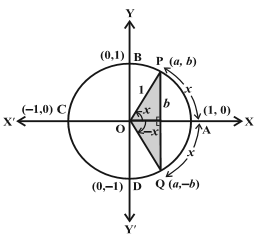
Let P (a, b) be a point on the unit circle with centre at the origin such
that ÐAOP = x. If ÐAOQ = – x, then the coordinates of the point Q will be (a, –b). Therefore
cos (– x) = cos x
and sin (– x) = – sin x
Source: Kapdec.com
Since for every point P (a, b) on the unit circle, – 1 £a £1 and
– 1 £b £1, we have – 1 £cos x £1 and –1 £sin x £1 for all x. We have learnt in previous classes that in the first quadrant (0 <x <

Source: Kapdec.com
) a and b are both positive, in the second quadrant (

Source: Kapdec.com
<x <p) a is negative and b is positive, in the third quadrant (p<x <

Source: Kapdec.com
) a and b are both negative and in the fourth quadrant (

Source: Kapdec.com
<x < 2p) a is positive and b is negative.
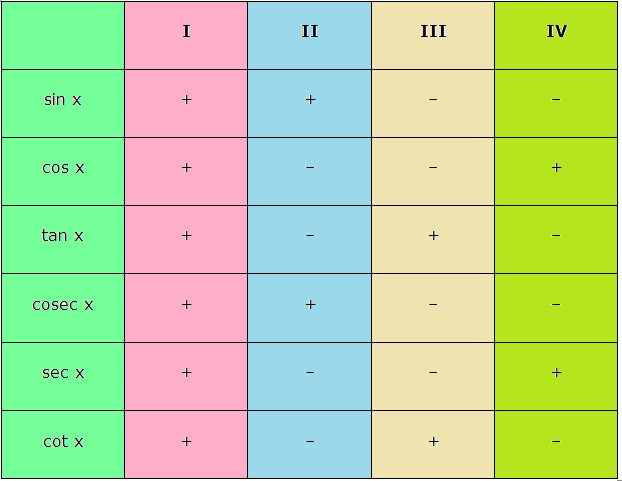
Therefore, sin x is positive for 0 <x <p, and negative for p<x < 2p. Similarly, cos x is positive for 0 <x <p2 , negative for p2 < x <3p2 and also positive for 3p2 <x < 2p. Likewise, we can find the signs of other trigonometric functions in different quadrants. In fact, we have the following table.
Source: Kapdec.com
Graph of Sinusoidal Functions
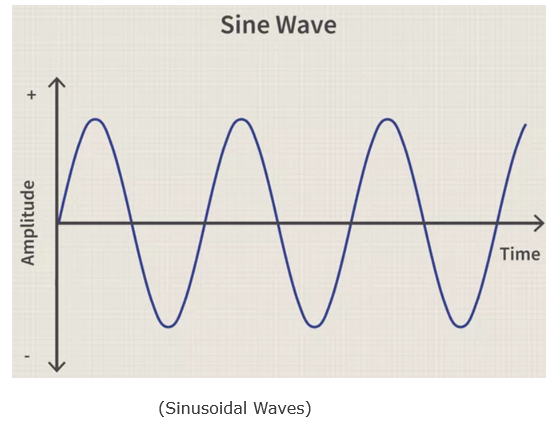
Period: The period of a sinusoidal function represents the length of one complete cycle of the graph. It is the horizontal distance between two consecutive peaks or two consecutive troughs. The period is denoted by the symbol T and is related to the frequency of the function.
Amplitude: The amplitude of a sinusoidal function represents the maximum displacement from the midline. It is the vertical distance between the peak or trough and the midline. The amplitude is always a positive value and determines the vertical scaling of the graph.
Midline: The midline of a sinusoidal function is a horizontal line about which the graph oscillates. It represents the average value of the function and is equidistant from the peak and the trough. The midline can be shifted vertically by adding or subtracting a constant value.
Phase Shift: A phase shift refers to a horizontal translation or shift of the graph of a sinusoidal function. It occurs when there is a change in the starting point of the graph relative to its usual position. A positive phase shift moves the graph to the right, while a negative phase shift moves it to the left.
Graphing Techniques: To graph a sinusoidal function, start with the basic shape of the function (usually sine or cosine) and consider the amplitude, period, midline, and phase shift. Identify key points such as the maximum and minimum values, as well as the x-values at which the function crosses the midline. Plot these points and sketch the graph, making sure to maintain the correct shape, amplitude, period, and any shifts.
Source: Kapdec.com
Example: Consider the sinusoidal function f(x) = 3sin(2x – π/4) + 2. Find the amplitude, period, midline, and any phase shift. Also, determine the solutions to the equation f(x) = 4.
Solution:
Amplitude: The amplitude of the function is the coefficient of the sine function, which is 3 in this case. So, the amplitude is 3.
Period: The period of a sine function is given by 2π divided by the coefficient of x inside the sine function. In this case, the coefficient is 2. Therefore, the period is (2π)/2 = π.
Midline: The midline is the constant term added to the sine function, which is 2 in this case. So, the midline is y = 2.
Phase Shift: To determine the phase shift, set the argument of the sine function (2x – π/4) equal to zero and solve for x:
2x – π/4 = 0
2x = π/4
x = π/8
Therefore, the phase shift is π/8 to the right.
Solving the Equation: Set f(x) equal to 4 and solve for x:
3sin(2x – π/4) + 2 = 4
3sin(2x – π/4) = 2
Divide both sides by 3:
sin(2x – π/4) = 2/3
To solve for x, take the inverse sine of both sides:
2x – π/4 = arcsin(2/3)
Now, solve for x:
2x = arcsin(2/3) + π/4
x = (arcsin(2/3) + π/4)/2
This expression gives the solutions to the equation f(x) = 4.
In summary, for the given sinusoidal function f(x) = 3sin(2x – π/4) + 2, the amplitude is 3, the period is π, the midline is y = 2, and there is a phase shift of π/8 to the right. The solutions to the equation f(x) = 4 are given by x = (arcsin(2/3) + π/4)/2.
Key Points
- Sinusoidal Function: A sinusoidal function is a function that can be represented by a sine or cosine curve. It exhibits periodic behavior and is commonly used to model phenomena that repeat over time.
- Amplitude: The amplitude of a sinusoidal function represents the maximum displacement from the midline. It is a positive value that determines the vertical scaling of the graph.
- Period: The period of a sinusoidal function is the length of one complete cycle of the graph. It is the horizontal distance between two consecutive peaks or troughs.
- Frequency: Frequency is the number of cycles or repetitions of a sinusoidal function that occur per unit of time. It is the reciprocal of the period and is measured in hertz (Hz).
- Midline: The midline of a sinusoidal function is a horizontal line about which the graph oscillates. It represents the average or equilibrium position of the function.
- Phase Shift: A phase shift is a horizontal translation or shift of the graph of a sinusoidal function. It occurs when there is a change in the starting point of the graph relative to its usual position.
- Trigonometric Equations: Trigonometric equations involve trigonometric functions, such as sine, cosine, and tangent. Solving these equations involves finding the values of the variable that satisfy the equation.
- Trigonometric Identities: Trigonometric identities are equations that are true for all values of the variables in the domain of the functions involved. They are used to simplify and manipulate trigonometric expressions and equations.
- Pythagorean Identities: Pythagorean identities are a set of trigonometric identities that relate the trigonometric functions squared to each other. Examples include sin²θ + cos²θ = 1 and 1 + tan²θ = sec²θ.
- Sum and Difference Identities: Sum and difference identities are trigonometric identities that express the sine, cosine, and tangent of the sum or difference of two angles in terms of the sine, cosine, and tangent of the individual angles.
- Double-Angle Identities: Double-angle identities are trigonometric identities that express the sine, cosine, and tangent of twice an angle in terms of the sine, cosine, and tangent of the original angle.
- Solving Trigonometric Equations: Solving trigonometric equations involves finding the values of the variable that make the equation true. This can be done by applying trigonometric identities, manipulating equations, and using algebraic techniques.
- Unit Circle: The unit circle is a circle with a radius of 1 centered at the origin in the coordinate plane. It is used to define trigonometric functions and to determine the values of trigonometric functions for various angles.
- Inverse Trigonometric Functions: Inverse trigonometric functions, such as arcsine, arccosine, and arctangent, are used to find the angle whose trigonometric function value is known. They allow us to solve equations involving trigonometric functions.
- Applications: Sinusoidal functions and trigonometric equations have numerous applications in various fields such as physics, engineering, signal processing, and wave analysis. They are used to model periodic phenomena, analyze wave behavior, and solve real-world problems.
Scan to visit this resource online
https://kapdec.com/resources/solving-with-waves-sinusoidal-models-equations
