KAPDEC® | Elite STEM Learning Platform | https://kapdec.com
Unit : – CIRCLES
Chapter: – Degrees & Radians
What students will learn in this Section
In the section on Degrees & Radians for SAT Trigonometry, students will learn to understand and convert between degrees and radians, the two primary units for measuring angles. They will explore the relationship between these units and practice converting angles from one unit to the other. Additionally, students will delve into the unit circle, using it to define angles in radians and understand their geometric interpretation.
This includes recognizing key angles and their corresponding coordinates on the unit circle. They will also learn to apply these concepts to solve problems involving angular measurements, trigonometric functions, and their applications. Mastering these skills will enable students to accurately interpret and manipulate angles in various mathematical and real-world contexts on the SAT.
Important Definitions:
- Circle:
- A set of points in a plane equidistant from a fixed center point.
- Radius:
- The distance from the center of a circle to any point on its circumference.
- Diameter:
- A line segment passing through the center, connecting two points on the circle.
- Circumference:
- The total length of the boundary of a circle.
- Area of a Circle:
- The space enclosed by the circle.
- Arc:
- A portion of the circle’s circumference.
- Sector:
- The region enclosed by an arc and two radii.
- Degrees:
- A unit of measurement for angles.
- Radians:
- Another unit of angle measurement, often used in trigonometry.
- Central Angle:
- An angle whose vertex is at the center of the circle.
- Tangent Line:
- A line that intersects the circle at exactly one point.
- Secant Line:
- A line that intersects the circle at two points.
Important Formulae:
- Circumference of a Circle (C): C=2πr where r is the radius.
- Area of a Circle (A): A=πr2 where r is the radius.
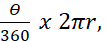
- Arc Length (s): s=
Source: Kapdec.com
where ϴ is the central angle in degrees.
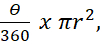
- Area of a Sector (Asector): Asector= ,
Source: Kapdec.com
where ϴ is the central angle in degrees.
- Inscribed Angle Theorem:
- The measure of an inscribed angle is equal to half the measure of its intercepted arc.
- Tangent Line Theorem:
- A tangent line is perpendicular to the radius at the point of tangency.
- Law of Cosines for Triangles (Inscribed Angle): c2=a2+b2−2abcos(C) where a, b, and c are sides of a triangle, and C is the angle opposite side c.
Speed Strategy
- Memorize Key Formulas:
- Memorize essential formulas to reduce the time spent looking them up. This includes formulas for Area, sector Angles, Tangent line equation, and other geometrical measures.
- Practice Formula Rearrangement:
- Familiarize yourself with rearranging formulas. This skill allows you to quickly solve for different variables without having to derive the entire formula.
- Use Pre-calculated Constants:
- Pre-calculate constants or values that frequently appear in formulas. For example, memorize common Z-scores or values associated with circles & Angles.
