KAPDEC® | Elite STEM Learning Platform | https://kapdec.com
Unit: Thermodynamics
Chapter: Thermodynamic Systems and Ideal Gas Law
Reference: AP Physics Algebra, Thermodynamics, Thermodynamic Systems and Ideal Gas Law, Thermodynamic Terms, Pressure, Zeroth Law of Thermodynamics, Thermal equilibrium, Triple Point of Water, Thermodynamic Process, Ideal Gas Equation
After studying this chapter, you should be able to know,
- Thermodynamic system
- Thermal equilibrium
- Zeroth law of thermodynamics
- The first law of thermodynamics
- Ideal Gas laws
Thermodynamic Terms
(i) Thermodynamic system: A thermodynamic system refers to a definite quantity of matter which is considered unique and separated from everything else, which can influence it. Every system is enclosed by an arbitrary surface, which is called its boundary. The boundary may enclose a solid, a liquid or a gas. It may be real or imaginary, either at rest or in motion and may change its size and shape. The region of space outside the boundary of a system constitutes its surroundings.
(a) Open System: It is a system which can exchange mass and energy
with the surroundings. A water heater is an open system.
(b) Closed system: It is a system which can exchange energy but not mass with the surroundings. A gas enclosed in a cylinder fitted with a piston is a closed system.
(c) Isolated system: It is a system which can exchange neither mass nor energy with the surrounding. A filled thermos flank is an ideal example of an isolated system.
(ii) Thermodynamic Variables or Coordinates:
To describe a thermodynamic system, we use its physical properties such on temperature (T), pressure (P), and volume (V). These are called
thermodynamic variables.
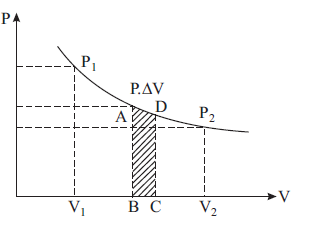
(iii) Indicator diagram:. To study a thermodynamic system, we use a pressure-volume graph. This graph indicates how the pressure (P) of a system varies with its volume (V) during a thermodynamic process and is known as an indicator diagram.
The indicator diagram can be used to obtain an expression for the work done. It is equal to the area under the P-V diagram (Fig. given below). Suppose that pressure is P at the start of a very small expansion ΔV. Then, work done by the system.
ΔW = P ΔV = Area of a shaded strip ABCD
Source: Kapdec.com
Pressure:
Thermodynamic pressure is the concept of physics that studies the relation between temperature, heat, energy and work in a system. Thermodynamics pressure represents the total energy present in the fluid that constitutes the pressure head.
PV = nRT is the formula for thermodynamics pressure. Here, R is the universal gas constant. The other values are pressure (P), volume (V), temperature (T) or the number of molecules (n) under an ideal thermodynamic condition.
Zeroth Law of Thermodynamics:
If two bodies or systems A and B are separately in thermal equilibrium with a third body C, then A and B are in thermal equilibrium with each other.
Thermal equilibrium:
A thermodynamic system is said to exist in a state of thermodynamic equilibrium when no change in any macroscopic property is registered if the system is isolated from its surroundings.
An isolated system always reaches in the course of time a state of thermodynamic equilibrium and can never depart from it spontaneously.
Therefore, there can be no spontaneous change in any macroscopic property if the system exists in an equilibrium state. A thermodynamic system will be in a state of thermodynamic equilibrium if the system is a state of Mechanical equilibrium, Chemical equilibrium and Thermal equilibrium.
- Mechanical equilibrium: The criteria for Mechanical equilibrium are the equality of pressures.
- Chemical equilibrium: The criteria for Chemical equilibrium are the equality of chemical potentials.
- Thermal equilibrium: The criterion for Thermal equilibrium is the equality of temperatures.
Triple Point of Water
The triple point of a pure substance is a very stable state signified by precisely constant temperature and pressure values. For this reason, in Kelvin’s scale of thermometry, the triple point of water is taken as the upper fixed point. On increasing pressure, the melting point of a solid decreases and the boiling point of the liquid increases. It is possible that by adjusting temperature and pressure, we can obtain all three states of matter to co-exist simultaneously. These values of temperature and pressure signify the triple point.
Thermodynamic Process
- If any of the thermodynamic variables of a system change while going from one equilibrium state to another, the system is said to execute a thermodynamic process.
- For example, the expansion of a gas in a cylinder at constant pressure due to heating is a thermodynamic process. A graphical representation of a thermodynamic process is called a path.
(i) Reversible process: If a process is executed so that all intermediate stages between the initial and final states are equilibrium states and the process can be executed back along the same equilibrium states from its final state to its initial state, it is called reversible process. A reversible process is executed very slowly and in a controlled manner.
(ii) Irreversible process: A process which cannot be retraced along the same equilibrium state from the final to the initial state is called an irreversible process. The all-natural process is irreversible.
(iii) Isothermal process: A thermodynamic process that occurs at constant temperature is an isothermal process. The expansion and compression of a perfect gas in a cylinder made of perfectly conducting walls are isothermal processes. The change in pressure or volume is carried out very slowly so that any heat developed is transferred into the surroundings and the temperature of the system remains constant. The thermal equilibrium is always maintained. In such a process, ΔQ, ΔU and ΔW are finite.
(iv) Adiabatic process: A thermodynamic process in which no exchange of thermal energy occurs is an adiabatic process. For example, the expansion and compression of a perfect gas in a cylinder made of perfect insulating walls. The system is isolated from the surroundings. Neither any amount of
heat leaves the system nor enters it from the surroundings. In this process,
therefore ΔQ = 0 and ΔU = –ΔW.
The change in the internal energy of the system is equal to the work done on
the system. When the gas is compressed, work is done on the system. So,
ΔU becomes positive and the internal energy of the system increases. When
the gas expands, work is done by the system. It is taken as positive and ΔU becomes negative. The internal energy of the system decreases.
(v) Isobaric process: A thermodynamic process that occurs at constant pressure is an isobaric process. The heating of water under atmospheric pressure is an isobaric process.
(vi) Isochoric process: A thermodynamic process that occurs at constant volume is an isochoric process. For example, the heating of a gas in a vessel of constant volume is an isochoric process. In this process, the volume of the gas remains constant so that no work is done, i.e., ΔW = 0. We, therefore, get ΔQ = ΔU.
In a Cyclic Process, the system returns back to its initial state. It means that there is no change in the internal energy of the system. ΔU = 0.
∴ ΔQ = ΔW.
The relation between three properties of a gas i.e., pressure, volume and temperature are called the ideal gas equation. You will learn more about the properties of gases in chemistry. Using absolute temperatures, the gas laws can be stated as given below.
Charles’ law: Charles’ law can be stated as the volume of a fixed mass of gas is directly proportional to its absolute temperature if the pressure is kept constant.
PV = constant
Combining the above three equations, we get
∴ PVT

Source: Kapdec.com
= constant
For one mole of a gas, the constant of proportionality is written as R
∴ PVT

Source: Kapdec.com
= R or PV = RT
If the given mass of a gas consists of n moles, then Eq. (PV = RT) can be written as
PV= nRT
This relation is called the ideal gas equation. The value of constant R is the same for all gases.
Therefore, it is known as the universal gas constant. Its numerical value is 8.31 J K-1 mol-1.
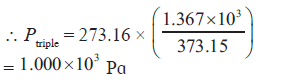
Example: The pressure reading in a thermometer at the steam point is 1.367 × 10³ Pa. What is the pressure reading at the triple point knowing the linear relationship between temperature and pressure?
Solution: We have Ptriple = 273.16 × PT

Source: Kapdec.com
Where,
Ptriple and P are the pressures at the temperature of triple point (273.16 K) and T respectively. We are given that P = 1.367×10³ Pa at steam point i.e., at 273.15 + 100 = 373.15 K.
Source: Kapdec.com
- Key points:
- If two bodies or systems A and B are separately in thermal equilibrium with a third body C, then A and B are in thermal equilibrium with each other.
- The total kinetic energy of the molecules constitutes the internal kinetic energy of the body.
- Two systems at different temperatures are put in thermal contact and Mechanical rubbing between two systems. In both cases, change in their temperatures occurs but it cannot be explained by the Zeroth law. To explain such processes, the first law of thermodynamics was postulated.
- The first law of thermodynamics is, in fact, the law of conservation of energy for a thermodynamic system. It states that the change in the internal energy of a system during a thermodynamic process is equal to the sum of the heat given to it and the work done on it.
- The ideal gas equation is PV = nRT, where P is the pressure of the gas, V is the volume of the gas, n is the number of moles of gas, R is the gas constant, and T is the temperature of the gas.
- The equation assumes that the gas is an ideal gas, which means that its particles have no volume, there are no intermolecular forces between particles, and the collisions between particles are perfectly elastic.
- The gas constant, R, has a value of 8.314 J/(mol*K) in SI units, where J is the joule, mol is the mole, and K is the Kelvin.
- The ideal gas equation can be used to calculate the pressure, volume, temperature, or amount of gas in a system, as long as the other three variables are known.
- The ideal gas equation is only valid for ideal gases, which do not exist in the real world. However, it is a good approximation for many gases under normal conditions.
- The ideal gas equation can be derived from the kinetic theory of gases, which relates the macroscopic properties of gases to the behaviour of their individual particles.
- The ideal gas equation is often used in engineering and science to model the behaviour of gases in various systems, such as in combustion engines, refrigeration systems, and chemical reactors.
Scan to visit this resource online
https://kapdec.com/resources/thermodynamic-systems-and-ideal-gas-law
