KAPDEC® | Elite STEM Learning Platform | https://kapdec.com
Unit: Geometric and Physical Optics
Chapter: Refraction, reflection, and Absorption
Reference: AP Physics Algebra, Geometric and Physical Optics, Refraction, reflection, and Absorption, Reflection, refraction and dispersion of light, Laws of reflection state that, Cartesian sign convention, Total Internal Reflection, Dispersion, Absorption
After studying this chapter, you should be able to,
- state the Reflection, refraction and dispersion of light
- explain the concepts of total internal reflection
Reflection, refraction and dispersion of light
- The speed of light in a vacuum is given by c = 3 × 10⁸ms–1, which is the highest speed that can be attained in nature.
- A light wave travels along a straight line from one point to another. This path is called a ray of light, and the bundle of such rays together form a beam of light.
Laws of reflection state that
• The angle of reflection (i.e., the angle between the reflected ray and the normal to the reflecting surface or the mirror) equals the angle of incidence (the angle between the incident ray and the normal),
i.e., ∠i = ∠r
• The incident ray, the normal to the mirror at the point of incidence and the reflected ray, all lie in the same plane.
Snell’s law for refraction is given by Sin i/Sin r =n,
where the angle of incidence, angle of refraction and refractive index of the medium is given by i, r and n respectively.
The angle of incidence at which a ray travelling from a denser to rarer medium makes an angle of refraction of 90°is a critical angle and is denoted by ic.
Cartesian sign convention:
• Positive sign is used for distances measured in the same direction as the incident light, whereas
the negative sign is used for those measured in the direction opposite to the direction of the incident
light.
• All distances are measured from the pole of the mirror or the optical centre of the lens. The
heights measured upwards with respect to the x-axis and normal to the principal axis of the mirror/ lens is taken as positive.
• The heights measured downwards with respect to the x-axis are taken as negative.
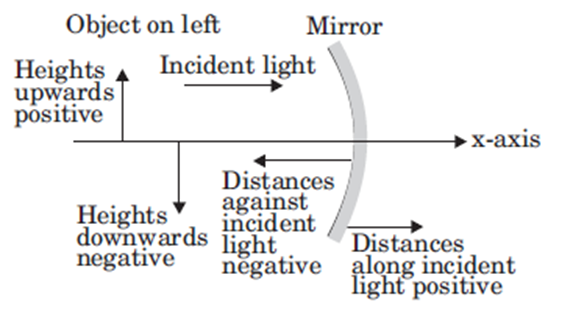
Source: Kapdec.com
Cartesian sign convention
If the distance of the object and the image is given by u and v, respectively and f is the focal length of the mirror. Then the mirror formula is given by,
1V

Source: Kapdec.com
+ 1U

Source: Kapdec.com
=1f

Source: Kapdec.com
Focal length f for a concave mirror is negative and is positive for a convex mirror.
The magnification produced by a mirror is given by
m=h‘h

Source: Kapdec.com
= -v u

Source: Kapdec.com
where h′ is the height of the image and h is the height of the object.
Total Internal Reflection:
• When light travels from an optically denser medium to a rarer medium at the interface, it is partly reflected back into the same medium and partly refracted to the second medium. This reflection is called internal reflection when all light is reflected back, it is called total internal reflection.
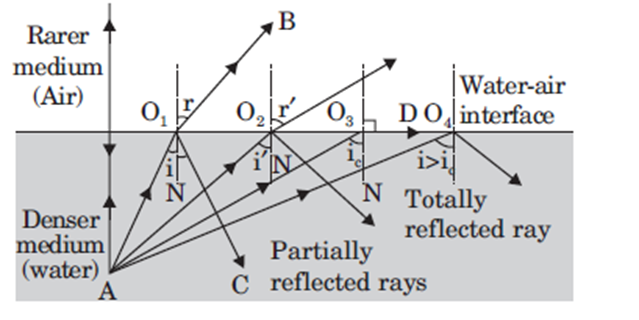
Source: Kapdec.com
Total Internal Reflection
The applications of total internal reflection include mirages, diamonds, prism and optical fibres.
Refraction through glass slab:
The emergent ray through a glass slab is parallel to the incident ray but it is laterally displaced.
Also, ∠

Source: Kapdec.com
Angle of incidence = ∠

Source: Kapdec.com
Angle of emergence
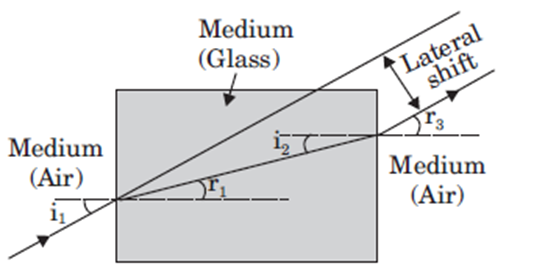
Source: Kapdec.com
Reflection through a glass slab
Refraction at spherical surfaces
If the rays are incident from a medium of refractive index n1 to another of refractive index n2, then
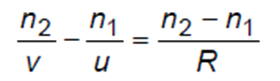
Source: Kapdec.com
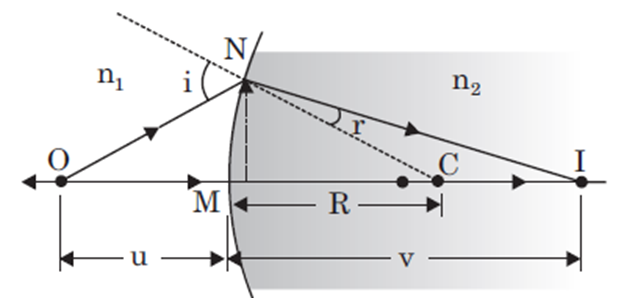
Source: Kapdec.com
Fig.: Refraction at a spherical surface
For a prism of the angle A, of refractive index n2 placed in a medium of refractive index n1 and Dm being the angle of minimum deviation.
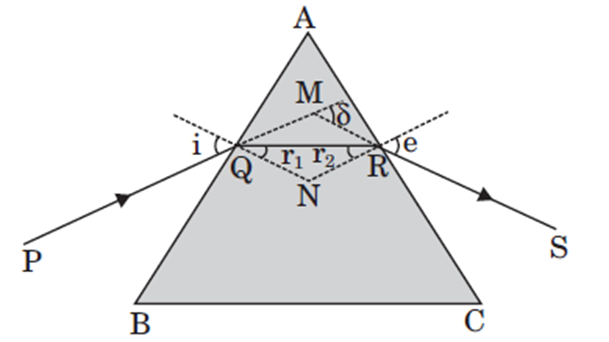
Source: Kapdec.com
Prism
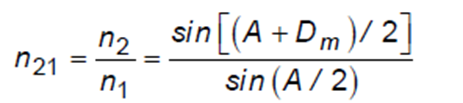
Source: Kapdec.com
• If the distance of the object and the image is given by u and v, respectively and f is the focal length of the lens. So, the lens formula is,
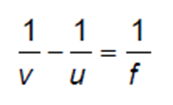
Source: Kapdec.com
Focal length f is positive for a converging lens and is negative for a diverging lens.
• The magnification produced by a mirror is given by m=h‘h
Source: Kapdec.com
= -v u
Source: Kapdec.com
where h′ is the height of the image and h is the height of the object.
The power (P) of a lens is given by, P =1f

Source: Kapdec.com
Where f is the focal length of the lens and the SI unit of power is dioptre (D): 1 D = 1 m–1
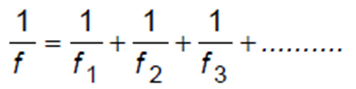
• The effective focal length of a combination of thin lenses of focal lengths f1, f2, f3 ….. is given by
Source: Kapdec.com
And the effective power of the same combination is given by P = P1 + P2 + P3 ……
Dispersion:
• Splitting light into its constituent colours is known as dispersion of light.
• When white light is incident on a prism, the white light is split into seven components, violet, indigo, blue, green, yellow, orange and red (given by the acronym VIBGYOR) Some natural phenomena due to sunlight are rainbow and scattering of light.
- The Eye: It has a convex lens of a focal length of about 2.5 cm. This focal length can be varied somewhat by the help of ciliary muscle so that the image is always formed on the retina. This ability of the eye of adjusting the muscle to form a clear image is called accommodation.
- In a defective eye, if the image is focused before the retina, it is called myopia. For the correction of myopia, a diverging corrective lens is needed. In a defective eye, if the image is focused beyond the retina, it is called hypermetropia. For the correction of hypermetropia, a converging corrective lens is needed.
- Astigmatism: A refractive error in which the vision is blurred at all distances, is corrected by using cylindrical lenses.
Absorption:
Absorption is a process in which incident light is absorbed by a material rather than being transmitted or reflected. The absorption of light by a material can be quantified using the Beer-Lambert law, which relates the absorption of light to the concentration of absorbing molecules and the path length through the material.
The Beer-Lambert law is given by the following formula:
A = εcl
Where:
A is the absorbance of the material,
ε is the molar absorptivity (also known as the molar absorption coefficient), which is a measure of how strongly a substance absorbs light at a specific wavelength,
c is the concentration of the absorbing species in moles per litre (Molarity),
l is the path length through the material in centimetres.
Example: A concave mirror is used to focus the image of a flower on a nearby well 120 𝑐𝑚 from the flower. If a lateral magnification of 16 is desired, the distance of the flower from the mirror should be __________.
Solution:

Source: Kapdec.com
Key points:
Refraction:
- Refraction is the bending of light as it passes from one medium to another with a different optical density.
- The change in the direction of light occurs due to the variation in the speed of light in different materials.
- When light travels from a rarer medium (lower optical density) to a denser medium (higher optical density), it bends towards the normal (an imaginary line perpendicular to the surface of separation).
- When light travels from a denser medium to a rarer medium, it bends away from the normal.
- The amount of bending depends on the angle of incidence and the refractive indices of the two media involved.
- Snell’s Law, which relates the angle of incidence and the angle of refraction, governs the behaviour of light during refraction.
Reflection:
- Reflection is the bouncing back of light when it encounters a surface that cannot absorb or transmit the light.
- The angle of incidence (the angle between the incident ray and the normal) is equal to the angle of reflection (the angle between the reflected ray and the normal).
- The law of reflection states that the incident ray, the reflected ray, and the normal to the surface all lie in the same plane.
- The reflection can be categorized into two types: specular reflection (smooth surface, parallel rays) and diffuse reflection (rough surface, scattered rays).
- Specular reflection produces a clear and well-defined reflection, while diffuse reflection results in a scattered reflection.
Absorption:
- Absorption occurs when light is absorbed by a material rather than being reflected or transmitted through it.
- When light interacts with matter, the photons’ energy can be transferred to the atoms or molecules of the material, leading to the absorption of specific wavelengths of light.
- The absorbed energy can result in an increase in the internal energy of the material, which can manifest as an increase in temperature or other forms of excitation.
- Different materials have different absorption properties, meaning they absorb light differently depending on factors such as wavelength and intensity.
- The absorbed light energy can be re-emitted in the form of heat or fluorescence, depending on the material’s characteristics.
Scan to visit this resource online
https://kapdec.com/resources/refraction-reflection-and-absorption
