KAPDEC® | Elite STEM Learning Platform | https://kapdec.com
Unit: Transformations
Chapter: Introduction to Transformations
Reference: – Definition & Types of Transformations, Rigid Transformations (Isometries), Non-Rigid Transformations, Translation in the Coordinate Plane, Reflection in the Coordinate Plane, Rotation in the Coordinate Plane, Dilation and Scale Factor, Composition of Transformations, Symmetry and Transformations
After studying this chapter, you should be able to understand:
- Definition & Types of Transformations
- Rigid & Non- Rigid Transformations (Isometries)
- Translation, Rotation & Reflection in the Coordinate Plane
- Composition of Transformations & Symmetry and Transformations
Definition of Transformations – A transformation is a function that maps every point of a geometric figure onto another set of points in the same plane. Transformations preserve or modify the properties of the original figure while changing its position, size, or orientation. Transformations are fundamental to understanding the relationships between geometric figures.
Types of Transformations – Transformations are broadly classified into two categories: rigid transformations (which preserve the size and shape of a figure) and non-rigid transformations (which alter the size but maintain the shape). These classifications help in distinguishing between movements that retain congruency and those that modify proportions.
Rigid Transformations (Isometries) – Rigid transformations, also called isometries, preserve the length of sides and the measure of angles, ensuring that the preimage and image are congruent. The three main types of rigid transformations are translations, rotations, and reflections. Each of these movements does not alter the shape but changes its position or orientation.
Non-Rigid Transformations – Non-rigid transformations, such as dilations, modify the size of a figure while maintaining its shape. These transformations introduce a scale factor that expands or contracts the figure. Unlike rigid transformations, non-rigid transformations do not preserve congruency but maintain similarity between the original and transformed figures.
Translation in the Coordinate Plane – A translation is a transformation that moves every point of a figure the same distance in the same direction. Translations do not change the size, shape, or orientation of the figure. In coordinate geometry, a translation is represented algebraically by adding or subtracting specific values to the x- and y-coordinates of each point in the figure.
Reflection in the Coordinate Plane – A reflection is a transformation that flips a figure over a specific line, known as the line of reflection. Each point on the figure has a corresponding reflected point equidistant from the reflection line but on the opposite side. Reflections preserve the size and shape of the figure but change its orientation, creating a mirror image.
Rotation in the Coordinate Plane – A rotation is a transformation that turns a figure around a fixed point, known as the center of rotation, by a specified angle. Rotations can be clockwise or counterclockwise and are typically measured in degrees. Rotations preserve the size and shape of the figure, but they change its orientation. In coordinate geometry, rotations are performed using trigonometric rules or rotational matrices.
Dilation and Scale Factor – A dilation is a transformation that changes the size of a figure without altering its shape. The transformation is controlled by a scale factor, which determines whether the figure is enlarged or reduced. If the scale factor is greater than 1, the figure is enlarged; if it is between 0 and 1, the figure is reduced. Dilations preserve similarity but not congruency.
Composition of Transformations – A composition of transformations occurs when two or more transformations are applied sequentially to a figure. The order of transformations affects the final result, and multiple transformations can sometimes be combined into a single equivalent transformation. Compositions are useful in understanding complex transformations and their cumulative effects.
Symmetry and Transformations – Symmetry is a property of a geometric figure that remains unchanged under certain transformations. Reflectional symmetry occurs when a figure is divided into two mirror-image halves by a line of reflection. Rotational symmetry exists when a figure can be rotated by a certain angle around a point and still look the same. Translational symmetry occurs when a figure can be moved in a particular direction without changing its appearance.
Introduction to Transformations- Partition
We already revisited transformations in our introductions to congruency and similarity, but we haven’t really worked close with understanding them on a deeper level. In this lesson, we are going to learn a new transformation, quickly review the transformations we know, and then gain a new perspective on what a transformation really is.
Vertical and Horizontal Stretch
Vertical and horizontal stretches are quite simple transformations. A horizontal stretch takes a figure and elongates or shortens its horizontal dimension (pre-image red, image blue):

Source: Kapdec.com
A vertical stretch does the same thing in the vertical direction:
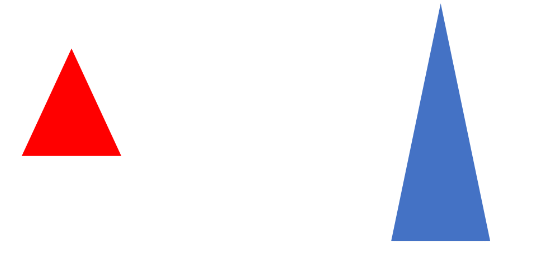
Source: Kapdec.com
In the coordinate plane, there is usually a factor by which something stretches. If a figure horizontally stretches by a factor d, then each point undergoes the following transformation:
(x, y) => (dx, y)
Similarly, if a figure vertically stretches by a factor d, then each point undergoes the following transformation:
(x, y) => (x, dy)
If the factor d is less than 1, then the transformation is a compression. If the factor d is greater than 1, then the transformation is a stretch. If the factor d is 1, the figure is not transformed.
The reason we have waited so long to learn about this transformation is that it does not preserve similarity. This is because unless you are stretching a rectangle, the angles change, and if you are stretching a rectangle, the side ratios change.
Transformation Review
This table should be a good review of all the transformations we know so far.
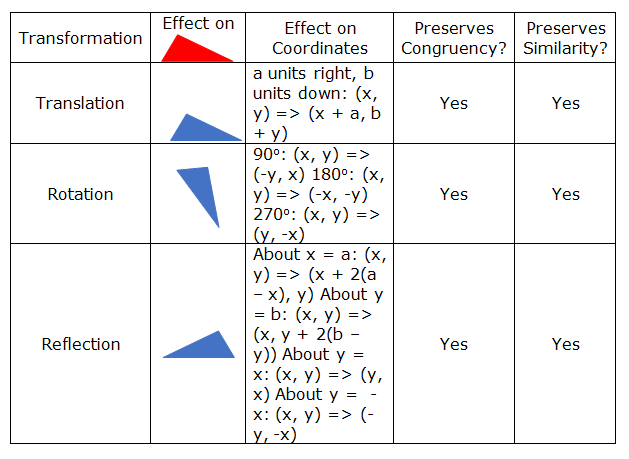
Source: Kapdec.com
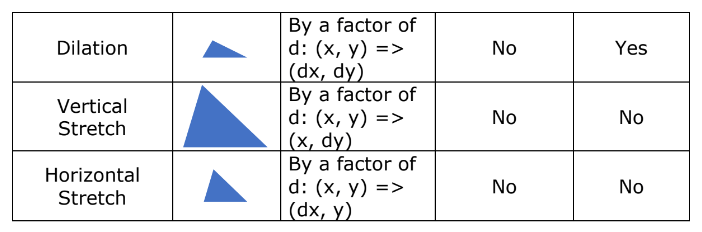
Source: Kapdec.com
Transformations are Functions
It is a function as the algebraic form of a geometric transformation. While that is a useful explanation for an introduction, now that we are at a more advanced level, it is important to know that a transformation is a function as well.
Notice the coordinate transformations for each type of transformation in the table above. For each, there is an input assigned with the framework for an output. While it cannot very well be expressed in an equation, it is a rule for transforming an input into an output, and thus must be considered a function.
Five-point conclusion summarizing the Introduction to Transformations chapter in HS Geometry:
- Transformations Define Movement and Change in Geometry – Transformations are fundamental operations that alter a geometric figure’s position, size, or orientation while preserving or modifying its properties. They help in visualizing changes and relationships between figures.
- Rigid Transformations Preserve Congruency – Translations, rotations, and reflections maintain the original size and shape of a figure, ensuring that the preimage and image remain congruent. These transformations are essential in proving geometric theorems and establishing symmetry.
- Non-Rigid Transformations Preserve Similarity – Dilations change the size of a figure while maintaining its shape and proportionality. They are widely used in real-world applications such as scaling in maps, models, and computer graphics.
- Composition of Transformations Creates Complex Changes – When multiple transformations are applied sequentially, the overall effect can often be represented as a single transformation. Understanding composition helps in solving advanced geometric problems efficiently.
- Symmetry Provides a Structural Basis for Transformations – Reflectional, rotational, and translational symmetry play a crucial role in understanding transformations, allowing for pattern recognition, tessellations, and real-world applications in design and architecture.
