KAPDEC® | Elite STEM Learning Platform | https://kapdec.com
Source: Kapdec.com
Unit: Non-linear functions
Rational, Radical and Other Nonlinear Functions
Understanding different types of nonlinear functions is crucial for advanced algebra and calculus. This includes rational functions, radical functions, and other nonlinear functions such as exponential, logarithmic, and piecewise-defined functions.
Rational Functions
- Definition: A rational function is a ratio of two polynomials f(x)

Source: Kapdec.com
, where P(x) and Q(x) are polynomials and 𝑄(𝑥)≠0.
- Key Features:
- Domain: All real numbers except where Q(x)=0.
- Vertical Asymptotes: Values of x where Q(x)=0.
- Horizontal Asymptotes: Determined by the degrees of P(x) and Q(x):
- If the degree of P(x) < degree of Q(x), y=0.
- If the degree of P(x) = degree of Q(x), 𝑦=

Source: Kapdec.com
where a and b are the leading coefficients.
- If the degree of P(x) > degree of Q(x), there is no horizontal asymptote.
- Oblique Asymptotes: Occur when the degree of P(x) is exactly one more than the degree of Q(x).
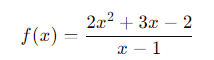
- Example:
Source: Kapdec.com
-
- Vertical asymptote at x=1.
- Horizontal asymptote at y=2x+5.
Radical Functions
- Definition: A radical function contains a root, such as a square root or cube root, of a variable.
- Key Features:
- Domain: Determined by the requirement that the radicand (expression under the root) must be non-negative (for even roots) or defined for all real numbers (for odd roots).
- Behaviour: Typically involves analyzing the principal square root or other roots.
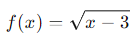
- Example:
-
Source: Kapdec.com
- Domain:x≥3.
- Graph: Starts at (3,0) and increases gradually.
-
Exponential Functions
- Definition: An exponential function has the form f(x)=a⋅bx, where a is a constant and b is the base (a positive real number).
- Key Features:
- Domain: All real numbers.
- Range: Positive real numbers for a>0.
- Horizontal Asymptote: Typically, y=0.
- Example:
f(x)=2⋅3x
-
- Rapid growth or decay depending on b>1 (growth) or 0<b<1 (decay).
Logarithmic Functions
- Definition: The inverse of an exponential function, written as f(x)=logb(x) where b is the base.
- Key Features:
- Domain: Positive real numbers.
- Range: All real numbers.
- Vertical Asymptote: Typically, x=0.
- Example:
f(x)=log2(x)
-
- Increases slowly and passes through (1,0).
Piecewise-Defined Functions
- Definition: A function defined by different expressions over different intervals of the domain.
- Key Features:
- Defined by multiple sub-functions.
- Continuity and differentiability depend on the match at the boundaries.
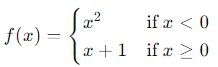
- Example:
Source: Kapdec.com
-
- Different rules apply for x<0 and x≥0.
Summary
- Rational Functions: Ratios of polynomials with potential vertical, horizontal, or oblique asymptotes.
- Radical Functions: Involve roots with domains determined by the radicand.
- Exponential Functions: Feature rapid growth or decay.
- Logarithmic Functions: Inverses of exponentials, slow increase over their domain.
- Piecewise-Defined Functions: Different rules in different parts of the domain, useful for modelling real-world situations with distinct phases.
Understanding and analyzing these nonlinear functions is crucial for solving complex equations and modelling various phenomena in mathematics and science.
Scan to visit this resource online
https://kapdec.com/resources/rational-radical-and-other-nonlinear-functions
