KAPDEC® | Elite STEM Learning Platform | https://kapdec.com
Unit: Algebra
Chapter: General Terms and Mathematical Operations in Arithmetic Progression
Reference: – Introduction to Sequences and Series, Definition of Arithmetic Progression (AP), The General (nth) Term of an AP, Common Difference and its Significance, Sum of the First n Terms of an AP, Properties and Middle Terms, Application-Based Problems, Arithmetic Mean
After studying this chapter, you should be able to understand:
- The fundamental concept of an Arithmetic Progression (AP).
- How to find the general term (nth term) of an AP.
- How to calculate the sum of the first n terms of an AP.
- The properties of an AP and its application in solving problems.
Introduction to Sequences and Series
Definition
A sequence is an ordered list of numbers following a specific pattern. A series is the sum of the terms of a sequence. An Arithmetic Progression (AP) is one of the most common and simplest types of sequences.
The core idea is that in an AP, the difference between consecutive terms remains constant.
[Importance of Arithmetic Progression]
- Used to model real-life situations with uniform increase or decrease (e.g., yearly savings, seating arrangements in a stadium).
- Forms the basis for understanding more complex series.
- Frequently tested in school exams and competitive tests.
- Applications in computer science, physics, and economics.
Example
Sequence: 2, 5, 8, 11, 14, …
This is an AP because the difference between consecutive terms is always 3.
[Subtopics]
1. Concept of a Pattern
A pattern is a rule that defines the relationship between consecutive terms in a sequence. In an AP, the pattern is additive.
Key Points:
- The constant difference can be positive, negative, or zero.
- Each term is obtained by adding a fixed number to the previous term.
2. Terminology
- Term: Each number in the sequence.
- First Term (a): The starting term of the sequence.
- Common Difference (d): The fixed number added to each term to get the next term.
Definition of Arithmetic Progression (AP)
[Definition]
An Arithmetic Progression (AP) is a sequence of numbers in which the difference between any two consecutive terms is constant. This constant is called the common difference, denoted by ‘d’.
An AP can be represented as:
a, a + d, a + 2d, a + 3d, …
[Importance of the Definition]
- Provides the foundational rule for identifying an AP.
- Essential for deriving formulas for the nth term and the sum.
- Helps in solving problems related to patterns.
Examples
- 1, 3, 5, 7, … is an AP with a = 1, d = 2.
- 10, 7, 4, 1, -2, … is an AP with a = 10, d = -3.
[Subtopics]
1. Condition for AP
A sequence

Source: Kapdec.com
is an AP if

Source: Kapdec.com
for all n.
2. Common Difference

Source: Kapdec.com
- If d > 0, the AP is increasing.
- If d < 0, the AP is decreasing.
- If d = 0, the AP is constant (all terms are the same).
The General (nth) Term of an AP
[Definition]
The general term (or nth term) of an AP allows us to find any term in the sequence without listing all the previous terms. It is given by the formula:

Source: Kapdec.com
where:
-

Source: Kapdec.com
is the nth term,
- a is the first term,
- d is the common difference,
- n is the term number.
[Importance of the General Term]
- Enables direct calculation of any term in the sequence.
- Crucial for solving problems where the term number is large.
- Used in finding specific terms and verifying if a number is part of the AP.
Examples
- Find the 10th term of the AP: 3, 7, 11, 15, …
[Subtopics]
1. Derivation of the Formula
The first term is a.
The second term is a + d.
The third term is a + 2d.
…
The nth term is a + (n – 1)d.
2. Application
To find the nth term, substitute the values of a, d, and n into the formula.
Example Solution:
For AP: 3, 7, 11, 15, …
a = 3, d = 4

Source: Kapdec.com
Common Difference and its Significance
[Definition]
The common difference ‘d’ is the hallmark of an AP. It determines the behavior of the sequence (increasing, decreasing, or constant).
[Importance of Common Difference]
- Defines the rate of change of the sequence.
- Used in the formulas for the nth term and the sum.
- Helps in determining the nature of the AP.
Examples
- In the AP: 100, 95, 90, 85, …, d = -5.
[Subtopics]
1. Calculating d

Source: Kapdec.com
2. Impact on the Sequence
- Positive d: Sequence increases.
- Negative d: Sequence decreases.
- Zero d: All terms are equal.
Sum of the First n Terms of an AP
[Definition]
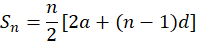
The sum of the first n terms of an AP, denoted by

Source: Kapdec.com
, is the total obtained by adding the first n terms of the sequence. It is given by the formula:
Source: Kapdec.com
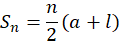
Alternatively,
Source: Kapdec.com
where l is the last term (nth term) of the sequence.
[Importance of the Sum Formula]
- Allows quick calculation of the sum without adding all terms individually.
- Useful in solving real-life problems involving total amounts.
- Frequently used in conjunction with the nth term formula.
Examples
- Find the sum of the first 20 terms of the AP: 2, 5, 8, 11, …
[Subtopics]
1. Derivation of the Sum Formula
Let

Source: Kapdec.com
Write it in reverse:

Source: Kapdec.com
Add the two equations:

Source: Kapdec.com
So,

Source: Kapdec.com
2. Application
Substitute the values of a, d, and n into the formula.
Example Solution:
For AP: 2, 5, 8, 11, …
a = 2, d = 3

Source: Kapdec.com
Properties and Middle Terms
[Definition]
An AP has specific properties related to its terms. For example, in a finite AP, the sum of terms equidistant from the beginning and end is constant. Also, if three numbers are in AP, the middle one is the average of the other two.
[Importance of Properties]
- Useful for solving problems without using formulas directly.
- Helps in finding missing terms.
- Simplifies calculations in symmetric APs.
Examples
- If 4, x, 10 are in AP, find x.
[Subtopics]
1. Condition for Three Terms to be in AP
If a, b, c are in AP, then 2b=a+c.
2. Middle Term in an AP
For an odd number of terms in AP, the middle term is the average of the first and last terms.
Application-Based Problems
[Definition]
These are word problems that involve modeling real-world situations using the concepts of AP. They require translating the problem into mathematical terms and then applying AP formulas.
Importance of Application Problems
- Demonstrates the practical utility of AP.
- Enhances problem-solving and analytical skills.
- Common in examinations.
Examples
- “A man saves ₹100 in the first month, ₹150 in the second, ₹200 in the third, and so on. How much will he save in 2 years?”
[Subtopics]
1. Steps to Solve
- Identify the pattern and confirm it is an AP.
- Determine the first term (a) and common difference (d).
- Identify what needs to be found (nth term or sum).
- Apply the appropriate formula.
- Interpret the result in the context of the problem.
Arithmetic Mean
[Definition]
If three numbers are in AP, the middle term is called the Arithmetic Mean (AM) of the other two. For two numbers a and b, their Arithmetic Mean is given by

Source: Kapdec.com
.
[Importance of Arithmetic Mean]
- Used to insert terms between two given numbers to form an AP.
- A fundamental concept in statistics.
- Helps in understanding the average value.
Examples
- Insert 3 arithmetic means between 4 and 16.
[Subtopics]
1. Formula for AM
For two numbers a and b,

Source: Kapdec.com
.
2. Inserting Arithmetic Means
To insert ‘k’ arithmetic means between a and b, the common difference is

Source: Kapdec.com
. The means are then a + d, a + 2d, …, a + kd.
[Example: -]
Problem Statement:
The first term of an AP is 5 and the common difference is 3. Another AP has the same first term and the sum of its first 10 terms is 275. Find the common difference of the second AP.
Question: Find the common difference of the second AP. Prove your answer by providing a step-by-step solution and giving three independent reasons supporting your conclusion from these domains: (A) Using the Sum Formula for the Second AP, (B) Using the General Term and Sum Relationship, (C) Verification by Listing Terms.
[Solution: -]
Given:
- First AP:

Source: Kapdec.com
,

Source: Kapdec.com
- Second AP:

Source: Kapdec.com
,

Source: Kapdec.com
- We need to find

Source: Kapdec.com
, the common difference of the second AP.
(A) Using the Sum Formula for the Second AP
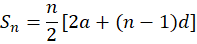
The sum of the first n terms of an AP is given by:
Source: Kapdec.com
For the second AP, n = 10, a = 5,

Source: Kapdec.com
.
Substitute these values into the formula:

Source: Kapdec.com

Source: Kapdec.com
Divide both sides by 5:

Source: Kapdec.com

Source: Kapdec.com

Source: Kapdec.com
Source: Kapdec.com
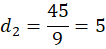
So, the common difference of the second AP is 5.
(B) Using the General Term and Sum Relationship
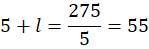
The sum

Source: Kapdec.com
can also be written as

Source: Kapdec.com
, where l is the last term (10th term).
So, for the second AP:

Source: Kapdec.com
Source: Kapdec.com

Source: Kapdec.com
The 10th term

Source: Kapdec.com
But we found

Source: Kapdec.com
So,

Source: Kapdec.com

Source: Kapdec.com

Source: Kapdec.com
This confirms the common difference is 5.
(C) Verification by Listing Terms
Let’s list the first 10 terms of the second AP using a=5 and

Source: Kapdec.com
:
Term1: 5
Term2: 5 + 5 = 10
Term3: 10 + 5 = 15
Term4: 15 + 5 = 20
Term5: 20 + 5 = 25
Term6: 25 + 5 = 30
Term7: 30 + 5 = 35
Term8: 35 + 5 = 40
Term9: 40 + 5 = 45
Term10: 45 + 5 = 50
Now, sum these terms:
S = 5 + 10 + 15 + 20 + 25 + 30 + 35 + 40 + 45 + 50
This is an AP with a=5, d=5, n=10. We can use the sum formula to verify:

Source: Kapdec.com
This matches the given sum. If we try any other value for

Source: Kapdec.com
, the sum would not be 275. For example, if

Source: Kapdec.com
, the 10th term would be

Source: Kapdec.com
, and the sum would be

Source: Kapdec.com
, which is not 275.
Final Conclusion:
All three independent methods—direct application of the sum formula, using the relationship between the sum and the last term, and verification by listing terms—confirm the same result.
The common difference of the second AP is 5.
Because these three proofs are independent (using different relationships and verification techniques), the solution is rigorously confirmed.
Scan to visit this resource online
https://kapdec.com/resources/general-terms-and-mathematical-operations-in-arithmetic-progression
