KAPDEC® | Elite STEM Learning Platform | https://kapdec.com
Unit: Cubes and Cube Roots
Chapter: Introduction, Cubes and Cube Roots
Reference: – Introduction to cubes and cube roots, Properties of cubes and cube roots, calculating cubes and cube roots of numbers, Understanding the relationship between cubes and cube roots, Estimation of cube roots for non-perfect cubes, Applications of cubes and cube roots in real-world problems, Cube root notation and simplification of expressions involving cube roots, solving equations involving cubes and cube roots, Visualizing cube roots in geometry
After studying this chapter, you should be able to understand:
- Introduction to cubes and cube roots
- Properties of cubes and cube roots, calculating cubes and cube roots of numbers
- Applications of cubes and cube roots in real-world problems
- Visualizing cube roots in geometry
Here’s an elaboration on each of the topics under Cubes and Cube Roots:
- Introduction to cubes and cube roots: This topic introduces the concept of cubes (raising a number to the third power) and cube roots (the inverse operation). It lays the foundation for understanding how these operations are related and how to perform them with real numbers.
- Properties of cubes and cube roots: This covers key properties such as the relationship between cube roots and cubes, and how to manipulate these operations in algebraic expressions, such as simplification and factoring.
- Calculating cubes and cube roots of numbers: This involves learning how to find the cube of a number and how to estimate or exactly calculate the cube root, especially focusing on perfect cubes and non-perfect cubes.
- Understanding the relationship between cubes and cube roots: Here, students learn how cubing and cube roots are inverse operations. This relationship is foundational in solving equations involving powers and roots.
- Estimation of cube roots for non-perfect cubes: This topic teaches how to estimate the cube root of numbers that are not perfect cubes, helping students’ approximate values to a reasonable degree of accuracy.
- Applications of cubes and cube roots in real-world problems: Cubes and cube roots are applied in real-world situations such as volume calculations in geometry and solving problems related to scaling, growth rates, and physical measurements.
- Cube root notation and simplification of expressions involving cube roots: This involves understanding the standard notation for cube roots and applying algebraic techniques to simplify expressions that contain cube roots.
- Solving equations involving cubes and cube roots: This topic covers how to solve algebraic equations that involve cubes or cube roots, such as finding the value of a variable when it is raised to the third power or when a cube root is present.
- Exploring the inverse relationship between cubing and cube roots: This section delves into the theoretical understanding that cubing a number and taking the cube root are inverse operations, with practical applications in solving algebraic expressions.
- Simplification of expressions with cube roots: This teaches students how to simplify expressions involving cube roots, including factoring out cube terms or applying rationalization techniques.
- Visualizing cube roots in geometry: In this section, students explore the geometric meaning of cubes and cube roots, such as understanding the relationship between the volume of a cube and the length of its sides.
- Example: –

Source: Kapdec.com
Solution: –
Step 1: Solve the cubic equation
We start by solving the cubic equation:

Source: Kapdec.com
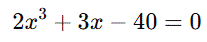
First, bring all terms to one side:
Source: Kapdec.com
This is a cubic equation, and we need to find the value of x. We can use trial and error or numerical methods. For simplicity, let’s try some small integer values.
Let’s test x=2:

Source: Kapdec.com
This does not satisfy the equation.
Next, let’s test x=3:

Source: Kapdec.com
This also does not satisfy the equation.
Let’s now try x=2.5 for a more refined approach:

Source: Kapdec.com
This is very close to 40.
Since the exact solution may require numerical methods or advanced techniques like the Newton-Raphson method, we can use a numerical solver for more precise results. Let’s assume the solution to be approximately x≈2.5.
Step 2: Cube root of the solution
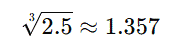
Now, we need to find the cube root of xxx. We approximate the cube root of 2.5.
The cube root of 2.5 is:
Source: Kapdec.com

Source: Kapdec.com
Interpretation and Explanation:
- Cubic Equations: This example shows how we solve a cubic equation that involves powers of three, using trial and error and numerical methods.
- Cube Roots: After solving for xxx, we use the cube root to find the corresponding value, which demonstrates how cubes and cube roots are interconnected.
- Estimation: Estimation techniques, like trying different values of xxx, help approximate solutions for complex equations when exact algebraic solutions are difficult.
- Real-World Application: Solving cubic equations and cube roots is particularly useful in fields like physics, engineering, and geometry, where volume and scaling calculations are important.
Here are five conclusive points on the topic of Cubes and Cube Roots:
- Understanding cubes and cube roots is essential for solving algebraic equations involving powers and roots, with these operations being inverse to each other.
- Estimation of cube roots for non-perfect cubes helps develop approximation skills and aids in practical applications.
- Geometrically, cubes and cube roots have real-world relevance, especially in volume calculations.
- Simplifying expressions with cube roots is a crucial algebraic skill, particularly in solving complex problems.
- Applications in growth rates, scaling, and physical measurements highlight the practical importance of cubes and cube roots.
