KAPDEC® | Elite STEM Learning Platform | https://kapdec.com
Unit: Real Numbers
Chapter: Introduction to Real Numbers
Reference: – Understanding the Real Number System, Rational and Irrational Numbers, Properties of Real Numbers, Comparing and Ordering Real Numbers, Operations on Real Numbers, The Density Property of Real Numbers, Sets and Intervals in Real Numbers
After studying this chapter, you should be able to understand:
- Understanding the Real Number System
- Real Numbers and their properties
- Comparing and Ordering Real Numbers
- Operations on real Numbers and their density property
1. Understanding the Real Number System
The real number system is a broad classification of numbers that includes various subsets. It consists of all possible numbers that can be represented on a number line. These numbers can be further categorized based on their properties and forms. The main subsets include:
- Natural Numbers: These are the basic counting numbers used in daily life.
- Whole Numbers: This set includes all natural numbers along with zero.
- Integers: These extend whole numbers to include negative numbers as well.
- Rational Numbers: These are numbers that can be expressed as a ratio of two integers, where the denominator is not zero.
- Irrational Numbers: These numbers cannot be written as a simple fraction because their decimal expansions are non-repeating and non-terminating.
All these numbers collectively form the real number system, which serves as the foundation for algebraic operations and analysis.
2. Rational and Irrational Numbers
Numbers are classified as rational or irrational based on their decimal representations and divisibility properties.
- Rational Numbers: These are numbers that can be written in the form of a fraction where both the numerator and denominator are integers, and the denominator is not zero. The decimal representation of rational numbers either terminates after a finite number of digits or follows a repeating pattern indefinitely.
- Irrational Numbers: These numbers cannot be expressed as fractions of two integers. Their decimal representation neither terminates nor repeats. They often arise from geometric or algebraic calculations, such as the length of a diagonal in a square or the ratio of a circle’s circumference to its diameter.
The distinction between these two categories is fundamental to understanding real numbers and their properties.
3. Properties of Real Numbers
Real numbers follow a set of algebraic properties that define their behavior under different operations:
- Commutative Property: This states that the order in which numbers are added or multiplied does not change the result.
- Associative Property: This states that when adding or multiplying three or more numbers, the way they are grouped does not affect the outcome.
- Distributive Property: This property links multiplication with addition or subtraction, allowing a number to be multiplied individually with terms inside a parenthesis before summing them.
- Identity Property: This states that there exist special numbers (called identity elements) that, when used in an operation, do not change the other number.
- Inverse Property: Every number has a corresponding opposite or reciprocal that, when combined with the original number, results in an identity element.
- Closure Property: This property ensures that the sum or product of any two real numbers always results in another real number.
These properties provide the structural rules that govern algebraic manipulations.
4. Comparing and Ordering Real Numbers
Real numbers can be compared and arranged based on their position on the number line.
- The Number Line Representation: Every real number has a unique location on the number line, which extends infinitely in both directions. Numbers positioned to the right are greater, while those on the left are smaller.
- Absolute Value: This represents the magnitude of a number without considering its sign. It determines the distance of a number from zero on the number line.
- Inequalities: These are mathematical expressions that describe relationships of greater than, less than, or equal to between two numbers.
- Ordering: When comparing real numbers, one can arrange them from smallest to largest based on their magnitude and position on the number line.
Understanding this concept is crucial for solving equations, inequalities, and real-world problems.

Source: Kapdec.com
5. Operations on Real Numbers
Real numbers follow specific rules when combined through different mathematical operations.
- Addition and Subtraction: The sum or difference of two real numbers depends on their relative values and signs.
- Multiplication and Division: When real numbers are multiplied or divided, their signs and values determine the outcome.
- Properties of Roots: Real numbers also include their square and cube roots, which represent the values that, when multiplied by themselves, result in the original number.
- Approximations: Since irrational numbers cannot be exactly written in fractional form, they are often approximated to a certain number of decimal places for practical use.
Mastering these operations helps in simplifying expressions and solving equations effectively.
6. The Density Property of Real Numbers
The density property states that between any two distinct real numbers, there always exists another real number. This means the real number system is continuous and does not have gaps.
- Application: This property is useful in understanding decimals, fractions, and limits in calculus.
- Implication: Since there is always another number between two given numbers, the real number line is infinitely divisible, making it different from discrete numerical systems.
This concept is fundamental in higher mathematics and analysis.
7. Sets and Intervals in Real Numbers
A set is a collection of numbers that follow a specific rule, while an interval represents a range of numbers within the real number system.
- Subsets of Real Numbers: Different types of real numbers form subsets, which help in organizing and categorizing them based on properties.
- Interval Notation: This is a way of expressing the range of numbers between two given points using brackets and parentheses to indicate whether the endpoints are included or excluded.
- Set Notation: This is another method of representing a group of numbers by specifying their defining properties.
- Union and Intersection: These operations describe how different sets interact, combining elements or identifying common ones.
Example: –
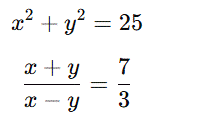
Let x and y be two real numbers such that:
Source: Kapdec.com
(a). Determine the possible values of x and y.
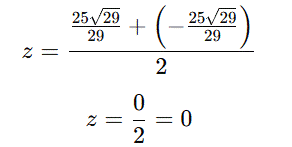
(b). Verify if these values satisfy the density property by finding at least one real number between them.
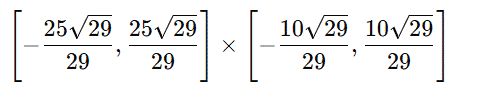
(c). Express the solution set using interval notation.
Solution: –
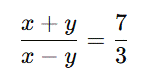
Step 1: Express x in terms of y using the second equation
From the given equation:
Source: Kapdec.com
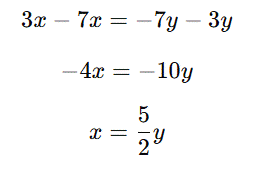
Cross multiplying gives:

Source: Kapdec.com
Rearrange:
Source: Kapdec.com
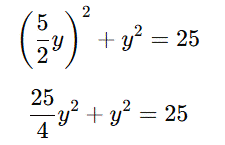
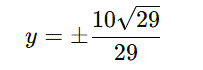
Step 2: Substitute: –
Source: Kapdec.com
Rationalizing:
Source: Kapdec.com
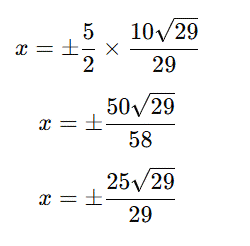
Step 3: Find the values of x
Source: Kapdec.com
Step 4: Verify the Density Property
Source: Kapdec.com
Step 5: Express the Solution in Interval Notation
The possible values of x and y form a closed interval:

Source: Kapdec.com
Thus, the solution set in interval notation is:
Source: Kapdec.com
Here are five conclusive points summarizing the Introduction to Real Numbers:
- The Real Number System is Comprehensive – The real number system includes natural numbers, whole numbers, integers, rational numbers, and irrational numbers, forming a continuous and ordered structure on the number line.
- Rational and Irrational Numbers Define Uniqueness – Rational numbers have terminating or repeating decimal representations, while irrational numbers have non-terminating and non-repeating decimals, distinguishing them as an essential part of real numbers.
- Properties Govern the Behavior of Real Numbers – Fundamental properties like commutativity, associativity, distributivity, identity, and inverses establish rules for performing arithmetic operations within the real number system.
- Real Numbers Are Densely Packed – The density property ensures that there is always another real number between any two given real numbers, proving that the real number system is infinite and continuous.
- Sets and Intervals Help in Organization – Real numbers can be categorized using set notation and interval notation, allowing for efficient representation, comparison, and analysis in algebra and higher mathematics.
