KAPDEC® | Elite STEM Learning Platform | https://kapdec.com
Unit: Right Triangles
Chapter: General Triangle Area Formula
Reference: – Concept of Triangle Area, Standard Area Formula for Right Triangles, Extension to Non-Right Triangles, Use of the Base-Height Relationship in Any Triangle, Area Calculation Using the Law of Sines, Area Formula in Terms of Side Lengths and an Included Angle (SAS Case), Heron’s Formula for Area Using Three Sides (SSS Case), Area of Special Types of Triangles Applications of Triangle Area in Real-World Contexts
After studying this chapter, you should be able to understand:
- Concept of Triangle Area & Standard Area Formula for Right Triangles
- Use of the Base-Height Relationship in Any Triangle
- Area Calculation Using the Law of Sines
- Area of Special Types of Triangles Applications of Triangle Area in Real-World Contexts
Concept of Triangle Area
The area of a triangle represents the extent of the region enclosed by its three sides. It is a fundamental geometric property that helps in understanding spatial measurements and plays a significant role in geometry, physics, and real-world applications like construction and design.
Standard Area Calculation for Right Triangles
In a right-angled triangle, one of the angles measures exactly 90 degrees. The two sides that form this right angle serve as references for measuring the enclosed space. Since a perpendicular segment already exists within the triangle, determining its area follows a direct approach based on fundamental geometric principles.
Generalization of Area to Non-Right Triangles
Triangles that do not contain a right angle require different considerations when calculating their area. Since there is no naturally occurring perpendicular height, additional geometric methods, such as projections and trigonometric reasoning, are required to measure the enclosed space effectively.
Interdependence of Base and Height in Triangles
In any given triangle, a specific side can be chosen as the base, and the corresponding height is defined as the perpendicular segment from the opposite vertex to this base. This relationship between the base and height forms the foundation of all area calculations for triangles, regardless of their shape or orientation.
Utilizing Angle Relationships to Determine Area
When dealing with oblique triangles, where the height is not readily available, angles play a crucial role in deriving the necessary measurements. By analyzing the relationship between a triangle’s sides and angles, an indirect method can be applied to express the area in terms of known quantities.
Determining Area Based on Two Sides and Their Included Angle
In situations where two sides and the angle between them are known, the enclosed space can be calculated by incorporating the influence of this angle into the measurement. This method enables precise determination of area without requiring explicit knowledge of the height.
Area Calculation Using All Three Sides of a Triangle
When the three sides of a triangle are given, it is possible to determine the enclosed space without directly referencing angles or perpendicular heights. This approach relies on the idea that any closed figure with three sides has an inherent structure that governs the space it encloses, making it possible to derive its area using internal properties.
Area Formulas for Special Categories of Triangles
Some triangles, such as equilateral or isosceles triangles, have unique characteristics that simplify their area calculations. Equilateral triangles, for example, have three equal sides and angles, which leads to a specific way of determining their enclosed space based on symmetry. Similarly, isosceles triangles, with two equal sides, allow for a structured approach to measuring their area using specific geometric properties.
Significance of Triangle Area in Practical Applications
The ability to determine the area of a triangle extends beyond theoretical mathematics. In real-world scenarios, such as architectural design, engineering, and land surveying, understanding the enclosed space of a triangular region is essential for accurate measurements, structural stability, and optimal resource utilization.
Comparative Study of Different Methods for Finding Triangle Area
Various techniques exist for calculating the area of a triangle, each suitable for different conditions. Selecting the most efficient approach depends on the available information, whether it involves side lengths, angles, or height. Recognizing these differences enhances problem-solving skills and provides a deeper understanding of geometric reasoning.
General Triangle Area Formula
Until now, when we have had to find the area of a triangle, we have been given a right triangle or the height of the triangle. However, we can’t use the formula ½ * b * h every time, especially when we are simply given side lengths and angle measures as shown in the diagram below.
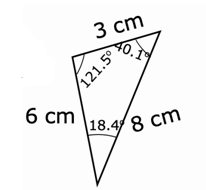
Source: Kapdec.com
In this lesson, we will learn a new area formula that doesn’t require a height measure at all, or even all the sides or angles. The rest of this chapter will cover more things we can do with triangles whether or not they are right triangles.
New Triangle Format
In previous lessons, we have labeled triangles with capital letters at the angles and the sides described as the name of the line segment connecting the two corners. For example, ∆ABC would have angles A, B, and C and sides AB, BC, and AC.
While our names for the angles will stay the same, our names for the sides in this lesson and the next two lessons are going to change. From now on, sides will be indicated with the same letter as the angle opposite of it, except in lowercase, as shown as below
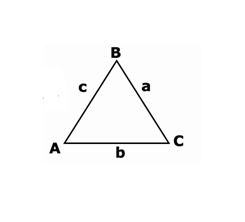
Source: Kapdec.com
Deriving the Formula
Let’s assume we know all of the angle measures and side lengths but not the height of ∆ABC.
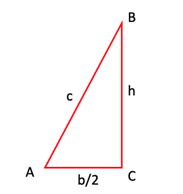
Source: Kapdec.com
The height is always perpendicular to the base, so we know that the height line creates two right triangles. To start deriving this formula, we will still start with the formula Area = ½*b*h. We have the measure for the base b, but we do not have the height h right now.
The height line has formed two right triangles and we are missing a side. A common way to solve the issue of a missing side of a triangle is to use the Pythagorean Theorem. We could do this if h perfectly bisected b; then we would know (b2

Source: Kapdec.com
)2 + h2 = c2.
Unfortunately, by the Perpendicular Bisector Theorem, h only bisects b if a ≅

Source: Kapdec.com
c. We could proceed with that assumption, but we want an area formula that applies to all triangles. Let’s look more closely at one of the triangles that line h creates:
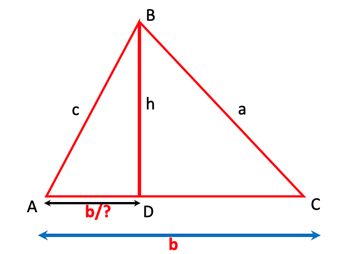
Source: Kapdec.com
All we know on this triangle (ADB or CDB) are the right triangles, the measure of

Source: Kapdec.com
C, and the measure of side a. We don’t know how much of “b” or

Source: Kapdec.com
B are represented in this triangle because “h” is not necessarily either a perpendicular bisector of side “b” or an angle bisector of angle B.
Until the last chapter, we would not have known how to find the length of h only knowing one angle measure and one side. This problem can only be solved using trigonometric ratios.
In relation to C, we currently have the hypotenuse, want to figure out the opposite side, and don’t really care about the adjacent side. We want a trigonometric function that involves opposite and hypotenuse. Remembering SOH-CAH-TOA, sine is the only one of the three primary trigonometric functions (as opposed to the reciprocal functions) that includes both the opposite side and the hypotenuse. Therefore, h can be expressed as:

Source: Kapdec.com

Source: Kapdec.com
We can now put this into our older triangle area equation:
A = ½*b*h
A = ½*b*(a*sin C)
A = ½*a*b*sin C
This substituted formula is the general formula for all triangles. It can also be written as Area = ½*b*c*sin(A) or Area = ½*a*c*sin(B); it’s easiest to remember in the above form because it goes in alphabetical order a-b-C, but don’t let any of the other forms trip you up if a problem uses them.
-

Source: Kapdec.com
Versatility in Area Calculation
The area of a triangle can be determined using multiple methods depending on the given information, such as base and height, side lengths, or included angles. This flexibility allows for efficient problem-solving in various geometric scenarios.
Applicability to All Types of Triangles
Whether dealing with right, acute, or obtuse triangles, the area can be calculated through general formulas, making this concept universally applicable across different types of triangles.
Geometric and Trigonometric Interconnection
The methods of finding a triangle’s area demonstrate the strong relationship between geometry and trigonometry. The use of angles and side lengths in deriving area formulas highlights the deeper mathematical structure within triangles.
Significance in Real-World Applications
Understanding how to calculate the area of a triangle is essential in fields like engineering, architecture, and land surveying, where precise measurements are crucial for construction, design, and spatial planning.
Foundation for Advanced Geometric Concepts
Mastering the area of triangles prepares students for more complex topics in geometry, such as coordinate geometry, three-dimensional modeling, and calculus-based applications, reinforcing fundamental mathematical reasoning.
