KAPDEC® | Elite STEM Learning Platform | https://kapdec.com
Unit: Revisiting real numbers
Chapter: Radicals & their respective exponents
Reference: – Definition of Radicals, Definition of Exponents, Relationship Between Radicals and Rational Exponents, Simplifying Radicals, Laws of Exponents (Product, Quotient, Power Rules), Converting Between Radical and Exponential Form, Multiplication of Radical Expressions, Division of Radical Expressions, Rationalizing the Denominator, Adding and Subtracting Radicals, Negative and Zero Exponents
After studying this chapter, you should be able to understand:
- Definition of Radicals & Definition of Exponents
- Relationship Between Radicals and Rational Exponents
- Converting Between Radical and Exponential Form & Multiplication of Radical Expressions
- Adding and Subtracting Radicals, Negative and Zero Exponents
- Definition of Radicals
A radical is a mathematical expression that represents the root of a number or an algebraic term. The most common radical is the square root, but higher-order roots such as cube roots or fourth roots also exist. The symbol is used to denote a radical.
- Definition of Exponents
An exponent refers to the number of times a base is multiplied by itself. It is a shorthand notation that indicates repeated multiplication and is used to express powers of numbers or variables.
- Relationship Between Radicals and Rational Exponents
Radical expressions can be rewritten as expressions with fractional (rational) exponents. For example, the nth root of a number corresponds to raising that number to the power, showing that radicals and exponents are two forms of the same mathematical idea.
- Simplifying Radicals
Simplifying radicals involves rewriting them in their simplest form. This typically means factoring out perfect powers from under the radical sign and reducing the expression as much as possible without changing its value.
- Laws of Exponents (Product, Quotient, Power Rules)
These laws provide rules for manipulating expressions involving powers. They include rules for multiplying powers with the same base, dividing powers with the same base, and raising powers to other powers, ensuring consistent simplification and manipulation.
- Converting Between Radical and Exponential Form
This involves expressing a radical using an exponent and vice versa. It allows one to switch between root notation and fractional exponent notation for easier computation or simplification.
- Multiplication of Radical Expressions
Multiplying radical expressions involves using the product rule for radicals, which states that the product of two radicals is equal to the radical of the product of the terms, assuming all quantities are within the domain of real numbers.
- Division of Radical Expressions
This refers to the process of simplifying expressions in which one radical expression is divided by another. The quotient rule for radicals is used here, which states that the radical of a quotient equals the quotient of the radicals.
- Rationalizing the Denominator
Rationalizing the denominator is the process of eliminating any radical expressions from the bottom of a fraction. This is often done by multiplying the numerator and denominator by a suitable radical that will remove the root from the denominator.
- Adding and Subtracting Radicals
Radical expressions can only be added or subtracted when they have the same radicand (the number under the root) and the same index. Such terms are called “like radicals” and can be combined by adding or subtracting their coefficients.
- Nested Radicals
A nested radical is a radical expression that contains another radical within it. Simplifying such expressions may involve successive applications of root properties or algebraic techniques to reduce their complexity.
- Negative and Zero Exponents
A negative exponent indicates the reciprocal of the base raised to the corresponding positive exponent, while a zero exponent signifies that any nonzero base raised to the power of zero is equal to one.
- Even and Odd Roots
Even roots (like square roots) are only defined for non-negative real numbers in the set of real numbers, whereas odd roots (like cube roots) are defined for all real numbers. This distinction affects the domain and behavior of radical expressions.
- Solving Equations Involving Radicals and Exponents
This involves isolating the radical or exponential part of an equation and then using inverse operations (such as raising both sides to a power or taking roots) to solve for the unknown variable.
- Domain and Restrictions of Radical Expressions
The domain of a radical expression refers to the set of values for which the expression is defined. For example, even-index radicals require non-negative radicands to ensure the expression remains within the real number system.
Example: –
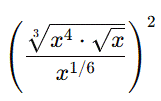
Simplify the expression completely:
Source: Kapdec.com
Solution: –
We need to simplify the entire expression using laws of exponents and radicals.
Express all radicals as exponents

Source: Kapdec.com
Now express this as a power using rational exponents:

Source: Kapdec.com
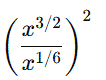
Now we rewrite the expression:
Source: Kapdec.com
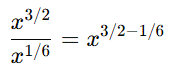
Apply quotient rule for exponents
Source: Kapdec.com
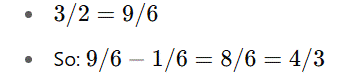
Find a common denominator:
Source: Kapdec.com
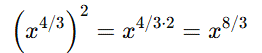
Step 3: Apply power of a power rule
Source: Kapdec.com
✅ Five Conclusive Points
- Radicals and Exponents Are Interrelated Forms
Every radical expression can be expressed as a rational exponent, and vice versa. This dual representation allows flexibility in solving, simplifying, and transforming algebraic expressions.
- Laws of Exponents Extend to Fractional Powers
The standard exponent rules—product, quotient, and power laws—apply not just to integers but also to rational (fractional) exponents, enabling consistent manipulation of roots and powers.
- Simplification of Radicals Requires Identifying Perfect Powers
Reducing a radical to its simplest form depends on recognizing and extracting perfect squares, cubes, or higher powers, which aids in comparison, computation, and algebraic operations.
- Radical Operations Are Constrained by Domain Restrictions
Even-index radicals are only defined for non-negative real numbers under the radical, while odd-index radicals are defined for all real numbers. This affects solvability and expression validity.
- Rationalizing the Denominator Standardizes Radical Expressions
Removing radicals from denominators is an essential algebraic technique that ensures expressions are in standard form and simplifies further operations or comparison.
Scan to visit this resource online
https://kapdec.com/resources/radicals-and-their-respective-exponents
