KAPDEC® | Elite STEM Learning Platform | https://kapdec.com
Unit: Understanding Structure of Expressions
Chapter: Rational Expressions
Reference: – Definition of Rational Expressions, Domain Restrictions in Rational Expressions, Simplifying Rational Expressions, Multiplication of Rational Expressions, Division of Rational Expressions, Addition of Rational Expressions, Subtraction of Rational Expressions, Complex Rational Expressions, Finding Least Common Denominator (LCD), Solving Equations Involving Rational Expressions, Applications of Rational Expressions, Restrictions After Simplifying
After studying this chapter, you should be able to understand:
- Definition of Rational Expressions & Domain Restrictions in Rational Expressions
- Division of Rational Expressions, Addition of Rational Expressions & Subtraction of Rational Expressions
- Finding Least Common Denominator (LCD) & Solving Equations Involving Rational Expressions
- Restrictions After Simplifying
- Definition of Rational Expressions:
A rational expression is a fraction in which both the numerator and the denominator are polynomials. It represents the division of one polynomial by another, except where the denominator equals zero.
- Domain Restrictions in Rational Expressions:
The domain of a rational expression consists of all real numbers except those that make the denominator equal to zero. These values are excluded because division by zero is undefined.
- Simplifying Rational Expressions:
This involves rewriting a rational expression in its simplest form by factoring both the numerator and denominator and then cancelling out any common polynomial factors.
- Multiplication of Rational Expressions:
To multiply rational expressions, multiply the numerators together and the denominators together, followed by simplification by factoring and cancelling common factors.
- Division of Rational Expressions:
Dividing rational expressions involves multiplying the first expression by the reciprocal of the second, and then simplifying the resulting expression by factoring and reducing.
- Addition of Rational Expressions:
To add rational expressions, first find a common denominator, rewrite each expression with this denominator, combine the numerators, and simplify the final result if possible.
- Subtraction of Rational Expressions:
Subtracting rational expressions requires the same steps as addition, with special attention to distributing negative signs when combining numerators.
- Complex Rational Expressions:
These are rational expressions where the numerator, denominator, or both contain other rational expressions themselves. Simplification involves reducing both inner and outer expressions.
- Finding Least Common Denominator (LCD):
The LCD is the smallest polynomial that is a common multiple of all denominators involved. Finding the LCD is essential for adding and subtracting rational expressions.
- Solving Equations Involving Rational Expressions:
This involves finding the variable that satisfies the equation after clearing denominators (by multiplying both sides by the LCD), solving the resulting equation, and checking for extraneous solutions.
- Applications of Rational Expressions:
These include real-world situations where relationships between quantities can be modelled by ratios of polynomials, such as work problems, rates, or mixture problems.
- Rational Expressions with Variables in Multiple Parts of the Denominator:
These are rational expressions where the denominator consists of multiple variable terms, such as binomials or trinomials. Careful factoring and domain restriction analysis are required.
- Restrictions After Simplifying:
After simplifying a rational expression, it is essential to retain any original restrictions from the simplified form. This ensures the expression remains defined for all allowed inputs.
- Identifying Non-permissible Values (Excluded Values):
These are specific values of the variable that would make any denominator in the original expression equal to zero, and therefore must be excluded from the solution set.
- Graphical Representation of Rational Functions:
A rational expression can be viewed as a rational function when graphed. Its graph often includes asymptotes, holes, and discontinuities that reflect the restrictions and behavior of the function.
Example: –
Solve the rational equation:

Source: Kapdec.com
Solution: –
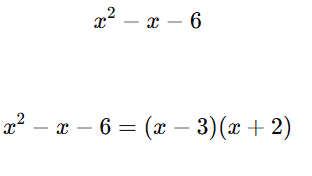
Step 1: Factor all denominators
The denominator in all three terms is the same:
Source: Kapdec.com
So, the equation becomes:

Source: Kapdec.com
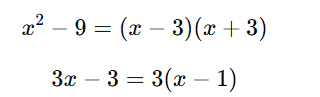
Step 2: Factor the numerator
Source: Kapdec.com
So the equation now is:

Source: Kapdec.com
Step 3: Cancel any common factors where possible
In the first term:

Source: Kapdec.com
So, after simplifying, the equation becomes:

Source: Kapdec.com
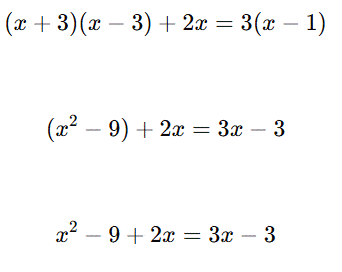
Step 4: Multiply both sides by the denominator
Source: Kapdec.com
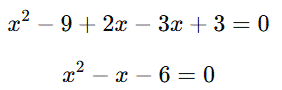
Step 5: Bring all terms to one side
Source: Kapdec.com
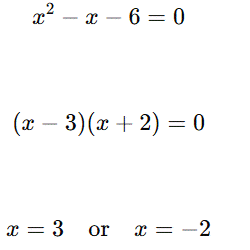
Step 6: Solve the quadratic equation
Source: Kapdec.com
Final Answer:
Both solutions are extraneous (because both make the original denominator zero).
Here are five conclusive points: –
- Understanding Restrictions is Critical:
Before performing any operation on a rational expression, identifying and respecting domain restrictions (values that make the denominator zero) is essential to avoid undefined results.
- Simplification Requires Factoring:
Simplifying rational expressions relies heavily on factoring both the numerator and denominator to cancel out common factors without altering the original value (except at restricted points).
- Operations Follow Fraction Rules:
All basic arithmetic operations (addition, subtraction, multiplication, division) with rational expressions follow the same rules as numerical fractions but require careful handling of variables and polynomials.
- Equation Solving Requires Eliminating Denominators:
To solve rational equations, denominators must typically be cleared by multiplying both sides by the least common denominator (LCD), ensuring to check for extraneous solutions afterward.
- Real-World Applications are Common:
Rational expressions are widely applicable in real-world scenarios like work problems, rates of change, mixing solutions, and any context where relationships between two changing quantities are represented as ratios.
