KAPDEC® | Elite STEM Learning Platform | https://kapdec.com
Unit: Graphing: Finding Solutions
Chapter: Non-Linear Functions and Linear Inequalities
Reference: – Definition of Non-Linear Functions, Types of Non-Linear Functions, Graphing Quadratic Functions, Graphing Absolute Value Functions, Graphing Cubic and Radical Functions, Graphing Exponential Functions, Definition of Linear Inequalities, Graphing Linear Inequalities in Two Variables, Identifying Solution Regions, Intersection of Inequality Regions (Systems of Inequalities), Boundary Lines and Open/Closed Solutions, Checking Solutions in Inequalities, Piecewise Definition of Non-Linear Functions
After studying this chapter, you should be able to understand:
- Definition of Non-Linear Functions & Types of Non-Linear Functions
- Graphing Quadratic Functions & Graphing Absolute Value Functions
- Definition of Linear Inequalities & Graphing Linear Inequalities in Two Variables
- Piecewise Definition of Non-Linear Functions
- Definition of Non-Linear Functions:
Non-linear functions are mathematical functions where the rate of change is not constant, and their graphs are not straight lines. Their equations involve variables raised to powers other than one or involve operations like roots or exponents.
- Types of Non-Linear Functions:
Non-linear functions include various categories like quadratic functions, cubic functions, exponential functions, logarithmic functions, radical functions, and absolute value functions. Each type has distinct characteristics and graph shapes.
- Graphing Quadratic Functions:
The graph of a quadratic function is a parabola, which can open upwards or downwards. Important features include the vertex (turning point), the axis of symmetry, and the direction of opening.
- Graphing Absolute Value Functions:
An absolute value function creates a V-shaped graph. It shows how values deviate positively from a central axis regardless of their sign, and transformations shift or stretch this graph.
- Graphing Cubic and Radical Functions:
Cubic functions produce S-shaped or curve-shaped graphs that change direction once. Radical functions, such as square root functions, start at a particular point and increase or decrease gradually in a curved fashion.
- Graphing Exponential Functions:
Exponential functions involve variables in the exponent. Their graphs represent rapid growth or decay, depending on the base of the exponent. They approach an asymptote and never cross it.
- Definition of Linear Inequalities:
A linear inequality expresses a relationship where two expressions are compared using inequality symbols (like less than or greater than). Its graph represents a half-plane divided by a straight boundary line.
- Graphing Linear Inequalities in Two Variables:
This involves plotting the boundary line associated with the inequality and shading the appropriate side of the line to indicate the solution region where the inequality holds true.
- Identifying Solution Regions:
The solution region in an inequality graph is the area where all points satisfy the inequality. It is usually shaded on the graph. Test points may be used to determine which side of the boundary line to shade.
- Intersection of Inequality Regions (Systems of Inequalities):
When graphing multiple inequalities, the solution is the overlapping region where all inequalities are satisfied at the same time. This shows the set of possible values that fulfil every condition.
- Boundary Lines and Open/Closed Solutions:
A solid boundary line represents solutions that include the line (using ≤ or ≥), while a dashed boundary line shows that points on the line are not included in the solution set (using < or >).
- Checking Solutions in Inequalities:
After graphing an inequality, substituting a test point (often the origin) helps verify whether the chosen shaded region correctly represents the solution to the inequality.
- Piecewise Definition of Non-Linear Functions:
Piecewise functions are defined by different expressions for different parts of the domain. Their graphs are made of multiple segments, each corresponding to a specific interval of the input values.
- Real-World Applications of Non-Linear Graphs and Inequalities:
Non-linear functions and inequalities can model real-world phenomena like population growth, physics-based trajectories, business profit constraints, or resource limitations in economics.
- Limitations and Accuracy of Graphing Methods:
Graphical solutions often provide visual approximations, especially for non-linear functions. Precise values may not always be clear from the graph, and algebraic methods are sometimes needed for exact solutions.
Example: –
Solve the following system graphically and algebraically. Also, represent the solution region clearly:
Given:
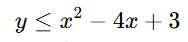
Non-linear function (parabola):
Source: Kapdec.com
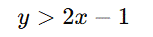
Linear inequality:
Source: Kapdec.com
Find the solution region that satisfies both conditions simultaneously.
Solution: –
- Equation:

Source: Kapdec.com
This is a quadratic function, representing a parabola that opens upward.
- Its boundary line is solid because of the “≤” sign (meaning points on the parabola are included in the solution).
We are interested in the region below or on the parabola.
Analyse the Linear Inequality
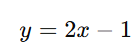
Equation:
Source: Kapdec.com
This is a linear equation, representing a straight line with positive slope.
The inequality is “>”, so the solution lies above the line, and the boundary line is dashed (since it doesn’t include the points on the line).
We need to find where the two curves meet (intersection points of the parabola and the line).
So, set them equal:

Source: Kapdec.com
Bring all terms to one side:

Source: Kapdec.com
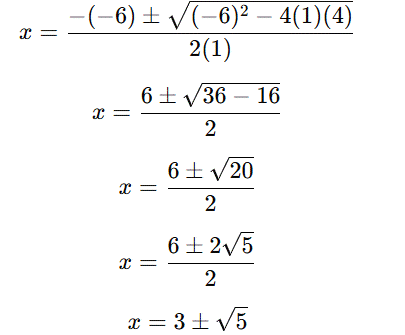
Now, use the quadratic formula:
Source: Kapdec.com
So the two intersection points are:

Source: Kapdec.com
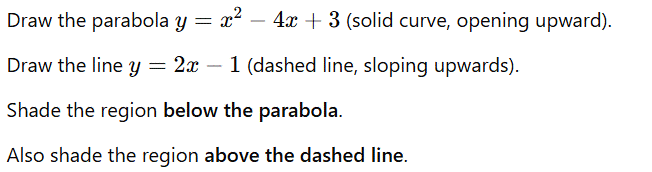
Graphical Interpretation (Conceptual Description):
On a graph:
Source: Kapdec.com
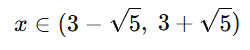
Final Answer (Graphical + Algebraic Summary):
Source: Kapdec.com
Here are five conclusive points for “Linear Functions in a Coordinate Plane”:
- Non-linear functions introduce complex graph shapes:
Unlike linear functions, non-linear functions produce curves such as parabolas, exponential curves, or absolute value graphs, making visual interpretation and solution-finding more diverse and interesting.
- Linear inequalities represent regions, not just lines:
When graphing linear inequalities, solutions are not single points or lines but shaded regions that represent all possible solutions satisfying the inequality conditions.
- Understanding boundary lines is essential for correct graphing:
Correctly identifying whether a boundary is solid (inclusive) or dashed (exclusive) is crucial in representing the solution area for linear inequalities.
- Systems of inequalities highlight intersection regions:
When solving systems of linear inequalities, the solution is always found in the overlapping (common) shaded region, demonstrating simultaneous satisfaction of multiple conditions.
- Graphing non-linear and inequality functions provides strong visual problem-solving skills:
Learning to graph both non-linear functions and linear inequalities helps develop a deeper understanding of relationships between variables, which is useful for analysing and solving real-world and abstract algebraic problems.
Scan to visit this resource online
https://kapdec.com/resources/non-linear-functions-and-linear-inequalities
