KAPDEC® | Elite STEM Learning Platform | https://kapdec.com
Unit: Circular Motion and Gravitation
Chapter: Vector fields
Reference: AP Physics Algebra, Circular Motion and Gravitation, Vector fields, Scalar, Vector, Position Vector, Types of Vectors, Vector Addition, Triangle law of vector addition, Vector Subtraction, Multiplication of a Vector by a Scalar, Scalar (or dot) product of two vectors, Two important properties of the scalar product
After studying this chapter, you should be able to:
- Know the concept of the vector
- Calculate vector addition, subtraction, multiplication
- Know the important properties of vector
Scalar
The physical quantity has a magnitude but no specific direction.
e.g. – distance, mass, speed.
Vector
The physical quantity has a magnitude as well as direction and follows the vector law of addition. e.g. – forces, velocity, displacement, momentum.
Note-1
Current is not a vector quantity though it has direction and magnitude as it does not follow the vector law of addition.
Position Vector
The position vector is used to specify the position of a certain body. The position vector of an object is measured from the origin, in general.
Position vector (r) = xi + yj + zk
Where,
i = unit vector along x direction
j = unit vector along y direction
k = unit vector along z direction
Types of Vectors:
Zero Vector: A vector, whose initial and terminal points coincide, is called a zero vector or (null vector). It is denoted by 0.
A zero vector cannot be assigned a definite direction as it has zero magnitudes.
The vectors AA, BB represent the zero vector.
Unit Vector: A vector whose magnitude is unity (i.e., 1 unit) is called a unit vector.
The unit vector in the direction of a given vector a

Source: Kapdec.com
is denoted by a

Source: Kapdec.com
.
Coinitial Vectors: Two or more vectors having the same initial point are called coinitial vectors.
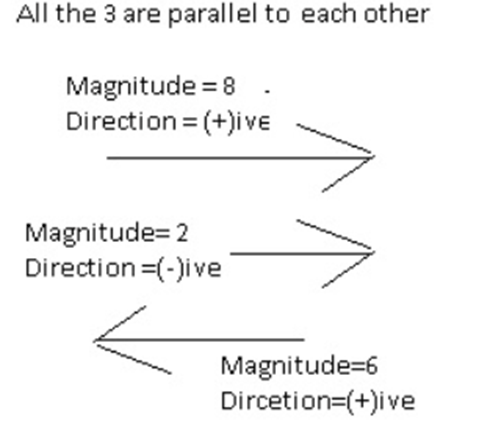
Collinear Vectors: Two or more vectors are said to be collinear if they are parallel to the same line, irrespective of their magnitudes and directions.
For example: Consider 3 vectors as shown in the figure, they all are parallel to each other but their magnitudes are different as well as the directions. But they are said to be collinear vectors because they are parallel to each other.
Source: Kapdec.com
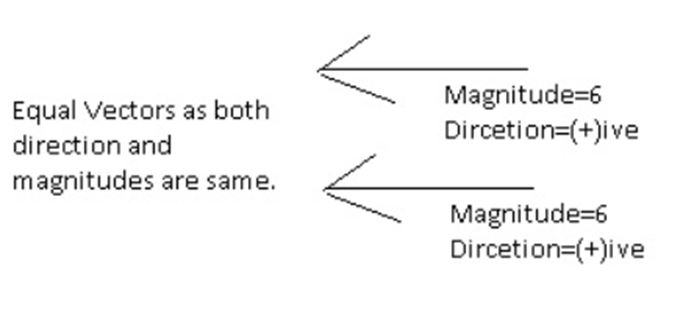
Equal Vectors: Two vectors a
Source: Kapdec.com
and b

Source: Kapdec.com
are said to be equal, if they have the same magnitude and direction regardless of the positions of their initial points, and are written as a
Source: Kapdec.com
and b
Source: Kapdec.com
.
For example: Consider 2 vectors whose magnitudes and their directions are the same irrespective of origin, then they are known as equal vectors.
Source: Kapdec.com
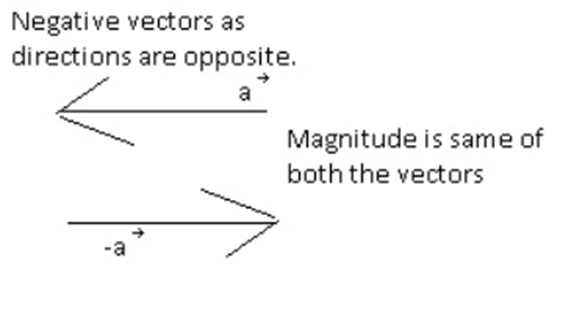
Negative of a Vector: A vector whose magnitude is the same as that of a given vector but whose direction is opposite to that of it is called the negative of the given vector.
Source: Kapdec.com
Vector Addition
A variety of mathematical operations can be performed with and upon vectors. One such operation is the addition of vectors. Two vectors can be added together to determine the result (or resultant). This process of adding two or more vectors has already been discussed in an earlier unit.
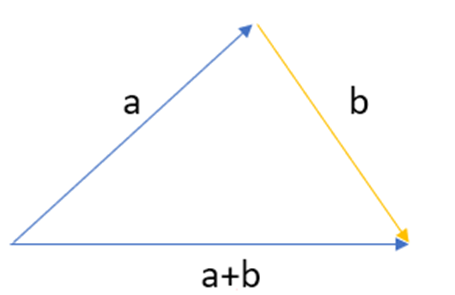
The two vectors a and b can be added giving the sum to be a + b. This requires joining them head to tail.
Source: Kapdec.com
Characteristics of Vector Math Addition
- Commutative Law: a + b = b + a
- Associative law: (a + b) + c = a + (b + c)
Triangle law of vector addition
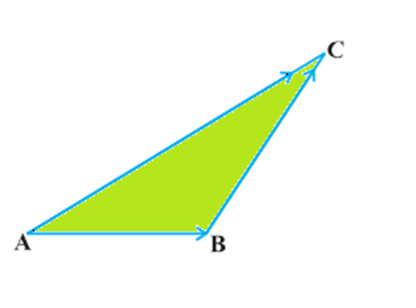
The triangle law of vector addition is appropriate to deal with such a situation. If two vectors are represented by two sides of a triangle in sequence, then the third closing side of the triangle, in the opposite direction of the sequence, represents the sum (or resultant) of the two vectors in both magnitude and direction.
A vector AB simply means the displacement from point A to point B. Now consider a situation in that a girl moves from A to B and then from B to C.
Source: Kapdec.com
The net displacement made by the girl from point A to point C, is given by the vector AC and expressed as
AC=AB+BC
Vector Subtraction
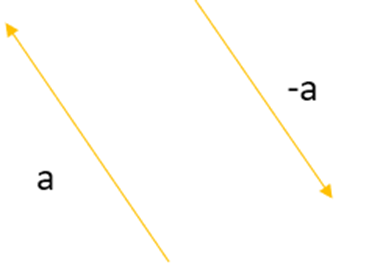
To subtract two vectors, you put their feet (or tails, the non-pointy parts) together; then draw the resultant vector, which is the difference of the two vectors, from the head of the vector you’re subtracting to the head of the vector you’re subtracting it from.
A reverse vector (-a) which is opposite of (a) has a similar magnitude as (a) but is pointed in the opposite direction.
Source: Kapdec.com
Multiplication of a Vector by a Scalar
The multiplication of a vector by a scalar quantity is called “Scaling.” In this type of multiplication, only the magnitude of a vector is changed not the direction.
- S(a + b) = Sa + Sb
- (S + T)a = Sa + Ta
- a.1 = a
- a.0 = 0
- a.(-1) = -a
Vector joining two points
If P1(x1, y1, z1) and P2(x2, y2, z2) are any two points, then the vector joining P1 and P2 is the vector P1P2.
Joining the points P1 and P2 with the origin O, and applying triangle law, from the triangle OP1P2, we have
Scalar (or dot) product of two vectors
In mathematics, the dot product or scalar product is an algebraic operation that takes two equal-length sequences of numbers (usually coordinate vectors), and returns a single number. … Geometrically, it is the product of the Euclidean magnitudes of the two vectors and the cosine of the angle between them.
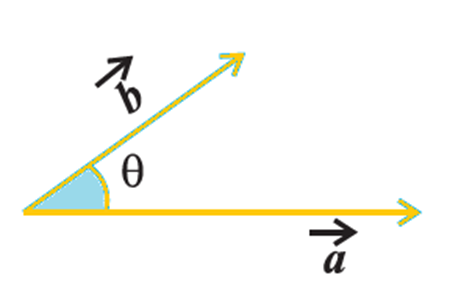
The scalar product of two nonzero vectors a and b, denoted by a . b, is defined as
Source: Kapdec.com
a . b=ab cosθ,
Two important properties of the scalar product
Property 1 (Distributivity of scalar product over addition) Let a, b and c

Source: Kapdec.com
be any three vectors, then a .b+c=a . b+a . c
Property 2 Let a
Source: Kapdec.com
and b
Source: Kapdec.com
be any two vectors, and l be any scalar. Then
la.b=la.b=la . b=a .lb
Key points:
- The position vector of a point P(x, y, z) is given as OP=r=xi+yj+zk, and its magnitude by x2+y2+z2 .
- The scalar components of a vector are its direction ratios and represent its projections along the respective axes.
- The magnitude (r), direction ratios (a, b, c) and direction cosines
- (l, m, n) of any vector are related as:
l=ar , m=br , n=cr
- The vector sum of the three sides of a triangle taken in order is 0

Source: Kapdec.com
.
- The vector sum of two coinitial vectors is given by the diagonal of the parallelogram whose adjacent sides are the given vectors.
- The multiplication of a given vector by a scalar l, changes the magnitude of the vector by the multiple |l|, and keeps the direction the same (or makes it opposite) according to the value of l is positive (or negative).
- For a given vector a

Source: Kapdec.com
, the vector a=a|a| gives the unit vector in the direction of a
Source: Kapdec.com
.
- The position vector of a point R dividing a line segment joining
- the points P and Q whose position vectors a
Source: Kapdec.com
and b

Source: Kapdec.com
are respectively, in the ratio m : n.
