KAPDEC® | Elite STEM Learning Platform | https://kapdec.com
Unit (5): Heredity
Chapter: Mendelian genetics
Reference: Mendel’s law of inheritance, monohybrid cross, dihybrid cross
Learning objectives
- To learn about Mendel’s law of inheritance
MENDEL’S LAWS OF INHERITANCE
- Gregor Mendel, conducted hybridisation experiments on garden peas for seven years (1856-1863) and proposed the laws of inheritance in living organisms.
- Mendelism: the study of Mendel’s laws of inheritance, which are:
(a)Law of dominance
(b) Law of segregation
(c)Law of independent assortment
- Mendel selected 7 contrasting traits, which always appears in the two opposite conditions.
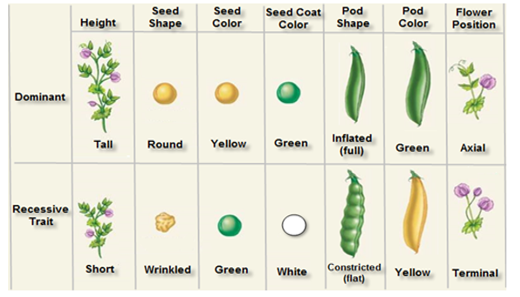
Source: Kapdec.com
Contrasting traits of garden pea plant selected by Mendel
- Mendel conducted such artificial pollination/cross pollination experiments
using several true-breeding pea lines.
- True breeding line is the progeny of an organism that is homozygous because of continuous inbreeding.
Advantages of pea plant-
- Presence of number of easily detectable contrasting characters
- Pure varieties of pea are available
- Short life span and gives result in 3 months
- Large no of seeds are produced per plant
- Though plant is self-pollinated but can undergo cross-pollination also.
- Pea flowers contain both male and female organs.
Monohybrid Cross
When one pair of contrasting characters was taken to cross two pea plants, it is known as a monohybrid cross.
- Mendel took pea plants with different characteristics as tall plants and short plants.
- The first generation or F1 progeny thus formed are all tall.
- Mendel then allowed the F1 progeny plants for self-pollination
- The second generation of F2 progeny of the F1 tall plants are not all tall, some are short. This indicates that both tallness and shortness traits were inherited in F1 plants but only the tallness trait was expressed.
- Thus, two copies of the traits are inherited in each sexually reproducing organism.
- In the figure, both TT and Tt are tall plants, while the only tt is a short plant.
- A single copy of T is enough to make the plant tall while both copies must be ‘t’ for the plant to be short. Therefore, traits like ‘T’ are dominant traits while ‘t’ are recessive traits.
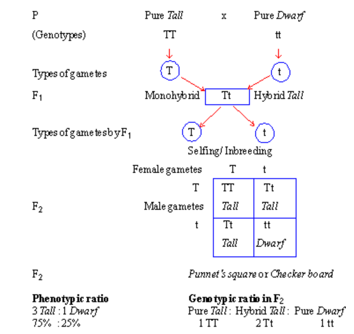
Source: Kapdec.com
Symbolic representation of a cross between tall and dwarf pea plant
- Punnett square method- by British geneticist R. C. Punnett. For situations involving one or two genes, it is possible to write down all the gametes and combine them systematically to generate the array of zygotic genotypes. Once these have been obtained, the Principle of Dominance can be used to determine the associated phenotypes.
- The forked line method– predicting the outcome of a cross involving two or more genes is the forked-line method. However, instead of enumerating the progeny in a square by combining the gametes systematically, we tally them in a diagram of branching lines.
The Principle of Dominance: In a heterozygote, one allele may conceal the presence of another. This principle is a statement about genetic function. Some alleles evidently control the phenotype even when they are present in a single copy.
- It also states that characters are controlled by discrete units called factors, factors occur in pairs and in a dissimilar pair of factors one member of the pair dominates (dominant) the other (recessive).
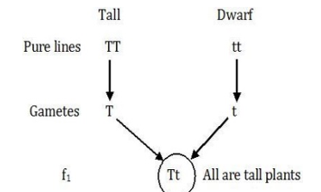
Source: Kapdec.com
Fig.6. A monohybrid cross showing law of dominance
- The Principle of Segregation: In a heterozygote, two different alleles segregate from each other during the formation of gametes. This principle is a statement about genetic transmission. An allele is transmitted faithfully to the next generation, even if it was present with a different allele in a heterozygote. The biological basis for this phenomenon is the pairing and subsequent separation of homologous chromosomes during meiosis.
- Dihybrid cross- it involves the inheritance of two pairs of contrasting characteristics at the same time.
- Mendel took pea plants with two different characteristics such as a tall plant with round seeds and a short plant with wrinkled seeds.
- F1 progeny are all tall with round seeds. Thus, tallness and round seeds are dominant traits.
- F2 progeny are tall plants with round seeds and some short plants with wrinkled seeds.
- But some F2 progeny shows new mixtures like tall having wrinkled seeds and short having round seeds.
- Therefore, tall/ short traits and round seed/wrinkled seed traits are independently inherited.

Source: Kapdec.com
Solved examples
Example 1. What do you call the physical expression of a gene?
- Genotype b) dominant c) phenotype d)allele
Solution 1: c. The physical expression of a gene is called phenotype
Example 2. Two brown eyed parents (Bb) have a baby. What is the chance the baby is blue eyed?
a)0 % b)25% c)50% d)75%
Solution 2: b. 25% chances are there that the baby is blue eyed.
Summary
•Genetics is branch of biology dealing with principles of inheritance and its practices.
•Mendel studied inheritance of seven different traits in garden peas, each trait being controlled by a different gene.
•Mendel’s research led him to formulate 3 principles of inheritance- alleles of a gene are either dominant or recessive, different alleles of gene segregate from each other and allele of different gene assorts independently.
•Outcome of cross can be predicted by systematic enumeration of genotypes using punnet square. When more than two genes are involved, forked line is used to predict outcome of cross.
