KAPDEC® | Elite STEM Learning Platform | https://kapdec.com
Unit: Measurement System
Chapter: Surface Area and Volume of Solids, Conversion of Solids, Frustum of a Cone
Reference: – Introduction to Solids, Surface Area and Volume of Cuboid, Cube, Cylinder, Cone, Sphere, Conversion of Solids from One Shape to Another, Frustum of a Cone – Surface Area and Volume, Applications and Word Problems
After studying this chapter, you should be able to understand:
- The concepts of surface area and volume for common 3D shapes.
- How to calculate the surface area and volume of a frustum of a cone.
- The principle of conversion of solids and its applications.
- How to solve real-world problems involving these concepts.
Introduction to Solids
Definition
A solid is a three-dimensional object that has length, breadth, and height (or depth). Unlike 2D shapes, solids occupy space and have volume. Common solids include cubes, cuboids, cylinders, cones, and spheres.
The surface area is the total area of the outer surfaces of the solid, while the volume is the amount of space enclosed by the solid.
[Importance of Solids]
- Essential for understanding objects in the real world, from boxes to buildings.
- Used in fields like architecture, engineering, and manufacturing.
- Helps in calculating material requirements, capacity, and cost.
- Forms the basis for more advanced topics in mathematics and physics.
Example
A cardboard box is an example of a cuboid. Its surface area would be the area of cardboard used, and its volume would be the space inside it.
[Subtopics]
1. Types of Solids
- Polyhedra: Solids with flat faces (e.g., cube, cuboid, pyramid).
- Curved Solids: Solids with curved surfaces (e.g., cylinder, cone, sphere).
Key Points:
- Lateral Surface Area (LSA): The area of all faces excluding the top and bottom.
- Total Surface Area (TSA): The area of all faces, including top and bottom.
- Volume: The measure of the space occupied by the solid.
Surface Area and Volume of Cuboid and Cube
[Definition]
- A cuboid is a solid with six rectangular faces. It has length (l), breadth (b), and height (h).
- A cube is a special cuboid where length = breadth = height = a.
[Importance of Cuboid and Cube]
- Most common shapes for packaging and storage.
- Easy to model and calculate for various applications.
- Foundation for understanding more complex solids.
Examples
- Find the TSA and volume of a cuboid with l=5 cm, b=4 cm, h=3 cm.
[Subtopics]
1. Formulas for Cuboid
- Volume (V) = l × b × h
- LSA = 2h(l + b)
- TSA = 2(lb + bh + hl)
2. Formulas for Cube
- Volume (V) = a³
- LSA = 4a²
- TSA = 6a²
Surface Area and Volume of Cylinder
[Definition]
A cylinder is a solid with two parallel circular bases connected by a curved surface. It has a height (h) and a base radius (r).
[Importance of Cylinder]
- Used in containers like cans, pipes, and tanks.
- Common in mechanical and civil engineering.
- Helps in understanding curved surface areas.
Examples
- Find the volume of a cylinder with r=7 cm and h=10 cm.
[Subtopics]
1. Formulas for Cylinder
- Volume (V) = πr²h
- Curved Surface Area (CSA) = 2πrh
- Total Surface Area (TSA) = 2πr(h + r)
Surface Area and Volume of Cone
[Definition]
A cone is a solid that tapers smoothly from a flat circular base to a point called the apex or vertex. It has a base radius (r), height (h), and slant height (l).
[Importance of Cone]
- Used in funnels, ice cream cones, and party hats.
- Important in geometry and calculus.
- Helps in understanding the concept of slant height.
Examples
- Find the slant height of a cone with r=3 cm and h=4 cm.
[Subtopics]
1. Formulas for Cone
- Slant Height (l) = √(r² + h²)
- Volume (V) = (1/3)πr²h
- CSA = πrl
- TSA = πr(l + r)
Surface Area and Volume of Sphere
[Definition]
A sphere is a perfectly round geometrical object in three-dimensional space, like a ball. It is defined by its radius (r).
[Importance of Sphere]
- Models objects like planets, balls, and bubbles.
- Used in physics and astronomy.
- Has the smallest surface area for a given volume.
Examples
- Find the surface area of a sphere with r=7 cm.
[Subtopics]
1. Formulas for Sphere
- Volume (V) = (4/3)πr³
- Surface Area (SA) = 4πr²
Conversion of Solids from One Shape to Another
[Definition]
This concept involves melting or reshaping a solid into another solid without any loss of material. The volume remains constant during conversion.
[Importance of Conversion]
- Practical in metallurgy and manufacturing.
- Helps in solving problems involving material reuse.
- Tests understanding of volume conservation.
Examples
- A metallic sphere of radius 6 cm is melted and recast into a cylinder of radius 3 cm. Find the height of the cylinder.
[Subtopics]
1. Principle
Volume of original solid = Volume of new solid
2. Application
Set up an equation using the volume formulas of both solids and solve for the unknown dimension.
Frustum of a Cone
[Definition]
When a cone is cut by a plane parallel to its base, the portion between the base and the cutting plane is called a frustum of the cone. It has two circular bases of different radii.
[Importance of Frustum]
- Common in buckets, lampshades, and certain architectural elements.
- Extends the understanding of cones to truncated shapes.
- Useful in practical volume and surface area calculations.
Examples
- Find the volume of a frustum with radii 3 cm and 5 cm, and height 6 cm.
[Subtopics]
1. Elements of a Frustum
- R: Radius of the larger base.
- r: Radius of the smaller base.
- h: Height of the frustum (vertical distance between bases).
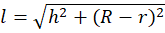
- l: Slant height of the frustum,
Source: Kapdec.com
.
2. Formulas for Frustum
- Volume (V) = (1/3)πh (R² + r² + Rr)
- CSA = πl (R + r)
- TSA = CSA + π(R² + r²)
Applications and Word Problems
[Definition]
These problems involve applying the formulas for surface area, volume, and conversion to real-life situations. They often require multiple steps and logical reasoning.
[Importance of Word Problems]
- Bridges theoretical math with practical application.
- Enhances problem-solving and analytical skills.
- Common in academic and competitive exams.
Examples
- A tent is in the shape of a cylinder surmounted by a cone. Find the canvas required for the tent.
[Subtopics]
1. Problem-Solving Strategy
- Understand the problem and identify the solids involved.
- Note down the given dimensions.
- Determine which formulas are needed (SA, Volume, etc.).
- Perform the calculations step by step.
- Ensure units are consistent and interpret the result.
[Example: -]
Problem Statement:
A solid metallic sphere of radius 10.5 cm is melted and recast into a number of smaller cones, each of radius 3.5 cm and height 3 cm. Find the number of cones formed.
Also, a bucket (frustum of a cone) has top and bottom radii of 28 cm and 21 cm respectively, and a height of 15 cm. Find its capacity in liters.
Question: Solve both parts. Prove your answers by providing a step-by-step solution and giving three independent reasons supporting your conclusion for the first part from these domains: (A) Volume Conservation Principle, (B) Mathematical Calculation, (C) Logical Unit Analysis.
[Solution: -]
Part 1: Number of Cones Formed
Given:
- Radius of sphere,

Source: Kapdec.com
cm
- Radius of each cone,

Source: Kapdec.com
cm
- Height of each cone,

Source: Kapdec.com
cm
(A) Volume Conservation Principle
When a solid is melted and recast, its volume remains unchanged.
Therefore, Volume of Sphere = Number of cones × Volume of one cone.
(B) Mathematical Calculation
First, calculate the volume of the sphere:

Source: Kapdec.com
Compute

Source: Kapdec.com

Source: Kapdec.com
Simplify step-by-step:
First,

Source: Kapdec.com
Then, ..

Source: Kapdec.com
Let’s compute precisely:

Source: Kapdec.com
Then,

Source: Kapdec.com
cm³.
So,

Source: Kapdec.com
cm³.
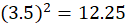
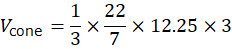
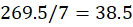
Now, volume of one cone:

Source: Kapdec.com
Compute
Source: Kapdec.com
Source: Kapdec.com
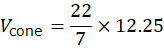
The 3 in numerator and denominator cancel:
Source: Kapdec.com

Source: Kapdec.com
,
Source: Kapdec.com
cm³.
Number of cones,

Source: Kapdec.com
Compute:

Source: Kapdec.com
So,

Source: Kapdec.com
.
(C) Logical Unit Analysis
The volumes are both in cm³, so the ratio

Source: Kapdec.com
is a dimensionless number, correctly giving the number of cones. The calculation is consistent with unit analysis.
Therefore, the number of cones formed is 126.
Part 2: Capacity of the Bucket (Frustum)
Given:
- Top radius, R=28 cm
- Bottom radius, r=21 cm
- Height, h=15 cm
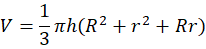
The bucket is a frustum of a cone. Its capacity is its volume.
Volume of frustum:
Source: Kapdec.com
Substitute the values:

Source: Kapdec.com
Compute the terms inside:

Source: Kapdec.com

Source: Kapdec.com

Source: Kapdec.com
Sum = 784+441+588=1813
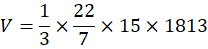
Now,
Source: Kapdec.com
First,

Source: Kapdec.com
So,

Source: Kapdec.com

Source: Kapdec.com
39886/7=5698 cm³ (approximately, let’s compute exactly).
Actually, 1813/7=259 exactly? Let’s check: 7×259=1813. Yes!
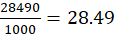
So, V=5×22×259=110×259=28490 cm³.
Now, convert to liters. Since 1 liter = 1000 cm³,
Capacity =
Source: Kapdec.com
liters ≈ 28.5 liters.
Final Answers:
- Number of cones formed = 126
- Capacity of the bucket = 28.5 liters (approximately)
The solution for the number of cones is verified by the principle of volume conservation, precise mathematical computation, and logical unit analysis.
Scan to visit this resource online
