KAPDEC® | Elite STEM Learning Platform | https://kapdec.com
Unit: Similarity
Chapter: Similarity Axioms of Triangles
Reference: – AA (Angle-Angle) Similarity Postulate, SSS (Side-Side-Side) Similarity Theorem, SAS (Side-Angle-Side) Similarity Theorem, AA Criterion for Similarity of Right Triangles, Basic Proportionality Theorem (Thales’ Theorem), Converse of the Basic Proportionality Theorem, Properties of Similar Triangles, Area of Similar Triangles
After studying this chapter, you should be able to understand:
- AA (Angle-Angle) Similarity Postulate & SSS (Side-Side-Side) Similarity Theorem
- SAS (Side-Angle-Side) Similarity Theorem
- Converse of the Basic Proportionality Theorem
- Properties of Similar Triangles & Area of Similar Triangles
Definition of Similar Triangles – Two triangles are considered similar if their corresponding angles are congruent, and the lengths of their corresponding sides are proportional. This means that the triangles have the same shape but may differ in size. Their corresponding angles are identical, and their sides have the same ratio.
AA (Angle-Angle) Similarity Postulate – If two angles of one triangle are congruent to two angles of another triangle, then the two triangles are similar. This postulate is based on the fact that if two angles are congruent, the third angle must also be congruent, ensuring the overall similarity between the triangles.
SSS (Side-Side-Side) Similarity Theorem – If the corresponding sides of two triangles are proportional, meaning the ratio of each pair of corresponding sides is the same, then the two triangles are similar. This theorem does not require the angles to be compared directly, only the proportionality of the sides.
SAS (Side-Angle-Side) Similarity Theorem – If one angle of a triangle is congruent to one angle of another triangle, and the sides including these angles are proportional, then the two triangles are similar. This theorem combines the congruency of one angle with the proportionality of two sides to establish similarity.
AA Criterion for Similarity of Right Triangles – This criterion states that two right triangles are similar if their corresponding angles are congruent. Since one of the angles in each right triangle is 90°, knowing that the other two angles are congruent is enough to prove similarity.
Basic Proportionality Theorem (Thales’ Theorem) – If a line is drawn parallel to one side of a triangle, it divides the other two sides into segments that are proportional. This theorem creates proportional relationships between the segments of a triangle when a parallel line intersects the triangle.
Converse of the Basic Proportionality Theorem – The converse states that if a line divides two sides of a triangle proportionally, then the line must be parallel to the third side. This inverse relationship is useful for proving parallelism and establishing proportionality in triangle geometry.
Properties of Similar Triangles – Similar triangles maintain certain properties: corresponding angles are congruent, and the ratios of corresponding sides are equal. These properties are key when solving problems that involve scaling, area, or finding unknown lengths and angles in similar triangles.
Area of Similar Triangles – The ratio of the areas of two similar triangles is equal to the square of the ratio of their corresponding sides. This means that if two triangles are similar and the ratio of their corresponding sides is k, then the ratio of their areas will be k².
Applications of Triangle Similarity – Similarity principles are widely used in practical applications, such as in determining distances indirectly (e.g., using shadows), scaling geometric figures, and solving problems related to similar objects or shapes in real life, such as maps, models, or designs.
Introduction to Similarity
In geometry, similarity refers to a relationship between two figures that have the same shape but may differ in size. Two figures are similar if their corresponding angles are equal, and their corresponding sides are proportional. This means one figure can be obtained from the other by a combination of rigid motions (translation, rotation, reflection) and dilation (resizing).
For example, all circles are similar, and two triangles are similar if they satisfy AA (Angle-Angle), SAS (Side-Angle-Side), or SSS (Side-Side-Side) similarity criteria. Similarity is widely used in real-world applications like scaling maps, models, and architecture.
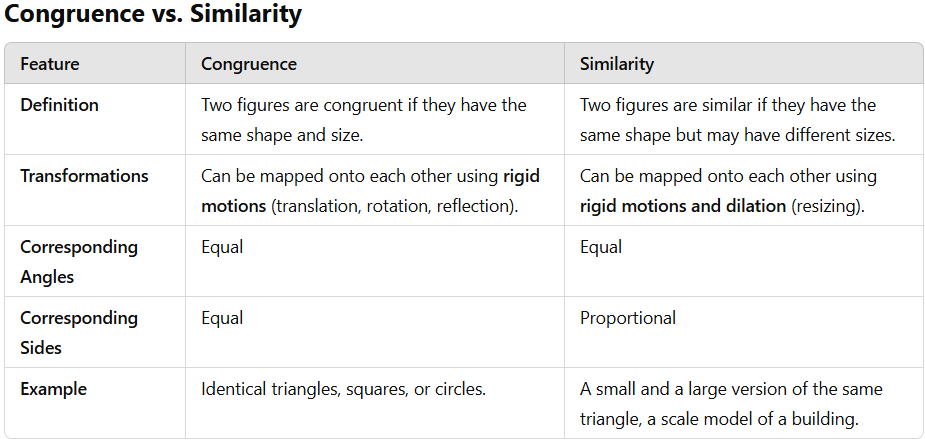
Congruency vs. Similarity
Definition
- Congruence: Figures have the same shape and size.
- Similarity: Figures have the same shape but may have different sizes.
Transformations Used
- Congruence: Achieved through rigid motions (translation, rotation, reflection).
- Similarity: Achieved through rigid motions and dilation (resizing).
Corresponding Angles
- Congruence: Equal.
- Similarity: Equal.
Corresponding Sides
- Congruence: Equal.
- Similarity: Proportional.
Mathematical Criteria
- Congruence: SSS, SAS, ASA, AAS (Triangle Congruence Theorems).
- Similarity: AA, SAS, SSS (Triangle Similarity Theorems).
Real-World Examples
- Congruence: Identical playing cards, two identical mobile phones.
- Similarity: A small and a large version of the same painting, scaled models of buildings.
Source: Kapdec.com
Squares and Equilateral Triangles
A regular polygon is a polygon in which all sides are equal. Squares and equilateral triangles are examples of regular polygons.
Source: Kapdec.com
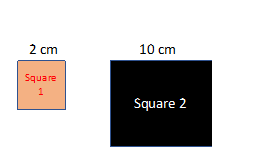
A square with a side length of 2 cm is not congruent to a square with side length of 10 cm. However, all squares only differ by their side length, which is the same on all sides. Since it is only one measure that differs, all squares can be dilated to congruency by a factor of the ratio of the two squares’ side lengths. This means that all squares are similar.
Theorem: All squares are similar.
An equilateral triangle is another figure by which all forms only differ by side length. Thus,
Theorem: All equilateral triangles are similar.
Circles
It’s not quite as easy to classify circle congruency and similarity in terms of points because the edge is round, but it is easy to do it with dilations and rigid motions.
A circle is perfectly symmetric. No matter how you flip it or rotate it, the circle will always look completely the same. Thus, rotations and reflections functionally serve the same purpose as translations. Thus, the only transformations we will talk about here are translations and dilations.
If we can translate the circle on the left so that it completely overlaps with the circle on the right, the circles are congruent. To do that, let’s translate the circles so that their centers overlap.
The circles are obviously not congruent. What if we were to dilate the inner circle until the radius is the same as the outer circle? Then, the circles would look like this.
There is complete overlap! Through two generic circles, we were able to perform a series of translations and dilations to make them completely overlap. Thus, the two generic circles are similar, leading us to the idea that:
Theorem: All circles are similar.
Criteria of Similarity:
There are certain conditions that need to be fulfilled before proving it to be similar. Mainly there are three axioms/rules for similarity.
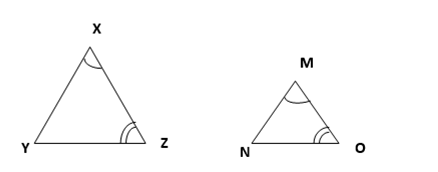
AXIOM 1: Two triangles are said to be similar when they have two same/equal angles. We call it Angle-Angle Axiom (AA axiom).
Source: Kapdec.com
In ∆XYZ and ∆MNO,
If ∠X=∠M and ∠Z= ∠O
Then, ∆XYZ ~ ∆MNO
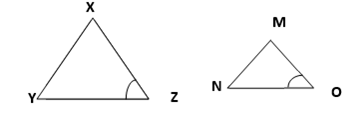
AXIOM 2: Two triangles are said to be similar when two sides are proportional along with the angle between them is equal, then the triangles are similar. It is called as Side-Angle-Side (S.A.S.) axiom.
Source: Kapdec.com
In ∆XYZ and ∆MNO
If ∠Z= ∠O and XZMO= YZNO
Then, ∆XYZ ~ ∆MNO .
AXIOM 3: Two triangles are said to be similar when all the three sides of both triangles are proportional. It is called the Side-Side-Side (S.S.S.) axiom.
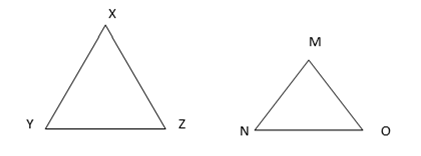
Source: Kapdec.com
In ∆XYZ and ∆MNO
If XYMN= YZN0= ZXOM
Then, ∆XYZ ~ ∆MNO
