KAPDEC® | Elite STEM Learning Platform | https://kapdec.com
Unit: Algebraic Expressions and Identities
Chapter: Standard Identities
Reference: – Introduction to standard identities, Square of a binomial (sum form), Square of a binomial (difference form), Difference of squares identity, Cube of a binomial (sum form), Cube of a binomial (difference form), Verification of identities, Application in simplification, Application in factorization, Use of identities in algebraic equations
After studying this chapter, you should be able to understand:
- Introduction to standard identities
- Square of a binomial (difference form)
- Verification of identities, Application in simplification
- Use of identities in algebraic equations
Here is the theoretical elaboration of each of the standard identities’ topics under the Algebraic Expressions and Identities model:
- Introduction to Standard Identities
Standard identities are predefined algebraic formulas that hold true for all values of the variables involved. They simplify the process of expanding or factoring expressions and serve as foundational tools for solving algebraic problems. - Square of a Binomial (Sum Form)
This identity explains the result of multiplying a binomial that involves addition with itself. It reveals how the square of a sum expands into three terms, involving both squares and a cross product of the terms. - Square of a Binomial (Difference Form)
This is the counterpart of the previous identity, where subtraction is involved. The pattern reveals the expansion of the square of a difference into three terms, with the middle term involving subtraction. - Difference of Squares Identity
This identity is used to represent the product of the sum and difference of two terms. It simplifies to the subtraction of the square of one term from the square of another and is often used in factorization. - Cube of a Binomial (Sum Form)
This identity shows how to expand the cube of a sum of two terms. The expansion involves multiple terms that include both cubes and products of the two original terms, following a recognizable pattern. - Cube of a Binomial (Difference Form)
Similar to the previous identity but with subtraction, this formula expands the cube of a difference into multiple terms that include negative signs and products arranged in a specific structure. - Verification of Identities
This involves proving that both sides of an identity are equivalent through algebraic manipulation. It reinforces understanding and develops the habit of logical validation in mathematical reasoning. - Application in Simplification
Standard identities are often used to simplify complex algebraic expressions. Recognizing these patterns allows students to condense expressions quickly and efficiently. - Application in Factorization
Identities help break down expressions into simpler factors. Recognizing standard forms allows students to convert expanded expressions into factored form, aiding in solving equations or simplifying rational expressions. - Use of Identities in Algebraic Equations
These identities are frequently applied to solve equations by reducing them into simpler forms. Mastery of these tools’ streamlines solving multi-step problems with greater accuracy and speed.
Example: –
Simplify the following expression using standard identities and then solve for x:

Source: Kapdec.com
Solution: –
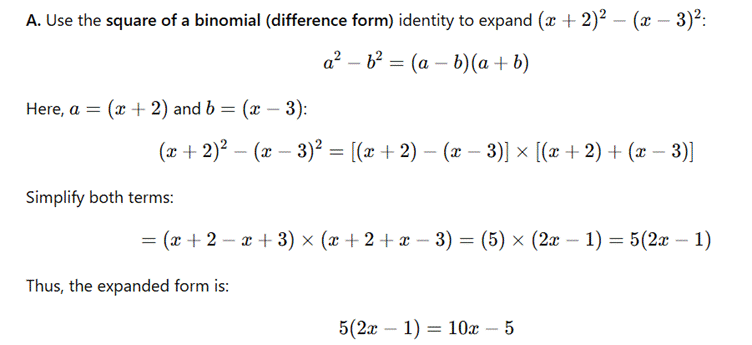
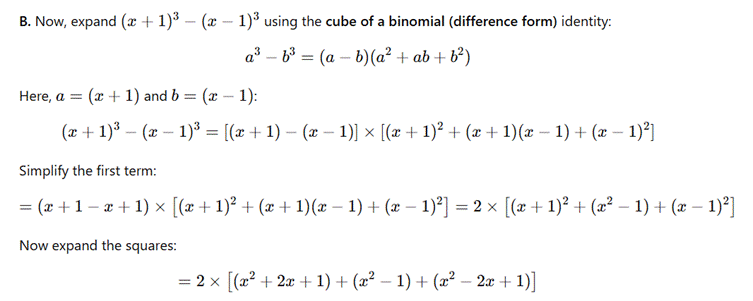
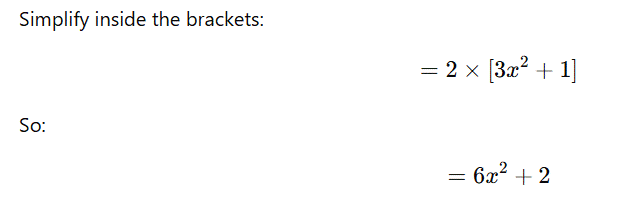
Step 1: Expand each part using the relevant identities
Source: Kapdec.com
Source: Kapdec.com
Source: Kapdec.com
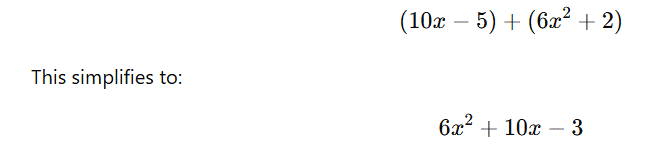
Step 2: Combine the results
Now combine the two expanded expressions:
Source: Kapdec.com
Step 3: Solve for x
If the problem asks to solve the equation for x, say we need to set the simplified expression equal to 0:
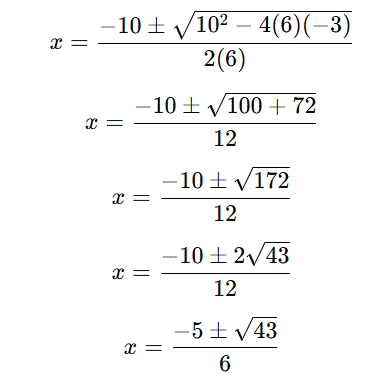
Source: Kapdec.com
Thus, the solutions are:

Source: Kapdec.com
Conclusion:
- We applied multiple standard identities: the difference of squares identity and the cube of a binomial identity.
- We simplified the expression efficiently using these identities.
- We then solved the resulting quadratic equation to find the values of x.
Here are five conclusive points for the topic Standard Identities under Algebraic Expressions and Identities:
- Understanding standard identities enhances algebraic fluency and enables efficient expansion or simplification of expressions.
- These identities serve as foundational shortcuts for solving complex equations without needing lengthy multiplication.
- Recognizing and applying these identities fosters pattern recognition, a key skill in higher-level mathematics.
- They streamline the process of factorization, helping to break down or construct expressions logically.
- Mastery of standard identities is essential for success in algebra, calculus, and various real-world applications involving formula manipulation.
