KAPDEC® | Elite STEM Learning Platform | https://kapdec.com
Unit: Cell communication and cell cycle
Chapter: Feedback
Reference: Feedback mechanism, Negative feedback mechanism with examples, Positive Feedback mechanism with example
Other examples of positive feedback
Learning objectives
- To understand the feedback mechanism of hormones
- To learn about positive and negative feedback with suitable examples
Feedback mechanism: The hormone feedback mechanism is defined as the mechanism that is used to maintain the hormone balance in the blood / body.
- The increase or decrease in the concentration of that hormone can sometimes stimulate and increase the secretion of that hormone or inhibit the secretion of the hormone.
- The excess or deficiency of hormones harms our body. For example, the deficiency of insulin hormone results in a disease called diabetes whereas an excess of insulin in the body can lead to coma.
- So, the hormones must be secreted by the glands in our body in precise quantities which are required for the normal functioning of the body.
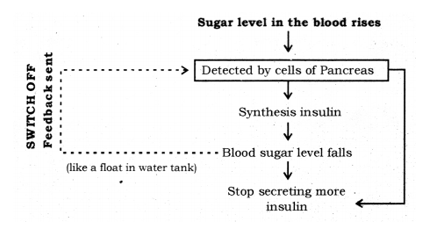
- The timing and amount of hormones released by various glands are controlled by the ‘feedback mechanism’. For example, if the sugar level in the blood rises too much, they are detected by the cells of the pancreas which respond by producing and secreting more insulin into the blood. And as the blood sugar falls to a certain level, the secretion of insulin is reduced automatically.
- A feedback mechanism is a loop that a product feeds into in order to manage its own production.
- Positive and negative feedback mechanisms are two different types of feedback mechanisms.
- Positive feedback stimulates and increases hormone secretion.
- Negative feedback stops and inhibits the hormone from being produced.
Source: Kapdec.com
Negative feedback mechanism with examples
- In negative feedback, the response will reverse or cause the opposite effect of the original stimulus.
- Negative feedback can be explained with the process of insulin production and release.
- After a meal the blood sugar level will be elevated due to the absorption of sugars from the digestive tract.
- This triggers the release of insulin from pancreas. Insulin converts sugar into cells and hence the blood sugar level drops.
- This low blood sugar level will result in the cessation of insulin release. This insulin response is negative feedback. Most endocrine glands are under the control of negative feedback mechanisms
Another example of negative feedback is the regulation of the blood calcium level.
- The parathyroid glands secrete parathyroid hormone, which regulates the level of calcium in the blood.
- If calcium decreases, the parathyroid glands sense the decrease and secrete more parathyroid hormone.
- The parathyroid hormone stimulates calcium release from the bones and increases the calcium uptake into the bloodstream from the collecting tubules in the kidneys.
- Conversely, if blood calcium increases too much, the parathyroid glands reduce parathyroid hormone production. Both responses are examples of negative feedback because in both cases the effects are negative (opposite) to the stimulus.
Positive Feedback mechanism with example
- Positive feedback mechanisms are rare. It amplifies changes rather than reversing them.
- The release of oxytocin from the posterior pituitary gland during labour is an example of positive feedback mechanism.
- Oxytocin stimulates the muscle contractions that push the baby through the birth canal.
- The release of oxytocin result in stronger or augmented contractions during labour.
- The contractions intensify and increase until the baby is outside the birth canal.
- When the stimulus to the pressure receptors ends, oxytocin production stops and labour contractions cease.
Other examples of positive feedback
- Clotting of blood causes the release of clotting factors that cover up the wound.
- Ripening of fruit causes the release of ethylene, which enhances the ripening process of fruits.
- The menstrual cycle causes the release of oestrogen, which promotes the secretion of other hormones that help in ovulation in females.
Solved examples
Example 1. The two types of feedback systems that help organisms maintain homeostasis are:
a) Positive and Negative b) Receptor and effector
c)Static and Dynamic d) Minor and Major
Solution 1: a. The two types of feedback systems that help organisms maintain homeostasis are positive and negative.
Example 2. According to the feedback loop, what does high blood sugar promote?
a) Insulin release b) Glucagon release c) Insulin uptake d) Glycogen uptake
Solution 2: a. According to the feedback loop, high blood sugar promotes insulin release.
Summary
- The property of a system to control any change in the body, amplify the change, and use its output as an input is called feedback in cell communication
- Positive feedback enhances or amplifies changes; and tends to move a system away from its equilibrium state.
- Negative feedbacks buffer changes and thus hold the system in an equilibrium state
- It is a dynamic process and causes continuous changes in our living systems.
