KAPDEC® | Elite STEM Learning Platform | https://kapdec.com
Unit: Sequences in Functions
Chapter: Geometric Sequences
Reference: – Definition of a Geometric Sequence, Common Ratio, General Form of a Geometric Sequence, First Term Identification, Recursive Formula for Geometric Sequences, Explicit Formula for Geometric Sequences, Graphing Geometric Sequences, Geometric Sequences as Exponential Functions, Finding Missing Terms, Sum of Finite Geometric Series, Real-Life Applications of Geometric Sequences
After studying this chapter, you should be able to understand:
- Definition of a Geometric Sequence & Common Ratio
- General Form of a Geometric Sequence & First Term Identification
- Graphing geometric Sequences & Geometric Sequences as Linear Functions
- Applications of Geometric Sequences
- Definition of a Geometric Sequence:
A geometric sequence is a set of terms where each term after the first is obtained by multiplying the previous term by a constant factor called the common ratio.
- Common Ratio:
The common ratio is the fixed multiplier between consecutive terms in a geometric sequence. It remains the same throughout the sequence.
- General Form of a Geometric Sequence:
This is the standard expression that defines any term in a geometric sequence as a function of its position (term number), the first term, and the common ratio.
- First Term Identification:
The first term is the starting value of the sequence, from which all other terms are generated by successive multiplication with the common ratio.
- Recursive Formula for Geometric Sequences:
A recursive formula defines each term in terms of the previous term and the common ratio, indicating how the sequence progresses step by step.
- Explicit Formula for Geometric Sequences:
An explicit formula gives a direct method to calculate any term in the sequence by plugging the term’s position into the formula, without needing to find previous terms.
- Graphing Geometric Sequences:
This involves plotting points representing the term positions and their corresponding values on a coordinate grid to visualize the sequence’s pattern of growth or decay.
- Geometric Sequences as Exponential Functions:
Geometric sequences can be viewed as discrete forms of exponential functions because each term represents repeated multiplication by a constant base.
- Finding Missing Terms:
This involves determining unknown values in the sequence using known terms and the properties of geometric progression, such as the common ratio and term position.
- Sum of Finite Geometric Series:
The finite sum is the total when a limited number of terms from the geometric sequence are added together, typically used to solve for total quantity over a specified number of terms.
- Sum of Infinite Geometric Series (Where Applicable):
For certain geometric sequences where the common ratio’s absolute value is less than one, the sum of infinitely many terms can converge to a finite value.
- Real-Life Applications of Geometric Sequences:
Geometric sequences are used in real-world scenarios that involve repeated multiplication, such as compound interest, population growth, radioactive decay, and scaling patterns.
- Geometric Means:
A geometric mean is a value or set of values that fit between two known terms in a geometric sequence to maintain the constant ratio throughout the sequence.
- Domain and Range of Geometric Sequences:
The domain typically consists of positive integers, representing term positions, while the range consists of the possible values the sequence’s terms can take based on the first term and common ratio.
- Function Notation for Geometric Sequences:
Geometric sequences can be represented as functions, where the input is the term number and the output is the term value, often written using functional notation.
Example: –
A ball is dropped from a height of 100 meters. Each time it bounces, it reaches 80% of its previous height.
Find the total vertical distance the ball travels before it comes to rest, assuming infinite bounces.
Solution: –
Step 1: Understanding the Situation
The ball travels:
- First downward distance = 100 meters (initial drop)
- Then it bounces up to 80% of the previous height, then falls back down the same distance, again and again.
This creates a geometric sequence for the bounce heights.
Step 2: Breaking Total Distance into Parts
Total Distance = First Drop + 2 × (Sum of All Subsequent Bounce Heights)
- First drop = 100 meters
- Every bounce height happens twice (once going up and once coming down), except the first drop.
Step 3: Represent the Bounce Heights as a Geometric Sequence
The heights after each bounce follow a geometric sequence:
- First term of bounces: a= 80% of 100 = 80 meters
- Common ratio: r=0.8 (because each bounce is 80% of the previous height)
So, bounce heights are:
80 m, 64 m, 51.2 m, 40.96 m, … and so on.
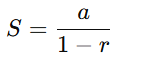
Step 4: Formula for Infinite Geometric Series
For an infinite geometric series with first term a and common ratio r (where ∣r∣<1), the sum S is:
Source: Kapdec.com
Where:
- a=80 (first bounce height)
- r=0.8 (common ratio)
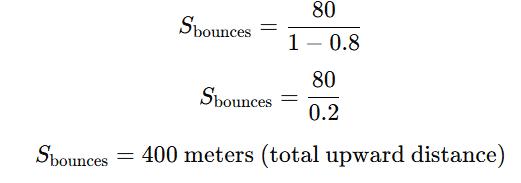
Step 5: Calculate Total Bounce Distance
First calculate the sum of all bounce heights (going upward):
Source: Kapdec.com

Source: Kapdec.com
The ball travels a total vertical distance of 900 meters before coming to rest.
Here are five conclusive points: –
1. Geometric Sequences Model Repeated Multiplication:
A geometric sequence follows a pattern of multiplying by a constant ratio, making it essential for understanding exponential growth and decay processes in both math and real-world scenarios.
2. Explicit and Recursive Formulas Allow Versatile Problem Solving:
Geometric sequences can be expressed in both explicit and recursive forms, giving students flexibility in calculating terms and solving sequence-related problems efficiently.
3. Graphical Behavior Reflects Exponential Patterns:
When plotted, geometric sequences reveal exponential curves (for increasing or decreasing ratios), highlighting their connection to exponential functions and helping in visual interpretation.
4. Finite and Infinite Sums Have Distinct Applications:
Understanding the difference between finite geometric series (sum over a specific number of terms) and infinite geometric series (convergence under certain conditions) is crucial for applications in finance, science, and engineering.
5. Real-Life Contexts Enhance Conceptual Understanding:
Applications of geometric sequences—like calculating compound interest, modeling population growth, or analysing depreciation—demonstrate their practical value and strengthen students’ algebraic reasoning.
