KAPDEC® | Elite STEM Learning Platform | https://kapdec.com
Unit: Playing with Numbers
Chapter: Letters for Digits
Reference: – Understanding the Concept of Letters Representing Digits, Introduction to Cryptarithms (Verbal Arithmetic), Rules and Constraints in Letter-Digit Substitutions, Strategies for Solving Letter-Digit Problems, Applications of Letter-Digit Substitutions in Real-World Problems, Using Algebraic Expressions to Represent Letter-Digit Problems, Exploring Patterns and Logical Deductions in Letter-Digit Problems
After studying this chapter, you should be able to understand:
- Understanding the Concept of Letters Representing Digits
- Rules and Constraints in Letter-Digit Substitutions
- Applications of Letter-Digit Substitutions in Real-World Problems
- Exploring Patterns and Logical Deductions in Letter-Digit Problems
1. Understanding the Concept of Letters Representing Digits
- In mathematical expressions, letters can be used as placeholders to represent numerical values.
- Each letter corresponds to a unique digit within a given number system, ensuring a one-to-one relationship between symbols and numbers.
- This approach allows for generalized mathematical reasoning and forms the basis for algebraic thinking.
- The use of letters to represent digits is fundamental in problem-solving, cryptography, and mathematical modeling.
In the equation A + 2 = 5,
→ A must be 3 (because 3 + 2 = 5).
So, the letter A is a placeholder for the digit 3.
Letters help represent unknown digits and can be solved using logic or algebra.
2. Introduction to Cryptarithms (Verbal Arithmetic)
- A cryptarithm is a mathematical puzzle in which digits in an arithmetic equation are replaced by letters or symbols.
- The objective is to determine the numerical values of each letter while ensuring the equation remains valid.
- These puzzles encourage logical reasoning and analytical skills, as solving them requires recognizing number patterns and relationships.
- Cryptarithms serve as an engaging way to develop problem-solving techniques and algebraic thinking.
Source: Kapdec.com
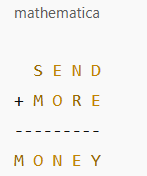
This is a classic cryptarithm where each letter represents a unique digit.
The goal is to figure out what number each letter stands for so the addition is valid.
3. Rules and Constraints in Letter-Digit Substitutions
- Each letter in a letter-digit problem represents a distinct numerical value, meaning no two letters can stand for the same digit.
- The same digit must be consistently assigned to a letter throughout the problem to maintain logical coherence.
- Additional constraints, such as place value rules and mathematical operations, must be considered to ensure accuracy.
- Understanding these constraints is crucial for systematically solving letter-based numerical problems.
- In the cryptarithm above:
- No two letters can have the same digit (E ≠ N).
- The same letter must always have the same value (M is always the same in both “MORE” and “MONEY”).
- A number can’t start with 0 (like M ≠ 0 in “MONEY”).
4. Strategies for Solving Letter-Digit Problems
- Logical deduction and elimination play a significant role in determining the correct digit assignments.
- Identifying patterns in the given numbers helps in narrowing down possible values for each letter.
- Systematic testing of digit assignments, combined with an understanding of arithmetic properties, leads to accurate solutions.
- Breaking down the problem into smaller, manageable steps improves efficiency in finding the correct solution.
Source: Kapdec.com
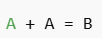
If A = 1, then B = 2
If A = 4, then B = 8
Use logical testing and eliminate values that don’t work.
5. Applications of Letter-Digit Substitutions in Real-World Problems
- Letter-digit substitution techniques are used in encryption, coding systems, and mathematical modeling.
- Such methods are applied in computer science, where symbolic representations of numbers enable secure communication.
- The use of these techniques extends to fields like artificial intelligence, where pattern recognition plays a key role.
- Understanding the application of letter-digit relationships helps in developing problem-solving skills useful in advanced mathematics and technology.
Example:
In digital lock systems or captchas, certain letters/numbers must be identified and matched.
In encryption, codes may look like this:
“X = 7, Y = 2” — these systems hide real digits for security, just like in cryptarithms.
6. Using Algebraic Expressions to Represent Letter-Digit Problems
- Letter-digit problems can be converted into algebraic equations, allowing for systematic analysis.
- Assigning variables to unknown digits enables the application of algebraic techniques, such as substitution and equation solving.
- This approach enhances mathematical flexibility, as different types of letter-based number problems can be analysed algebraically.
- Algebraic representation simplifies complex letter-digit relationships and provides structured solutions.
Source: Kapdec.com
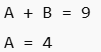
Substitute:
4 + B = 9 → B = 5
7. Exploring Patterns and Logical Deductions in Letter-Digit Problems
- Recognizing recurring patterns in number relationships helps in solving letter-digit problems efficiently.
- Logical deduction involves analysing place values, carrying-over effects, and number properties to determine valid assignments.
- Systematic organization of known and unknown values allows for step-by-step problem-solving.
- Strengthening pattern recognition skills enhances overall mathematical reasoning and logical thinking.
8. Enhancing Problem-Solving Skills Through Number Puzzles
- Engaging with number puzzles improves critical thinking and mathematical intuition.
- Letter-digit problems provide an interactive way to develop problem-solving strategies applicable to real-world situations.
- The challenge of finding correct digit assignments encourages perseverance and deeper analytical thinking.
- Regular practice with such puzzles helps in refining logical reasoning and boosting confidence in mathematical problem-solving.
Example: –
Solve the cryptarithm where each letter represents a unique digit.
SEND+MORE=MONEY
Solution: –
- Understanding Place Values:
- Each letter represents a distinct digit (0-9).
- The sum must be mathematically valid.
- Assigning Place Values:
1000S+100E+10N+D+1000M+100O+10R+E=10000M+1000O+100N+10E+Y
- Key Observations:
- The sum is a five-digit number, so M=1.
- The highest place-value contribution from SEND+MORE must be at least 10,000.
- Logical Deduction:
- O=0 because of place value alignment.
- Carefully assigning digits step by step leads to:
S=9, E=5, N=6, D=7, M=1, O=0, R=8, Y=2
Final Solution:
9567 + 1085 = 10652.
Here are five conclusive points summarizing the chapter “Letters for Digits”
- Letter-Digit Substitution Builds Algebraic Thinking
- Assigning letters to digits introduces students to the concept of variables, strengthening their foundation in algebra and logical reasoning.
- Logical Deduction and Pattern Recognition Are Essential for Problem-Solving
- Successfully solving letter-digit problems requires careful analysis of number patterns, arithmetic rules, and logical deduction techniques.
- Cryptarithms Enhance Critical Thinking and Mathematical Reasoning
- Engaging with mathematical puzzles where letters replace digits helps develop problem-solving skills, fostering deeper analytical thinking.
- Understanding Place Value Is Crucial in Letter-Digit Problems
- Recognizing how numbers are structured, including carry-over effects in addition and borrowing in subtraction, aids in systematically solving these problems.
- Real-World Applications Make Letter-Digit Substitutions Valuable
- The principles of letter-digit problems extend to fields such as cryptography, coding, and artificial intelligence, demonstrating the practical relevance of these mathematical concepts.
