KAPDEC® | Elite STEM Learning Platform | https://kapdec.com
Unit: Real Numbers
Chapter: Euclid’s Division Lemma, Fundamental Theorem of Arithmetic
Reference: – Introduction to Euclid’s Division Lemma, Statement and Proof, Application in Finding HCF, The Fundamental Theorem of Arithmetic, Prime Factorization, Uniqueness of Prime Factorisation, Applications in Rational and Irrational Numbers, HCF and LCM using Prime Factorization
After studying this chapter, you should be able to understand:
- The concept and application of Euclid’s Division Lemma.
- The process of finding HCF using Euclid’s Division Algorithm.
- The statement and significance of the Fundamental Theorem of Arithmetic.
- How to find HCF and LCM using prime factorization.
Introduction to Euclid’s Division Lemma
Definition
Euclid’s Division Lemma is a fundamental result in number theory that provides a formal statement about the division of integers. It asserts that for any two positive integers, there exist unique integers that represent the quotient and remainder upon division.
The core idea is that given any positive integer a and any non-zero positive integer b, we can find unique integers q (quotient) and r (remainder) such that:
a=bq+r,0≤r<b
[Importance of Euclid’s Division Lemma]
- Forms the basis for the Euclidean Algorithm to find the Highest Common Factor (HCF).
- Essential for understanding divisibility properties of integers.
- Used in computer algorithms for efficient computation of HCF.
- Foundation for more advanced concepts in number theory.
Example
Problem: Apply Euclid’s Division Lemma to a=25 and b=4.
Solution: We can write 25=4×6+1. Here, quotient q=6 and remainder r=1, where 0≤1<4.
[Subtopics]
1. Concept of Dividend, Divisor, Quotient, and Remainder
- Dividend (a): The number to be divided.
- Divisor (b): The number by which division is performed.
- Quotient (q): The result of the division (integer part).
- Remainder (r): The leftover part after division, which is always less than the divisor.
Key Points:
- The remainder r is always non-negative and strictly less than the divisor b.
- If r=0, then b divides a exactly.
2. Uniqueness of q and r
For given a and b, the integers q and r satisfying the lemma are unique. No other pair (q,r) will satisfy the equation with 0≤r<b.
Statement and Proof of Euclid’s Division Lemma
[Definition]
This section provides the formal statement of the lemma and a step-by-step logical proof demonstrating its validity for all pairs of positive integers.
Importance of Understanding the Proof
- Reinforces logical reasoning and mathematical rigor.
- Provides insight into why the lemma holds true.
- Builds a foundation for proving other theorems.
Examples
- Statement: Given positive integers a and b, there exist unique integers q and r such that a=bq+r, 0≤r<b.
[Subtopics]
1. Existence Proof
Consider the set S={a-bk:k∈Z,a–bk≥0}. This set is non-empty (e.g., for k=0, a∈S if a≥0). By the Well-Ordering Principle, S has a least element, say r. Then r=a-bq for some q, and 0≤r<b.
2. Uniqueness Proof
Assume two pairs (q,r) and (q‘,r‘) both satisfy the conditions. Then a=bq+r and a=bq‘+r‘. Subtracting gives b(q-q‘)=r‘-r. Since 0≤r,r‘<b, the absolute value ∣r‘-r∣<b. The only multiple of b with absolute value less than b is 0. Thus, r‘=r and q‘=q.
Application in Finding HCF (Euclid’s Division Algorithm)
[Definition]
Euclid’s Division Algorithm is a step-by-step procedure based on the division lemma to find the Highest Common Factor (HCF) of two positive integers. It is one of the oldest known algorithms.
Importance of Euclid’s Division Algorithm
- Provides an efficient method to compute HCF, especially for large numbers.
- More efficient than factorization for large integers.
- Widely used in computer science and cryptography.
Examples
- Find the HCF of 56 and 72 using Euclid’s Division Algorithm.
[Subtopics]
1. Step-by-Step Process
To find HCF of a and b (with a>b):
- Apply division lemma to a and b: a=bq1+r1, 0≤r1<b.
- If r1=0, then HCF is b.
- If r1≠0, apply lemma to b and r1: b=r1q2+r2, 0≤r2<r1.
- Continue until the remainder is 0. The divisor at this step is the HCF.
2. Worked Example
Find HCF(56, 72):
- 72=56×1+16
- 56=16×3+8
- 16=8×2+0
Remainder is 0, so HCF = 8.
The Fundamental Theorem of Arithmetic
[Definition]
The Fundamental Theorem of Arithmetic states that every composite number can be expressed (factorized) as a unique product of prime numbers, apart from the order of the factors. This is also known as the Unique Prime Factorization Theorem.
[Importance of the Fundamental Theorem]
- It is the cornerstone of number theory.
- It guarantees that prime factorization is unique.
- Essential for finding HCF and LCM efficiently.
- Used in proofs of irrationality and other number-theoretic results.
Examples
- 24=2×2×2×3=23×3
- 100=22×52
[Subtopics]
1. Existence of Prime Factorization
Every integer greater than 1 is either a prime or can be written as a product of primes. This can be proved by induction.
2. Uniqueness of Prime Factorization
The prime factors and their exponents are unique for a given number. This can be proved using the properties of prime numbers.
Prime Factorization
[Definition]
Prime factorization is the process of breaking down a composite number into its prime factors. It is a direct application of the Fundamental Theorem of Arithmetic.
Importance of Prime Factorization
- Simplifies the process of finding HCF and LCM.
- Helps in solving problems related to divisibility.
- Used in simplifying fractions and radicals.
Examples
- Factorize 180 into prime factors.
- 180=2×2×3×3×5=22×32×5
[Subtopics]
1. Factor Tree Method
A graphical method to break down a number into its prime factors by repeatedly dividing by prime numbers.
2. Division Method
A systematic method of dividing the number by prime numbers in increasing order until the quotient is 1.
Uniqueness of Prime Factorisation
[Definition]
This concept emphasizes that for any given composite number, the set of prime factors and their respective exponents is fixed and unique, regardless of the order in which the factorization is performed.
Importance of Uniqueness
- Ensures consistency in results for HCF and LCM.
- Provides a reliable method for mathematical proofs.
- Forms the basis for many algorithms in number theory.
Examples
- The number 36 can only be factorized as

Source: Kapdec.com
. No other combination of primes will multiply to 36.
[Subtopics]
1. Proof Sketch
Assume two different prime factorizations for the same number. Then, by the properties of primes, each prime in one factorization must appear in the other with the same exponent.
2. Implications
The uniqueness property allows us to confidently use prime factorization in various applications without ambiguity.
Applications in Rational and Irrational Numbers
[Definition]
The Fundamental Theorem of Arithmetic is used to prove whether a given number is rational or irrational. Specifically, it helps in proving the irrationality of numbers like

Source: Kapdec.com
,

Source: Kapdec.com
, etc.
Importance in Rationality Proofs
- Provides a rigorous method to classify numbers.
- Essential for understanding the real number system.
- Used in various mathematical proofs and contests.
Examples
- Prove that

Source: Kapdec.com
is irrational.
[Subtopics]
1. Proof of Irrationality of

Source: Kapdec.com
2. Generalization
Similar proofs can be used for

Source: Kapdec.com
where

Source: Kapdec.com
is prime.
HCF and LCM using Prime Factorization
[Definition]
The Highest Common Factor (HCF) and Least Common Multiple (LCM) of two or more numbers can be efficiently found using their prime factorizations.
Importance of Prime Factorization in HCF and LCM
- Provides a straightforward method, especially for small numbers.
- Helps in understanding the relationship between HCF and LCM.
- Useful in solving word problems involving multiples and factors.
Examples
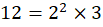
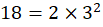
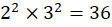
- Find HCF and LCM of 12 and 18 using prime factorization.
[Subtopics]
1. Finding HCF
Multiply the lowest power of all common prime factors.
-
Source: Kapdec.com
-
Source: Kapdec.com
- Common primes: 2 and 3. Lowest powers:

Source: Kapdec.com
,

Source: Kapdec.com
- HCF =

Source: Kapdec.com
2. Finding LCM
Multiply the highest power of all prime factors present in the numbers.
- Primes: 2 (highest power

Source: Kapdec.com
), 3 (highest power

Source: Kapdec.com
)
- LCM =
Source: Kapdec.com
Scan to visit this resource online
https://kapdec.com/resources/euclids-division-lemma-fundamental-theorem-of-arithmetic
