KAPDEC® | Elite STEM Learning Platform | https://kapdec.com
Unit: Exponents and Roots
Chapter: Exponent Rules
Reference: – Understanding the laws of exponents, Multiplication of powers with the same base, Division of powers with the same base, Power of a power rule, Power of a product rule, Power of a quotient rule, Negative exponents and their meaning, zero exponent rule, Working with fractional exponents
After studying this chapter, you should be able to understand:
- Understanding the laws of exponents
- Multiplication of powers with the same base
- Power of a product rule & Power of a quotient rule
- zero exponent rule & working with fractional exponents
Here’s an elaboration of each point in the chapter Exponent Rules: –
- Understanding the laws of exponents: This involves grasping the fundamental principles behind exponentiation, such as how repeated multiplication works, and the purpose of exponents in simplifying expressions.
- Multiplication of powers with the same base: When multiplying two terms with the same base, the exponents are added together, simplifying the expression.
- Division of powers with the same base: When dividing terms with the same base, the exponents are subtracted, which reduces the complexity of the expression.
- Power of a power rule: Raising a power to another power involves multiplying the exponents, allowing expressions to be simplified efficiently.
- Power of a product rule: This rule states that when raising a product to a power, each factor in the product is raised to the same power, helping break down complex expressions.
- Power of a quotient rule: Similar to the product rule, this rule allows the power to be distributed to both the numerator and denominator of a fraction, simplifying the expression.
- Negative exponents and their meaning: A negative exponent indicates the reciprocal of the base raised to the corresponding positive exponent, turning a fraction into a more manageable form.
- Zero exponent rule: Any non-zero number raised to the power of zero is equal to one, providing a simplification for expressions involving zero exponents.
- Working with fractional exponents: Fractional exponents represent both powers and roots, enabling simplification of expressions like square roots and cube roots using exponents.
- Simplifying expressions using exponent rules: By applying the above rules, complex algebraic expressions can be simplified, leading to more manageable forms for solving equations or further manipulation.
- Solving equations involving exponents: This involves applying exponent rules to simplify and solve equations that contain terms with exponents, often leading to finding the value of unknown variables.
Example: –
Simplify the expression:

Source: Kapdec.com
Solution: –
Apply the multiplication rule for exponents with the same base:

Source: Kapdec.com
Apply the division rule for exponents with the same base:
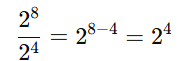
Source: Kapdec.com
Simplifying 24:
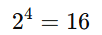
Source: Kapdec.com
So, the simplified result is 16
Here are five conclusive points on Exponent Rules:
- Exponent laws simplify expressions: Applying exponent rules allows for the reduction of complex algebraic expressions, making them easier to work with in equations and functions.
- Consistency in simplification: Each exponent rule ensures consistency in manipulating expressions, such as handling multiplication, division, and powers efficiently.
- Facilitates problem-solving: By mastering exponent rules, solving exponential equations becomes more straightforward and manageable.
- Handling negative exponents: Negative exponents and zero exponent rules simplify fractions and powers, improving understanding of algebraic fractions.
- Application to real-world problems: Exponent rules are foundational for solving problems involving growth rates, scientific notation, and other real-world algebraic applications.
