KAPDEC® | Elite STEM Learning Platform | https://kapdec.com
Unit: Sequences in Functions
Chapter: Recursive Sequences
Reference: – Definition of a Recursive Sequence, Initial Conditions, Recursive Rule (Recurrence Relation), First-Order Recursive Sequences, Higher-Order Recursive Sequences, Difference Between Recursive and Explicit Formulas, Generating Terms from a Recursive Formula, Domain of Recursive Sequences, Real-World Applications of Recursive Sequences, converting a Recursive Sequence to an Explicit Formula (When Possible), Graphing Recursive Sequences
After studying this chapter, you should be able to understand:
- Definition of a Recursive Sequence & Initial Conditions
- Recursive Rule (Recurrence Relation) & First-Order Recursive Sequences
- Generating Terms from a Recursive Formula & Domain of Recursive Sequences
- Real-World Applications of Recursive Sequences
- Definition of a Recursive Sequence:
A recursive sequence defines each term in the sequence by relating it to one or more previous terms using a fixed rule or formula.
- Initial Conditions:
These are starting values provided for the first term (or first few terms) of the sequence, which are essential to calculate the rest of the terms.
- Recursive Rule (Recurrence Relation):
This is a formula that specifies how each new term in the sequence is derived from one or more preceding terms.
- First-Order Recursive Sequences:
A type of recursive sequence where each term depends solely on the term immediately before it.
- Higher-Order Recursive Sequences:
Sequences where each term depends on two or more preceding terms, requiring multiple initial conditions for generation.
- Difference Between Recursive and Explicit Formulas:
A recursive formula defines terms in relation to earlier terms, while an explicit formula calculates the value of any term directly from its position number.
- Generating Terms from a Recursive Formula:
This involves applying the recursive rule repeatedly, starting from the initial condition, to calculate the next terms in the sequence step by step.
- Domain of Recursive Sequences:
The domain of a recursive sequence typically consists of positive integers or whole numbers, representing the positions of the terms in the sequence.
- Real-World Applications of Recursive Sequences:
Recursive sequences are used to model scenarios where a current state depends on previous states, such as population growth, financial investments, or biological processes.
- Converting a Recursive Sequence to an Explicit Formula (When Possible):
This involves transforming the recursive definition into a single formula that directly calculates any term’s value based on its position number, though not all recursive sequences allow this.
- Graphing Recursive Sequences:
Plotting the term positions on the horizontal axis and their corresponding term values on the vertical axis to visualize patterns, trends, or behaviours over time.
- Analysing Behavior of Recursive Sequences:
Studying the sequence’s overall pattern over many terms, such as whether it grows, decays, oscillates, or stabilizes at a fixed value.
- Fibonacci Sequence as a Recursive Model:
An example of a higher-order recursive sequence where each term is defined by a specific relation involving the two previous terms.
- Solving Recurrence Relations:
A process of finding a general formula for the sequence that describes all its terms, often requiring algebraic manipulation and understanding of sequence properties.
- Writing Recursive Functions Using Function Notation:
Representing recursive sequences formally using mathematical function notation, which clearly defines how each term depends on its previous term(s).
Example: –
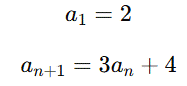
A sequence is defined recursively as follows:
Source: Kapdec.com
Find an explicit formula for the n-th term of this sequence, and then calculate the 10th term.
Solution: –
Step 1: Identify the Recursive Formula
Given:
- Initial term:

Source: Kapdec.com
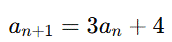
Recursive relation:
Source: Kapdec.com
This means each term depends on the previous term.
Step 2: Recognize the Form of the Solution
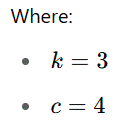
This is a non-homogeneous linear recurrence relation of the form:

Source: Kapdec.com
Source: Kapdec.com
Such sequences can often be solved using methods for linear non-homogeneous recursions.
Step 3: Solve the Homogeneous Part First
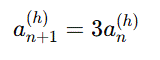
First, ignore the constant term (4), and solve the homogeneous recurrence:
Source: Kapdec.com
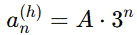
The general solution to this is:
Source: Kapdec.com
Where A is a constant to be determined later.
Step 4: Find a Particular Solution
Now, find a particular solution for the full (non-homogeneous) recurrence:
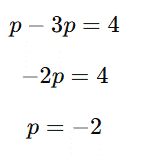
Assume a constant particular solution p, satisfying:
Source: Kapdec.com
So, a particular solution is p=−2.
Step 5: General Solution
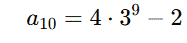
The general solution for the full sequence is:

Source: Kapdec.com
Source: Kapdec.com
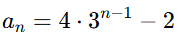
Final Answer (General Form):
Source: Kapdec.com
Here are five conclusive points: –
1. Recursive Sequences Build Terms Based on Prior Values:
Each term in a recursive sequence is generated from one or more preceding terms, making understanding initial conditions and recurrence rules essential.
2. Initial Conditions Determine the Entire Sequence:
The starting term(s) are crucial because every future term depends on them through the recursive rule.
3. Recursive Definitions Reflect Real-World Processes:
Recursive sequences effectively model real-life situations where future states depend on past states, such as population models, investment growth, or biological processes.
4. Some Recursive Sequences Can Be Converted to Explicit Formulas:
While not always possible, many recursive sequences can be rewritten as explicit formulas, making it easier to find any term directly.
5. Analysing Long-Term Behavior Is Critical in Recursive Sequences:
Understanding how a recursive sequence behaves over time—whether it grows, stabilizes, or oscillates—is important in both mathematical problem-solving and real-world interpretations.
