KAPDEC® | Elite STEM Learning Platform | https://kapdec.com
Unit: Polynomials
Chapter: Zero of Polynomials
Reference: – Definition of a polynomial and its degree, Finding the zeroes (roots) of a polynomial function, Relationship between factors and roots of a polynomial, The Fundamental Theorem of Algebra, Methods for finding real and complex zeros, Synthetic division and long division for polynomials, The role of multiplicity in zeros, Polynomial equations with multiple zeros
After studying this chapter, you should be able to understand:
- Definition of a polynomial and its degree
- Relationship between factors and roots of a polynomial
- The Fundamental Theorem of Algebra
- The role of multiplicity in zeros & Polynomial equations with multiple zeros
Here is a theoretical elaboration of each key topic under the chapter “Zero of Polynomials”: –
- Understanding Polynomial Functions
A polynomial function represents an algebraic expression involving variables raised to whole number powers and combined through addition or subtraction. Its structure and highest power of the variable determine its degree and overall behavior. - Concept of Zeros
The zeros of a polynomial are the values of the variable for which the entire expression evaluates to zero. These zeros represent points where the graph of the polynomial crosses or touches the horizontal axis. - Roots and Factors Connection
Every zero of a polynomial corresponds to a linear factor of the polynomial. This foundational concept establishes a direct relationship between solving polynomial equations and factoring expressions. - Multiplicity of Zeros
When a particular value makes the polynomial zero more than once, it is said to have a repeated or multiple zero. The multiplicity affects how the graph interacts with the axis at that point—either crossing it or merely touching it. - Algebraic Theorem Application
A key theorem guarantees that every non-constant polynomial has at least one zero within the complex number system. This allows for the complete factorization of polynomials when considering both real and imaginary values. - Symbolic Techniques for Division
Division methods, such as symbolic or algorithmic techniques, help break down a polynomial into simpler expressions. These are crucial when simplifying or solving higher-degree polynomials. - Sign-Based Root Prediction
A strategic rule involving the signs of the terms helps estimate the number of positive or negative real zeros a polynomial might have. This rule narrows down the possibilities and guides the solving process. - Equations and Zero-Product Rule
Polynomial equations are often solved by expressing them in a product form and applying the principle that if a product equals zero, then at least one of the components must be zero. - Visual Interpretation of Zeros
The graphical representation of a polynomial provides a visual means to identify zeros. These appear as points where the curve intersects or touches the axis, offering intuitive insight into the nature and number of solutions. - Solving Polynomial Equations
Solving involves identifying the values that make the polynomial expression zero, using factoring, substitution, graphical analysis, or algebraic theorems, depending on the structure and degree of the polynomial.
Example: –
Find the zeros of the polynomial:
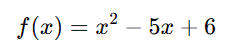
Source: Kapdec.com
Solution: –
Factor the quadratic:

Source: Kapdec.com
Set each factor equal to zero:
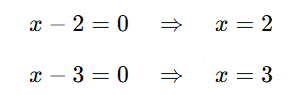
Source: Kapdec.com
Final Answer:
The zeros of the polynomial are 2 and 3
Here are five conclusive points for the topic “Zero of Polynomials” under the Polynomials module in Advanced Math:
- Zeros of a polynomial are fundamental in determining where the polynomial function intersects the horizontal axis, offering critical insights into its behavior.
- Each zero corresponds to a factor of the polynomial, allowing equations to be solved systematically through factorization.
- The multiplicity of zeros influences the graph’s shape, dictating whether it crosses or touches the axis at that point.
- Understanding the relationship between roots and coefficients helps in constructing or deconstructing polynomial expressions.
- Graphical and algebraic methods complement each other in accurately identifying and analysing polynomial zeros.
